
Blueberries Are Not Really Blue Inside. Their Wax Tricks the Light.
The pigments in a blueberry are dark red. The blue you see comes from tiny crystals in a wax coating two microns thick that scatter blue and ultraviolet light.
Key points
- Squash a blueberry and the juice is not blue.
- Researchers at the University of Bristol reported the answer in February 2024, in a study published in Science Advances.
- Most plants wear a thin wax coat.
Squash a blueberry and the juice is not blue. It is dark red purple. Yet the whole fruit in your hand looks blue. Both things are true, and the reason sits on the skin.
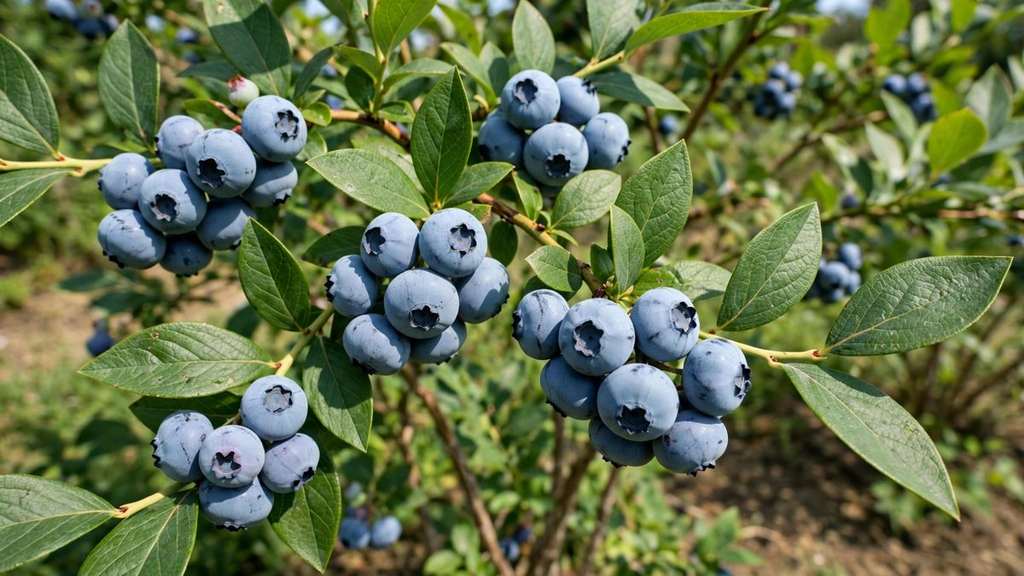
Researchers at the University of Bristol reported the answer in February 2024, in a study published in Science Advances. The fruit skin holds strong pigments called anthocyanins, and those pigments are dark red. The blue comes from outside them: a thin layer of wax that coats the fruit.
A coating two microns thick
Most plants wear a thin wax coat. It sheds water and helps block infection. On blueberries, the Bristol team found, that wax is built from miniature crystal structures arranged at random. When light hits those crystals, they scatter blue and ultraviolet light back to the eye. A human sees blue. A bird sees blue ultraviolet, a stronger signal in its own visual range.
The layer is remarkably thin. The university puts the colorant at around two microns thick, far thinner than a human hair. The lead researcher, Rox Middleton at Bristol's School of Biological Sciences, explained the key test in the university release: the blue of blueberries cannot be extracted by squishing, because it is not located in the pigmented juice that can be squeezed from the fruit.
The proof was to rebuild it
So the team removed the wax from real fruit and recrystallised it on a piece of card. The result was a brand new blue ultraviolet coating, made only from the wax itself. If the color had lived in the juice or the skin pigment, wax alone on plain card could not have turned blue. It did.
The same trick appears on other fruit of the same color. The Bristol release names damsons, sloes, and juniper berries: different fruit, same wax based blue. Blue is rare as a true pigment in nature, so evolution reached the color by structure instead of by dye. The color is not a substance in the fruit. It is a pattern the light runs into.
Why copy a berry's wax
A color that comes from structure, not pigment, points to a different kind of paint. The Bristol team notes that the recrystallised coating is visibly blue, reflects ultraviolet well, and could lead to more sustainable, biocompatible, and even edible blue and ultraviolet reflective coatings. In plain terms, a food safe blue made the way a berry makes it.
There is also a lesson for the kitchen. The dusty pale film on fresh blueberries, often called the bloom, is that wax coat. It is natural, it protects the fruit, and it is part of why the berry keeps well. Washing it off does not harm the fruit, but the blue you admire is at its best while the wax is still in place, scattering light over the dark red skin below.