
This Frog Freezes Solid for Months, Then Thaws and Hops Away
The wood frog stops its heart, fills with ice, and protects its cells with a flood of sugar from its liver. In spring it thaws from the inside out and walks off.
Key points
- Every winter, a small brown frog in the northern woods does something that should kill it.
- The animal is the wood frog, Rana sylvatica, also listed as Lithobates sylvaticus.
- The trick is control.
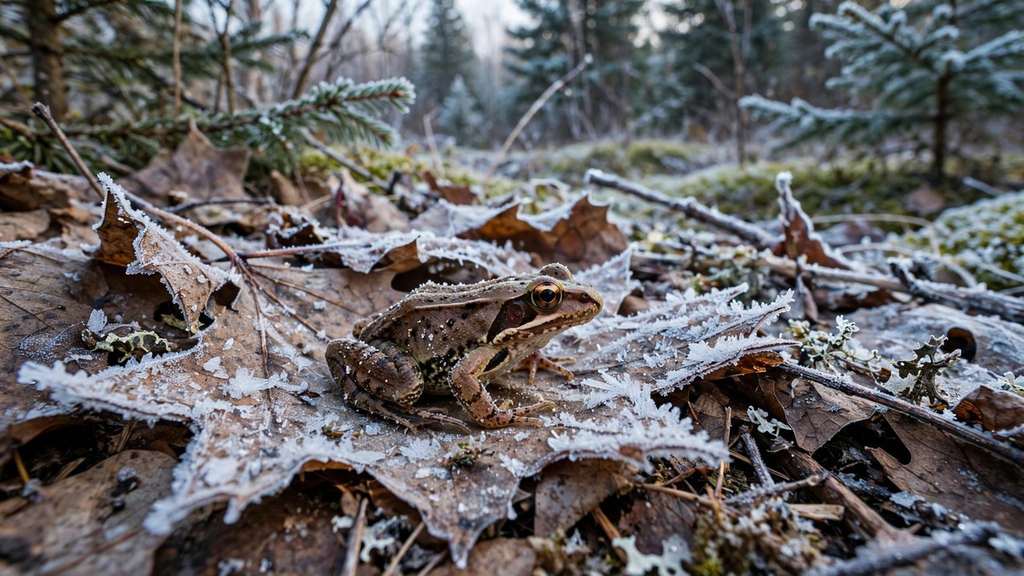
Every winter, a small brown frog in the northern woods does something that should kill it. It freezes solid. Its heart stops. It does not breathe. Ice fills the spaces around its organs. Months later, it thaws and hops away.
The animal is the wood frog, Rana sylvatica, also listed as Lithobates sylvaticus. It lives across northern North America and is the only frog found north of the Arctic Circle. Most frogs spend winter under water, below the ice. The wood frog stays on land, under leaf litter on the forest floor, where the cold reaches it in full.
Ice outside the cells, sugar inside them
The trick is control. When ice first touches the frog's skin, freezing begins slowly and in the right places. Ice forms under the skin and in the body cavity, around the organs. It does not form inside the cells themselves, and that difference is the whole story.
As freezing starts, the frog's liver releases a flood of glucose, made from stored glycogen, into the blood. The sugar reaches the cells and acts as a cryoprotectant, a natural antifreeze. It holds water inside the cells and stops them from drying out and collapsing as ice grows around them. Researchers who imaged freezing frogs with MRI scanners at the Exploratorium's wood frog project found that organs give up much of their water to the ice forming around them, and that cells can lose up to about 60 percent of their water and still recover on thawing.
By the time the frog is fully frozen, a large share of the water in its body sits as ice outside its cells. Breathing has stopped. The heart has stopped. To any instrument, the frog looks dead.
Months as a block of ice
Zoo Atlanta's account of the species puts the frozen stretch at six to eight months in the coldest parts of its range. The frog does not eat, move, or breathe in that time. It simply waits, preserved by its own sugar.
Spring reverses the process. The frog thaws from the inside out. The heart starts beating again, then the brain wakes, then the legs move. Within a short time the animal is doing what wood frogs do first each year: heading for melt water pools to breed, often before other frog species have even left their winter water.
Why doctors watch a frog
The frog matters beyond the woods. A body that can freeze, stop, and restart without damage is a working model for one of medicine's hard problems: keeping organs alive longer before transplant. Researchers funded through the National Science Foundation have studied the wood frog for years for exactly that reason. The frog is not magic. It is chemistry, timing, and a liver that can flood a body with sugar at the first touch of ice.
Next time you walk a cold northern forest in March, the leaf litter under your boots may hold frogs that have been, by every normal measure, dead for months. Give them a few warm days. They will get up and leave.