
At Least 68 Dead as Two High-Speed Trains Collide Near Toledo in Spain
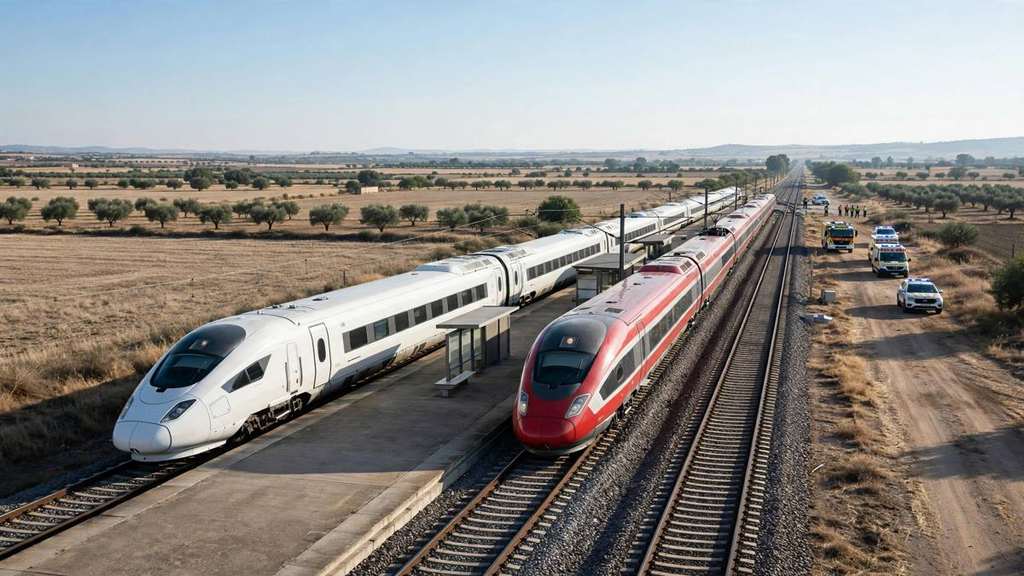
A Renfe AVE train ran into the back of an Iryo train on the Madrid to Seville line near Urda on Wednesday morning. Officials confirmed at least 68 deaths, warned the toll could rise, and suspended the Madrid to Andalusia line.
Key points
- Updated 21:10 UTC, Oct. 28, 2026.
- CNN reported the breakdown of the dead as 44 people on the Iryo train and 24 on the Renfe train.
- Reuters described the crash as Europe's deadliest train accident since the 2013 derailment at Santiago de Compostela, in which 80 people died.
Update: Passengers describe being thrown from their seats as rescuers search the wreckage into darkness
Updated 21:10 UTC, Oct. 28, 2026. Passengers on the two trains described a chaotic moment of impact near Urda, in Toledo province. Patricia, who was travelling on the Renfe train, told CNN her train had stopped for about 20 minutes, then set off again and crashed less than three minutes later. "Some people were hurled into the air. It was awful," she said, adding that part of the train structure entered her carriage, and that her carriage was not the worst affected. Yoander, 25, told CNN he had been sleeping and woke up crashing into the seats in front of him, injuring his face and his leg. Salvador Arriza, 62, told Reuters that passengers broke windows to get out and that some people could hardly move because they were trapped among the seats. Rafael Barcelo told Reuters he had stepped away from his seat for a coffee when the impact sent passengers flying, and that there had been at least eight victims in his carriage.
CNN reported the breakdown of the dead as 44 people on the Iryo train and 24 on the Renfe train. Reuters reported that at least three carriages had plunged down an embankment at the scene, that rescuers were still searching the carriages as darkness fell, and that regional president Emiliano Garcia-Page said rescuers did not know whether more bodies would be found once the carriages were moved. Spain's health minister, Monica Garcia, said 80 people were injured, 15 of them very seriously, Reuters reported.
Reuters described the crash as Europe's deadliest train accident since the 2013 derailment at Santiago de Compostela, in which 80 people died. The Civil Guard has opened four offices in Spanish cities to identify the victims, and the regional government appealed urgently for blood donations in Alcazar de San Juan, Ciudad Real and Toledo, CNN reported. The United States State Department said several Americans were among the injured, CNN reported. Renfe said it had suspended ticket sales on the Madrid to Andalusia high-speed corridor until December 13, Reuters reported.
Update: Spain declares three days of mourning as minister sets out how the crash happened
Updated 18:04 UTC, Oct. 28, 2026. Spain will observe three days of national mourning from October 29 to October 31 for the victims of the high-speed train collision near Urda, in Toledo province, Prime Minister Pedro Sanchez announced at the crash site. "Today all of Spain is grieving," Sanchez said, the Associated Press reported. He said: "It is unacceptable for a country like Spain to suffer two high-speed rail accidents in the same year." King Felipe VI also visited the crash site. Spain's royals said in a statement: "We share in the grief of the families and loved ones of those who lost their lives, and we send our heartfelt support to the injured and all those affected."
Transport Minister Oscar Puente set out the timeline that led to the collision. He said the safety system on a stretch of 63 kilometers (39 miles) stopped working at 8:30 a.m. because of a computer malfunction, and every train on that stretch stopped. Central command then told the Renfe train to start running again with no speed restriction, even though a stop signal was still active on the line, and the Renfe train collided with the stopped Iryo train at 8:53 a.m. Puente said the train should never have been told to move again while the stop signal was active, and that if it had been moved it should at least have been told to travel at reduced speed. He said the Renfe train may have been travelling at 200 kph (124 mph) on that stretch, that the crash followed what he called the inexplicable order from the central command center, and that the train engineers were not to blame. "I am not attributing responsibility to anyone, I am just stating the facts," Puente said.
Authorities said 397 passengers were travelling on the Renfe train and 147 on the Iryo train. The confirmed death toll remains at least 68, and 58 people were receiving treatment in hospital, the regional government of Castilla-La Mancha said. Sanchez said: "We are going to get to the bottom of this, and if there has been negligence, it will be revealed."
Update: Confirmed death toll rises to at least 68
Updated 15:35 UTC, Oct. 28, 2026. The confirmed death toll from the collision between two high-speed trains near Urda, in Toledo province, has risen to at least 68, the regional government of Castilla-La Mancha said. Regional president Emiliano Garcia-Page announced the revised toll on Wednesday. Fifty-eight people were being treated in hospital, 15 of them very seriously injured, and more than 80 people were injured in total, El Pais reported.
Prime Minister Pedro Sanchez visited the scene at Urda and promised that the investigation would go to the end and that any negligence would come out. He said it is not acceptable for Spain to suffer two serious high-speed accidents in less than a year, El Pais reported.
El Pais also reported that the Guardia Civil and the rail accident investigation commission are questioning the operator at the control centre who regulated traffic on the Madrid to Seville line. Transport Minister Oscar Puente said the LZB safety system on the line had failed, and that an order was given to resume running before that failure was resolved. Officials gave the total only and did not publish a confirmed breakdown of the dead by train.
Update: Transport minister says Renfe train was authorised past a red signal
Updated 15:23 UTC, Oct. 28, 2026. Spain's transport minister Oscar Puente told a press conference in Madrid that the Renfe high-speed train was authorised to continue its journey despite an active red signal because of a stationary train on the tracks ahead, breaking protocol, Reuters reported through USA Today. Puente said the red signal was issued due to a computer communications failure which automatically stopped traffic, and an erroneous decision was made to restart the train. He described the accident as utterly implausible, said it was caused by a fault in one of the track safety systems, and said that without the fault having been rectified an order was given, inexplicably, to resume the journey. The Civil Guard and the Railway Accident Investigation Commission are questioning the control centre operator who was managing traffic on the Madrid to Seville high-speed line at the time, The Times reported. Renfe said in a statement that after being authorised to continue, its train crashed into the Iryo train that had remained stationary for reasons it does not know, and that the exact sequence of events will have to be established by the investigation, Reuters reported through SRN News. A person briefed on the disaster said the Iryo train stopped near Toledo on orders from infrastructure manager ADIF due to a signal fault, and the Renfe train then struck the stationary train at high speed. Puente said: "Our rail system is reliable and it is safe. Failures can obviously happen, but I must repeat that we have a safe rail system." He added: "I have not blamed anyone. I have set out the established facts. It is for the investigation to clarify." Prime Minister Pedro Sanchez was on his way to the scene, his office said. The confirmed death toll remains at least 64.
Update: Confirmed death toll rises to at least 64, with about 80 injured
Updated 13:56 UTC, Oct. 28, 2026. The confirmed death toll from the collision between two high-speed trains near Urda, in Toledo province, has risen to at least 64, up from the 30 deaths confirmed earlier on Wednesday. USA Today, contributing reporting from Reuters, reported at least 64 dead citing local officials, and The Wall Street Journal reported at least 64 killed, about 80 injured with 50 of them in serious condition, and regional president Emiliano Garcia-Page saying more fatalities were expected. The Sun, citing the government delegation in Castilla-La Mancha, reported that 40 of the dead were travelling on the stationary Iryo train and 24 on the Renfe service, and that regional government sources told El Pais about 80 people were hurt, 50 of them seriously. The Sun also reported that nearly 100 personnel from Spain's military emergency unit were called in to assist the rescue effort. The collision happened shortly before 9 a.m. local time, when a Renfe AVE train ran into the back of a stopped Iryo train on the Madrid to Seville line. A total of 544 people were aboard the two trains, two carriages fell down an embankment, and the Madrid to Andalusia line remains suspended. It is the second deadly crash on the same line this year, after the January crash near Adamuz that killed 46 people.
Update: Regional president confirms at least 30 dead and 80 injured, and the Copa del Rey is postponed
Updated 12:57 UTC, Oct. 28, 2026. Emiliano Garcia-Page, the president of Castilla-La Mancha, confirmed on the broadcaster RTVE that at least 30 people died in the collision and said the death toll was expected to rise. Garcia-Page said 24 of the dead were travelling on the Renfe train and six on the Iryo train, and the Associated Press reported that he put the number of injured at at least 80. His statement puts the 30 figure on the record from the president of the region, after sources in his government had earlier given the same minimum to the EFE and Europa Press agencies. Preliminary counts in Spanish media remained higher and unconfirmed. El Espanol reported at least 50 dead, and Spanish media counts carried by several outlets put the injured at 179, figures that officials had not confirmed. The Royal Spanish Football Federation postponed all 24 Copa del Rey first round matches scheduled for Wednesday as a show of respect and solidarity with all the victims, Reuters reported, and said new dates for the matches would be announced soon. The federation said the crash had also disrupted rail travel between Madrid and Andalusia for several teams and their fans.
Update: Regional government sources raise the minimum toll to at least 30 dead
Updated 11:54 UTC, Oct. 28, 2026. Regional government sources told the EFE and Europa Press news agencies that at least 30 people died in the collision, calling that figure a minimum, the Associated Press reported in an update published at 11:13 UTC. RTVE reported that regional government sources had confirmed at least 30 deaths. The new minimum replaces the 10 deaths first confirmed on the record by regional spokeswoman Esther Padilla, who had warned that the number would surely rise. Higher figures remain unconfirmed. Renfe sources told EFE that 46 people had died, ABC, citing Civil Protection, reported at least 46 dead and later at least 50, and RTVE reported more than 40 dead. Health Minister Monica Garcia told TVE that emergency workers were focusing on rescuing survivors and bodies from the two most damaged cars, and that the injured were being sent to hospitals in the area. "It was a high-speed impact, so we are expecting this to be a tragedy," Garcia said. A military emergency brigade was deployed to help emergency services, firefighters and police at the site.
Update: Local authorities tell Sky News at least 39 dead, central confirmed toll still 10
Updated 10:52 UTC, Oct. 28, 2026. Local authorities told Sky News that at least 39 people had died in the collision. The Times reported emergency services giving a figure of 39 dead, and the Spanish outlet El Espanol reported 46 dead. The Castilla-La Mancha regional government had not raised its confirmed toll above the 10 deaths announced by its spokeswoman Esther Padilla. Spain's health minister Monica Garcia told RTVE there were no further confirmed details on the number of fatalities, as hospitals freed up resources to treat the injured, and she said officials feared a major tragedy. The 39 figure is therefore reported here as a figure given by local authorities and emergency services, not as a centrally confirmed total, until officials verify it.
Updated 10:38 UTC
This is a developing story and will be updated as officials confirm more facts.
At least 10 people were killed on Wednesday morning when two high-speed trains collided on the Madrid to Seville line near the town of Urda, in Toledo province, Spanish officials said. A Renfe AVE train ran into the back of an Iryo train in a rear-end collision, and two carriages of the Iryo train came off the track and fell down an embankment.
Esther Padilla, a spokeswoman for the regional government of Castilla-La Mancha, told the broadcaster TVE that at least 10 people had died and that the number was likely to rise as crews worked through the wreckage. Officials had not confirmed a total number of injured by late morning.
What happened
The crash happened at about 8:54 a.m. local time, according to reports from the scene. Both trains were travelling from Madrid toward Seville. The Renfe AVE service had left Madrid Puerta de Atocha station at 8:00 a.m. bound for Seville Santa Justa. The Iryo train carried 147 passengers, including a baby, and the Renfe train carried 397 passengers, 544 people in total, according to figures given by Padilla.
Adif, the state rail infrastructure operator, said traffic on the Madrid to Andalusia high-speed line was suspended after what it called a rear-end collision between two trains. Services linking Madrid, Ciudad Real and Andalusia were halted, and Renfe offered free changes and cancellations on affected routes.
Rescue at the scene
Fire crews from Alcazar de San Juan and Orgaz, Civil Protection teams, Guardia Civil officers and Red Cross staff were sent to the site, along with three medical helicopters and two mobile intensive care units. The Castilla-La Mancha regional government activated its emergency plan. Manuel Galan, the mayor of Urda, said emergency services had asked the town to prepare a sports hall and other facilities to receive passengers and the injured.
Prime Minister Pedro Sanchez said on X that he was shocked by the serious train accident in Toledo and was in constant contact with Transport Minister Oscar Puente and with Emiliano Garcia-Page, the president of Castilla-La Mancha, who was travelling to the site. Sanchez cleared his schedule for the day, and opposition parties cancelled campaign events.
Toll still uncertain
Some Spanish outlets carried higher figures attributed to emergency services during the morning. The central government had not confirmed any toll above the 10 deaths announced by the regional government, and this report uses only the confirmed figure until officials verify more. The cause of the collision has not been determined. Spanish media reported early assessments pointing to a signalling fault and a possible human error at a control centre, but authorities have not confirmed that account.
Second disaster on the line this year
The collision is the second serious crash on Spain's high-speed network this year, on the same Madrid to Andalusia corridor. In January, two trains collided near Adamuz in Cordoba province after a derailment, in a disaster that killed dozens of people and opened a national argument about rail maintenance and investment. That argument returned within hours of Wednesday's crash.
Timeline
- Oct 28, 2026Passengers describe being thrown from their seats in the impact. CNN reports the dead as 44 on the Iryo train and 24 on the Renfe train. Rescuers search the carriages as darkness falls, at least three carriages having plunged down an embankment, and Renfe suspends ticket sales on the Madrid to Andalusia corridor until December 13.
- Oct 28, 2026At about 8:54 a.m. local time, a Renfe AVE train travelling from Madrid to Seville ran into the back of an Iryo train near Urda, in Toledo province. Two Iryo carriages left the track and fell down an embankment.
- Oct 28, 2026Adif suspends traffic on the Madrid to Andalusia high-speed line. The Castilla-La Mancha regional government confirms at least 10 dead, warns the toll is likely to rise, and activates its emergency plan.
- Oct 28, 2026Local authorities tell Sky News at least 39 people have died, and The Times reports emergency services giving 39 dead, while the regional government's confirmed toll remains 10.
- Oct 28, 2026Regional government sources tell EFE and Europa Press that at least 30 people died, calling 30 a minimum toll, replacing the 10 deaths first confirmed on the record. Higher figures of 46 and more remain unconfirmed.
- Oct 28, 2026Regional president Emiliano Garcia-Page confirms at least 30 dead and at least 80 injured on RTVE, with 24 of the dead on the Renfe train and six on the Iryo train. The Royal Spanish Football Federation postpones all 24 Copa del Rey first round matches scheduled for Wednesday.
- Oct 28, 2026Officials confirm at least 64 dead and about 80 injured, 50 of them seriously. The government delegation breakdown puts 40 of the dead on the stationary Iryo train and 24 on the Renfe service, and regional president Garcia-Page says more fatalities are expected.
- Oct 28, 2026Transport Minister Oscar Puente tells a Madrid press conference the Renfe train was authorised to continue despite an active red signal after a computer communications failure, and investigators question the control centre operator on the Madrid to Seville line.
- Oct 28, 2026Regional president Emiliano Garcia-Page confirms the death toll has risen to at least 68, with 58 people in hospital, 15 of them very seriously injured, and more than 80 injured in total.
- Oct 28, 2026Transport Minister Oscar Puente says the safety system failed at 8:30 a.m. over a 63 kilometer stretch, central command ordered the Renfe train to restart with no speed restriction while a stop signal was still active, and it hit the stopped Iryo train at 8:53 a.m., possibly at 200 kph. He says the train engineers were not to blame.
- Oct 28, 2026Prime Minister Pedro Sanchez declares three days of national mourning from Oct 29 to Oct 31, and King Felipe VI visits the crash site.
Sources
- Reuters: Two high-speed trains collide in Spain, rail operator says
- Reuters wire report: Two high-speed trains collide in Spain, at least 10 dead
- El Pais via El Mundo America: New tragedy on Spain's high-speed rail network, 10 dead in Toledo
- The Times live coverage: Spain train crash, Toledo province
- Anadolu via Europe Says: At least 10 killed in high-speed train crash in central Spain
- Sky News: At least 39 killed after train collision in Spain
- The Sun: Spain train crash, local authorities told Sky News at least 39 people had died
- Associated Press via KNKX: At least 30 dead in crash between two trains in central Spain, media say
- Europa Press via Mallorca.com: Toledo crash, at least 30 dead, aid offered
- EU Today: At least 46 killed as high-speed trains collide in Spain
- Associated Press via The Washington Examiner: At least 30 dead in crash between two trains in central Spain, Garcia-Page says 80 injured
- The Wall Street Journal: Spain high-speed train crash kills at least 30, with toll expected to rise
- Reuters: Copa del Rey fixtures postponed following train crash
- The Sun: Spanish Football Federation postpone all 24 Copa del Rey fixtures after fatal train crash, RFEF statement
- USA Today, contributing Reuters: At least 64 dead after two high-speed trains collide in Spain
- The Sun: At least 64 killed after high speed trains crash in Spain
- Reuters via SRN News: Two high-speed trains rear-end in Spain, rail operator says
- Associated Press via WCIA: At least 68 dead in Spain after one high-speed train slams into another stopped on tracks
- El Pais: Al menos 68 muertos tras el choque entre un AVE de Renfe y un tren Iryo a la altura de Urda, en Toledo
- El Pais live: Ultima hora del choque entre dos trenes en Los Yebenes, Toledo, en directo
- Associated Press via The Reflector: Spain declares mourning as minister sets out crash timeline and King Felipe VI visits the site
- Zamin.uz: Three day mourning declared in Spain following train crash
- IANS: Spanish PM declares 3 days of national mourning after deadly train collision
- Reuters via LA Post: Two high-speed trains collide in Spain, passenger counts by train
- CNN: What caused the deadly train crash in Spain? What we know so far, passenger accounts