
Sharks Are Older Than Trees by Tens of Millions of Years
The earliest shark scales date to about 450 million years ago, and the oldest undisputed ones to about 420 million years ago. The oldest known forest is about 385 million years old. Sharks were already ancient when the first tree stood up.
Key points
- Sharks are older than trees, and not by a little.
- Those first sharks were small, and they left little behind.
- By the middle of the Devonian, about 415 million years ago, eel-like sharks such as Antarctilamna had entered the fossil record.
Sharks are older than trees, and not by a little. The earliest evidence of sharks in the fossil record is a scatter of tiny scales dated to about 450 million years ago. The oldest undisputed shark scales are about 420 million years old. The oldest known forest on Earth is about 385 million years old. Even on the most careful reading of the fossils, sharks were swimming tens of millions of years before the first tree existed.
What swam before forests
Those first sharks were small, and they left little behind. A shark skeleton is mostly cartilage, a flexible material that rots instead of turning to stone. Teeth, scales and spines are the hard parts, so they are what fossil hunters find. The Smithsonian notes that fossil scales hint at small sharks by the late Ordovician period, and that shark teeth appear later, in the Devonian period.
By the middle of the Devonian, about 415 million years ago, eel-like sharks such as Antarctilamna had entered the fossil record. Cladoselache came slightly later, a medium-sized predator with a streamlined body and a forked tail. It looked recognizably like a shark. On land at that time there were no forests at all. Plants were still low and simple, and nothing with a trunk had yet evolved.
When the first forest finally stood up
The oldest known forest grew near what is now Cairo, New York. Researchers from Binghamton University, Cardiff University and the New York State Museum described it in the journal Current Biology. The site is about 385 million years old, and it holds the root systems of Archaeopteris, a plant with a woody trunk and fern-like leaves that researchers describe as the first modern tree.
The roots are the surprise. They spread about 18 feet from the base of the trunk, branched and fine tipped, strikingly similar to the roots of trees alive today. Trees, in other words, arrived with their modern rooting strategy already worked out. They just arrived late. By the day the Cairo forest grew, the shark lineage had already been in the oceans for at least 35 million years on the strictest dating, and closer to 65 million years on the earliest scale evidence.
Five extinctions later, still swimming
Age is only half the story. The Smithsonian counts five mass extinctions in the history of sharks, and sharks came through all of them. They outlasted the giant armored fish that once preyed on them. They outlasted the marine reptiles. The body plan that worked in the Devonian, a light cartilage frame, replaceable teeth and a strong sense for faint electrical signals from prey, kept working while the world changed around it.
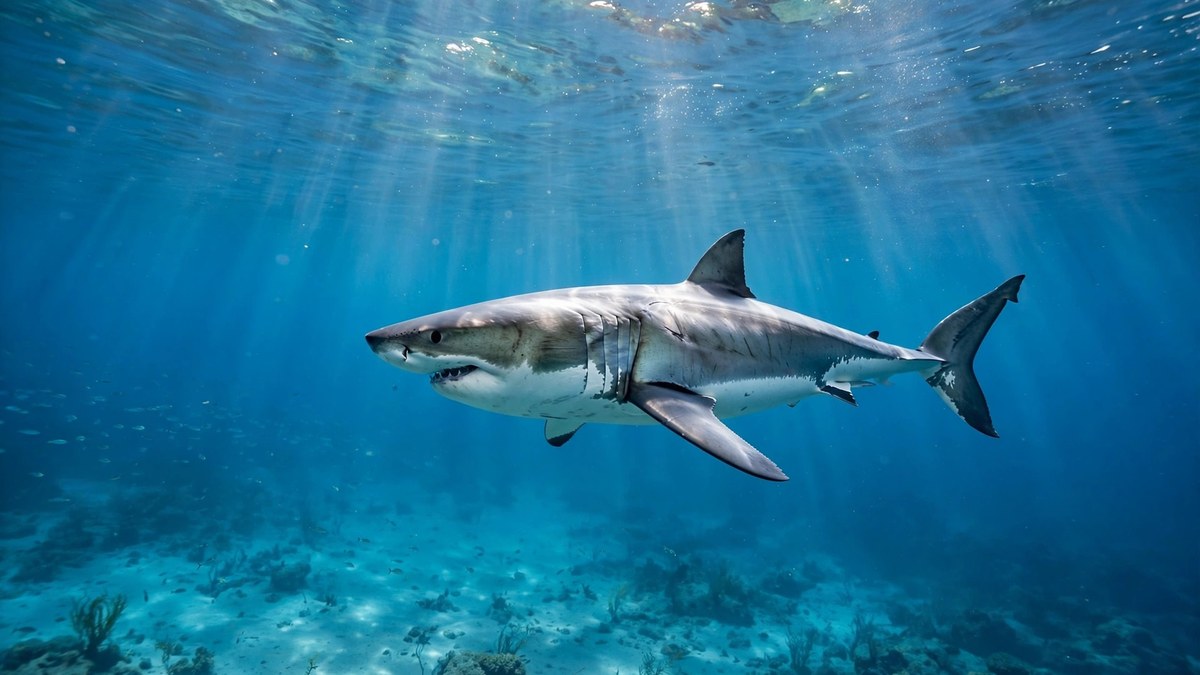
So the next time a shark slides past at an aquarium, the right comparison is not a dinosaur. It is a forest. The animal in front of you belongs to a lineage that predates every forest on the planet, every tree you have ever stood under, by a stretch of time longer than the entire age of mammals so far.