
Wombats Poop Cubes, and Their Intestines Mold Every Corner
The bare-nosed wombat is the only known animal that makes cube shaped droppings, up to 100 a day. A study in the journal Soft Matter found the cubes form in the last 17 percent of the intestine, where stiff and soft tissue squeeze at different speeds.
Key points
- The wombat is the only known animal that poops cubes.
- Wombats place their droppings on rocks, logs and other raised spots around their territory, four to eight pieces at a time.
- The animal itself is built for a slow life underground.
The wombat is the only known animal that poops cubes. A bare-nosed wombat leaves droppings with flat sides and clear corners, each one about two centimeters across, and it can produce up to 100 of them in a day. For years the shape was a standing joke with no answer. A team at the Georgia Institute of Technology has now shown how a soft, round intestine molds a cube, and the answer sits in the last stretch of the gut.
Cubes that stay where they are left
Wombats place their droppings on rocks, logs and other raised spots around their territory, four to eight pieces at a time. The piles work as scent markers for other wombats. A round dropping would roll off a log. A cube stays put. Researchers suspect that simple physics helped the trait along: flat sides hold a perch, and a marker that stays in place does its job longer.
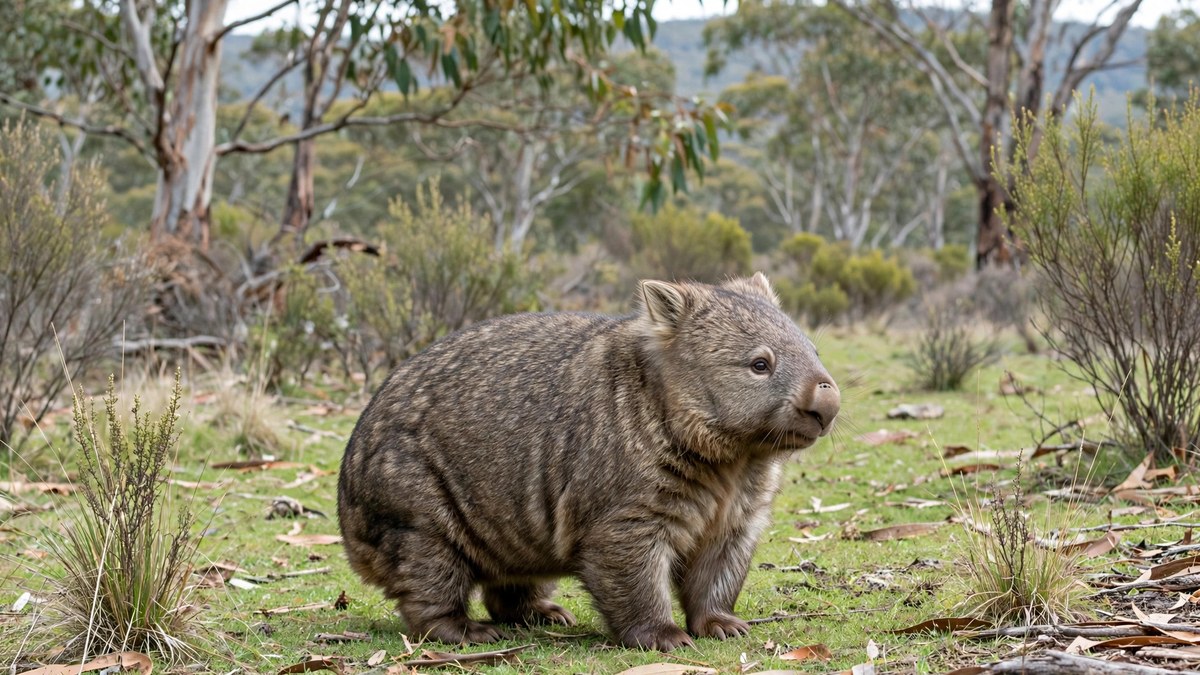
The animal itself is built for a slow life underground. The bare-nosed wombat, Vombatus ursinus, is a stocky Australian marsupial that digs long burrow systems and feeds mostly on grasses. Digestion is slow, and the droppings come out dry. That dryness matters. Wet material would slump. Dry material can hold an edge.
The mold is the intestine itself
Patricia Yang and her colleagues at Georgia Tech studied wombat intestines from animals killed on Tasmanian roads. Their paper, published in the journal Soft Matter, found that the cubes form inside the last 17 percent of the intestine. The wall of that final section is not even. Some regions are about twice as thick and four times as stiff as others.
As the intestine contracts to push waste forward, the stiff regions squeeze faster and the soft regions move more slowly. The uneven squeeze presses flat faces into the material and sharpens the corners, contraction after contraction, over the days the waste spends in the gut. The team tested the idea with a mathematical model of a stretchy ring built from alternating stiff and soft zones. The model made squares. More contrast between stiff and soft made squarer squares.
The anus, for the record, is round. The cube is finished before it gets there.
Why engineers read a paper about poop
The Soft Matter paper lists possible uses in manufacturing, clinical pathology and digestive health. Shaping a soft material into a hard cornered form without a mold is a real problem in factories, and the wombat solves it with nothing but uneven tissue and patience. The work also gave carers a health check they can use at a glance. In the Science report on the study, Georgia Tech researcher David Hu noted that captive wombats sometimes make less cubic droppings than wild ones, and that the squarer the poop, the healthier the wombat.
So the joke has an ending. The only cube in animal droppings is not stamped out at the exit. It is kneaded into shape, slowly, by a gut that squeezes unevenly on purpose.