
Honey Found in 3,000-Year-Old Tombs Is Still Edible
Pots of honey found in ancient Egyptian tombs stay preserved for thousands of years. The reason is a three part defense bees build into every jar: very little water, natural acidity near pH 4, and a small steady supply of hydrogen peroxide.
Key points
- Archaeologists who open ancient Egyptian tombs keep finding the same surprise: pots of honey, thousands of years old, still preserved.
- Honey is a sugar with very little water in it, and sugars pull moisture toward themselves.
- Getting honey that dry takes work.
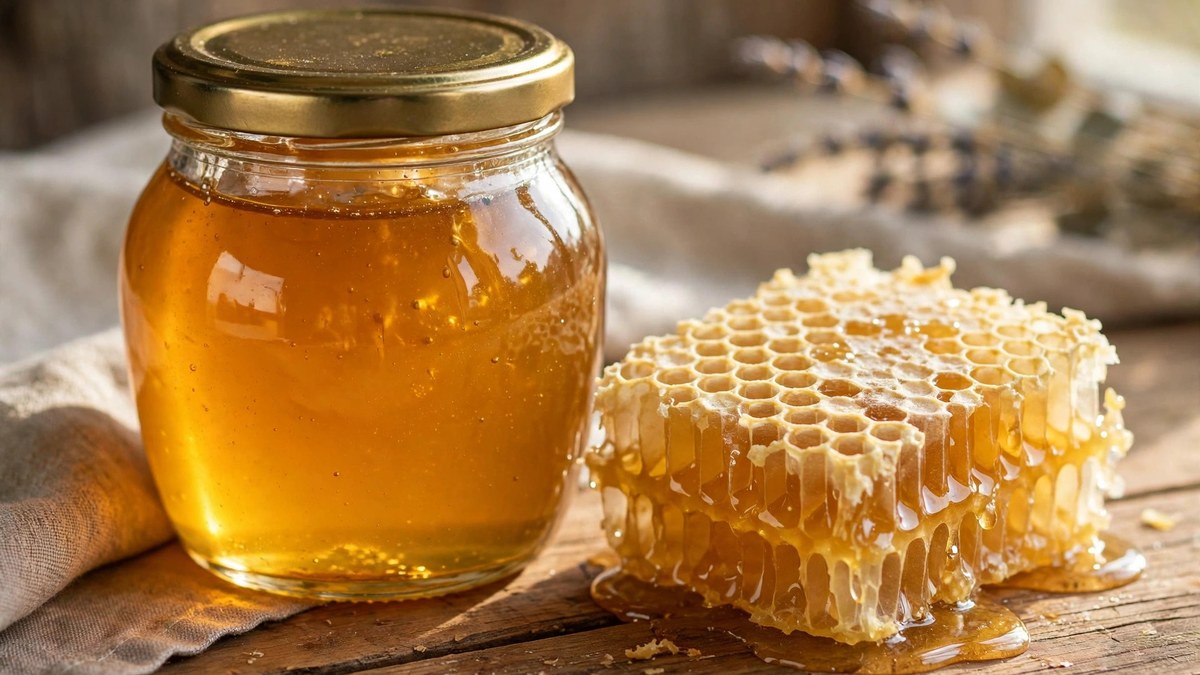
Archaeologists who open ancient Egyptian tombs keep finding the same surprise: pots of honey, thousands of years old, still preserved. Smithsonian Magazine reports that the honey in those pots stays in edible form, food a person could dip into and eat as if it were a day old. Honey does not rot the way other foods rot. Three defenses, all built by bees, explain why a sealed jar can outlast the civilization that filled it.
Defense one: almost no water
Honey is a sugar with very little water in it, and sugars pull moisture toward themselves. Smithsonian describes honey as hygroscopic: it holds little water of its own and can draw moisture in from its surroundings. Bacteria and fungi need available water to grow. In honey they land in a syrup that dries them out instead of feeding them. A food with almost no free water is a desert at the scale of a microbe, and almost nothing can live in it for long.
Getting honey that dry takes work. Nectar arrives at the hive full of water. Worker bees pass it back and forth, drink it and lay it down again, and then fan the comb with their wings to drive the water off. BBC Science Focus describes the same routine: repeated handling cuts the water down, and the fanning finishes the job. Only then do the bees seal the cell.
Defense two: acid
Honey is acidic, with a pH of around 4, close to orange juice. Most microbes that spoil food cannot grow in acid that strong. The acid is not an accident. An enzyme carried by the bees, glucose oxidase, breaks the nectar's glucose down into gluconic acid, and that acid is a large part of why honey sits near pH 4.
Defense three: a trickle of peroxide
That same enzyme reaction also makes hydrogen peroxide, the mild antiseptic people use on cuts. The amount in honey is small, but it works around the clock. Between the dryness, the acid and the peroxide, a microbe that lands in honey faces three separate problems at once. Smithsonian's account stresses that the factors work together: no single trick explains the shelf life, the combination does.
The seal still matters
The defense depends on keeping extra water out. A sealed pot in a dry tomb is the perfect test, and the tomb pots passed it for roughly 3,000 years, the figure used in popular accounts of these finds. The same logic guards your kitchen jar. Keep the lid on, keep water and crumbs out, and the honey inside stays what the bees made it: a food built to wait.
Salt, sugar and dried rice also keep for a very long time in raw form. Honey is the rare one you can eat as it is, with no cooking and no preparation, after a wait measured in empires. The pharaohs did not know the chemistry. The bees worked it out long before them.