
There Are More Possible Chess Games Than Atoms in the Observable Universe
Claude Shannon estimated about 10 to the power of 120 possible chess games in 1950. The observable universe holds roughly 10 to the power of 80 atoms. It is not close.
Key points
- A chess board fits on a kitchen table.
- In 1950, the American mathematician Claude Shannon published "Programming a Computer for Playing Chess," the first technical paper on computer chess.
- Shannon did not guess.
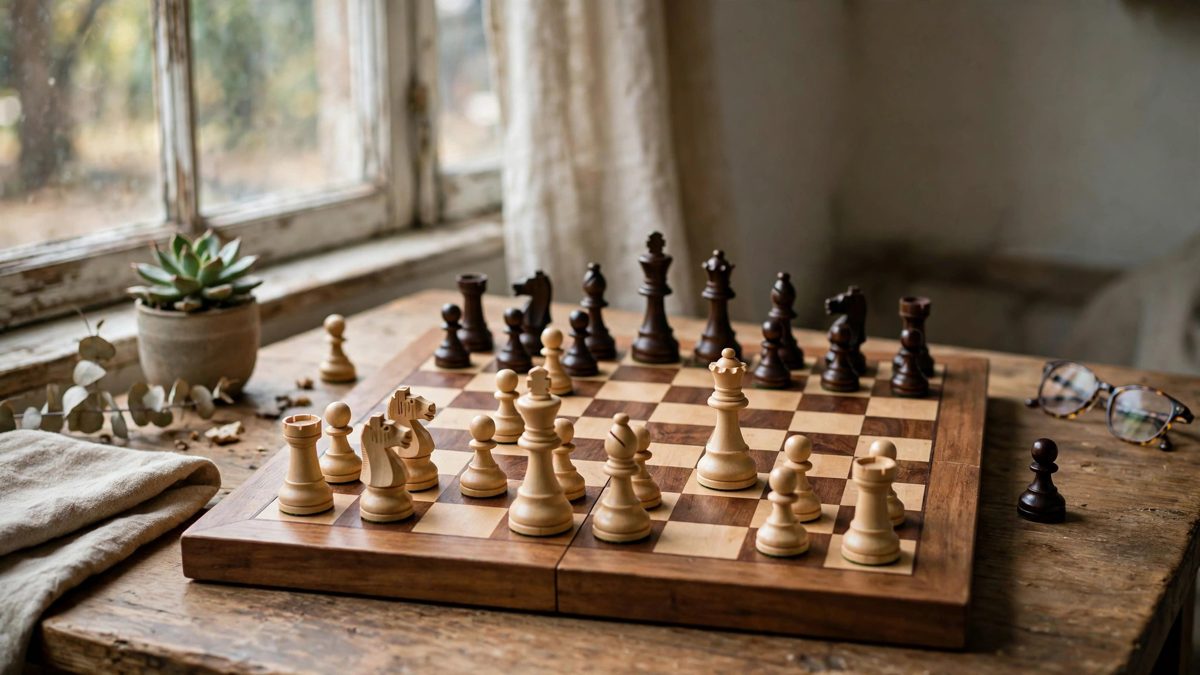
A chess board fits on a kitchen table. The number of games that can be played on it does not fit in the universe.
In 1950, the American mathematician Claude Shannon published "Programming a Computer for Playing Chess," the first technical paper on computer chess. Inside it sat a short calculation that still bends minds. Shannon estimated the number of possible chess games at about 10^120, a 1 followed by 120 zeros. That figure is now called the Shannon number.
Three plain numbers build it
Shannon did not guess. He multiplied three ordinary facts. In a typical position, a player has about 30 legal moves. A move by White and a reply by Black therefore give about 30 times 30, roughly 1,000, or 10^3, possible pairs. A typical game lasts about 40 such pairs. Multiply 10^3 by itself 40 times and the result is 10^120.
The growth shows early. White opens with 20 legal choices, and Black can answer with 20, so two plies already make 400 games. After three plies there are 8,902. After four, close to 200,000. The pile does not grow by addition. It grows by multiplication, and multiplication outruns intuition fast.
The universe loses by 40 zeros
The standard estimate for atoms in the observable universe is about 10^80. Set the two numbers side by side. Possible chess games beat all the atoms we can see by a factor of about 10^40. If every atom in the observable universe stored one complete chess game, the store would run out with the vast bulk of games still uncounted.
That gap is why Shannon raised the number at all. He wanted to show that no machine could play perfect chess by checking every game to the end. In his paper, he noted that a machine testing one variation per microsecond would need over 10^90 years to work out its first move. Brute force was dead on arrival, in 1950, before computer chess had played a single game.
What machines do instead
Shannon proposed the way out in the same paper. A machine should score a position, look ahead through a tree of moves, and search with judgment, pruning lines that do not matter. That approach, scoring plus selective search, is still the skeleton under modern chess engines. The engines that now beat every human do not count all games. They cannot. They win by looking at a tiny, well-chosen slice of a space too large to map.
That is the real shock of the number. Chess is a human invention with 64 squares, 32 pieces, and rules a child can learn in an afternoon. Yet its full set of possible games exceeds the atom count of everything we can observe. A small board, honestly counted, beats the cosmos.