
Can Hot Water Freeze Faster Than Cold Water? The Honest Answer Is Only Sometimes
The Mpemba effect is real in narrow lab conditions and unreliable in a kitchen freezer.
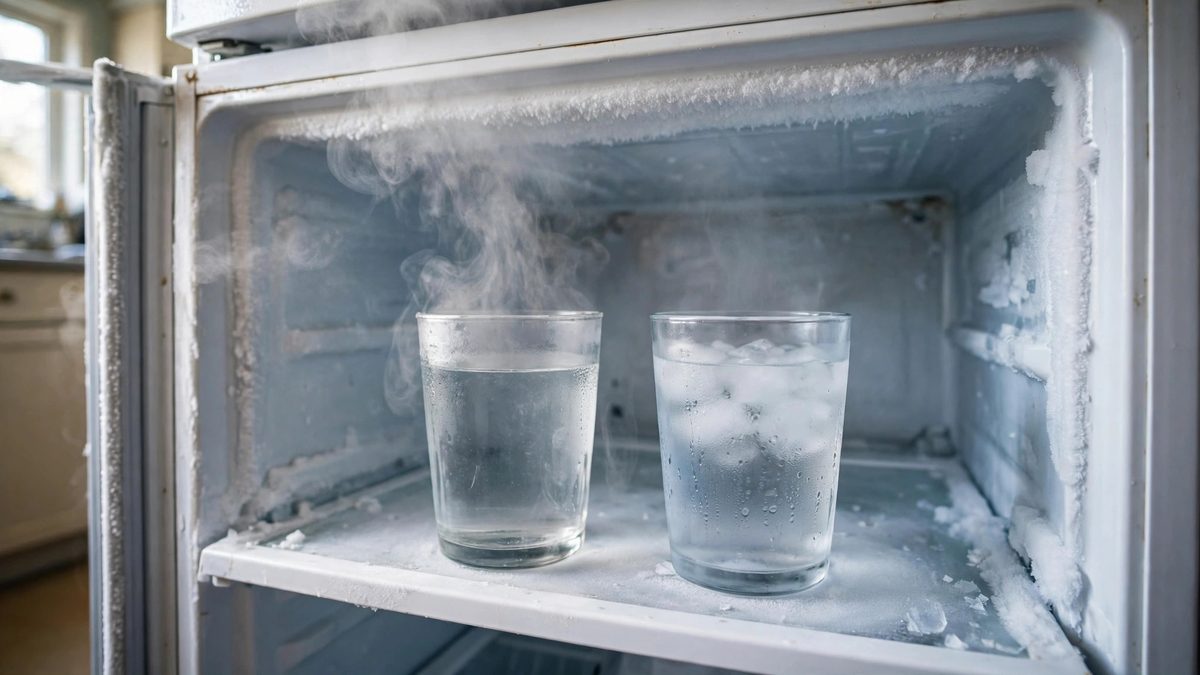
Key points
- Can hot water freeze faster than cold water?
- The effect takes its name from Erasto Mpemba, a Tanzanian schoolboy who in 1963 noticed that hot ice cream mix froze faster than a cold mix.
- In 2016, Henry Burridge and Paul Linden published a study in Scientific Reports titled "Questioning the Mpemba effect: hot water does not cool more quickly than cold." They measured how long water…
Can hot water freeze faster than cold water? Sometimes, under carefully controlled conditions. In an ordinary kitchen freezer with ordinary tap water, do not count on it. That is the honest answer to one of the most repeated claims in everyday science.
A claim with a long history
The effect takes its name from Erasto Mpemba, a Tanzanian schoolboy who in 1963 noticed that hot ice cream mix froze faster than a cold mix. He and physicist Denis Osborne published the observation in 1969, and the puzzle carried his name from then on. The idea was not new. Aristotle had noted a similar claim more than 2,000 years earlier.
What careful tests have found
In 2016, Henry Burridge and Paul Linden published a study in Scientific Reports titled "Questioning the Mpemba effect: hot water does not cool more quickly than cold." They measured how long water takes to cool to 0 degrees Celsius. They found no effect. They also showed that the height at which temperature is measured can create a fake effect, which helps explain why some earlier tests seemed to find one.
In 2020, Avinash Kumar and John Bechhoefer demonstrated a true Mpemba effect in a controlled colloidal system, using a microscopic bead in water. Their work was published in Nature. In that tuned system, the hotter setup cooled exponentially faster than the colder one. The result proves that the physics is possible. It does not prove that a bucket of hot tap water will beat cold water in a home freezer.
A 2025 study added another narrow case. When two cups of hot and cold water were placed in a freezer saturated with ice nucleating agents, the hot sample froze faster and to a greater depth. Even then, the onset of crystallization was still later for the hot sample. The conditions mattered as much as the starting temperature.
Why scientists still argue about it
Researchers have proposed several mechanisms, including evaporation, convection currents, dissolved gases, supercooling, and differences in heat transfer. No single explanation has won consensus. That disagreement is a clue. If the effect depended on one simple cause, repeated tests under the same conditions should agree far more often than they do. Instead, results differ between setups, and one careful study showed that even the measurement height alone can produce an apparent effect.
The bottom line for your freezer
So the claim is not a pure myth, and it is not a dependable kitchen rule either. In an ordinary freezer with ordinary tap water, do not count on hot water freezing first. The effect appears only under specific, controlled conditions, the kind researchers create on purpose in a lab. Fill a tray with hot water because the tap was closer if you like, but expect no shortcut.