
The Moon Is Shrinking, and Its Wrinkles Are Still Setting Off Moonquakes
NASA puts the loss at more than 150 feet of diameter over several hundred million years. Apollo seismometers recorded 28 shallow quakes, and a 2019 Smithsonian led study tied eight of them to young, still active faults.
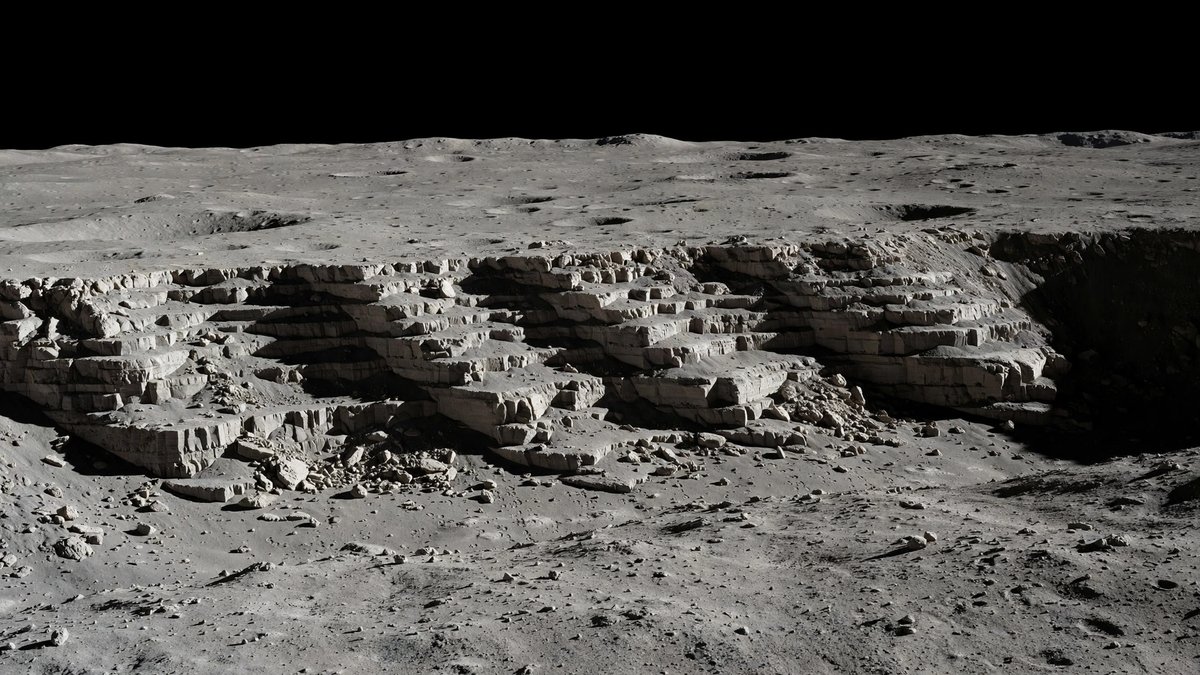
Key points
- The Moon is getting smaller.
- Those cliffs are not dead scenery.
- The Moon formed hot about 4.5 billion years ago and has been cooling ever since.
The Moon is getting smaller. As its interior cools, the whole body contracts, and NASA puts the loss at more than 150 feet (50 meters) of diameter over the last several hundred million years. The shrinkage is slow, but the surface keeps the receipts: thousands of small cliffs where the crust broke and one slab of rock shoved up over another.
Those cliffs are not dead scenery. A 2019 study in Nature Geoscience found the first evidence that some of these faults are still active today, and that they are likely producing moonquakes now.
A raisin with a brittle skin
The Moon formed hot about 4.5 billion years ago and has been cooling ever since. Cooling rock takes up less space, so a cooling world shrinks. NASA compares the surface to a grape drying into a raisin, with one key difference: grape skin is flexible and wrinkles, while lunar crust is brittle and cracks.
The cracks form thrust faults. Each one leaves a scarp, a stair-step cliff typically tens of yards high and stretching for a few miles. Lunar Reconnaissance Orbiter images have catalogued thousands of them across the surface, the visible count of a planet slowly tightening its belt.
Apollo heard it shaking
Astronauts left seismometers on the Moon during the Apollo missions, and the instruments that ran from 1969 to 1977 recorded 28 shallow moonquakes, ranging from about magnitude 2 to about 5. Shallow moonquakes start only 20 to 30 kilometers down, and NASA notes they can be strong, up to about 5.5 on the scale, and can keep shaking for more than 10 minutes, far longer than a similar quake on Earth.
For decades nobody knew exactly where those quakes came from. A team led by Thomas Watters of the Smithsonian's National Air and Space Museum re-ran the Apollo locations with a newer algorithm. Eight of the 28 epicentres landed within 30 kilometers (18.6 miles) of a young fault visible in orbiter images. The team calculated the chance of that clustering being a coincidence at less than 4 percent. Their conclusion: faults slipped as stress built from global contraction and tidal forces, and the Moon is still tectonically active.
Why it matters for the next landing
This is not only geology trivia. Planners for new lunar missions, including NASA's Artemis programme, now have to treat fault zones as live ground. A magnitude 5 shake beside a landing site can topple equipment and stir slopes, and the faults run through regions crews want to visit, including areas near the south pole.
The Moon looks finished from Earth, a grey disc that never changes. It is not. It is a cooling world still cracking its own skin, a few feet at a time, and the instruments astronauts left behind heard it happen.