
Cashews Grow Outside Their Fruit, and the Shell Carries the Same Irritant as Poison Ivy
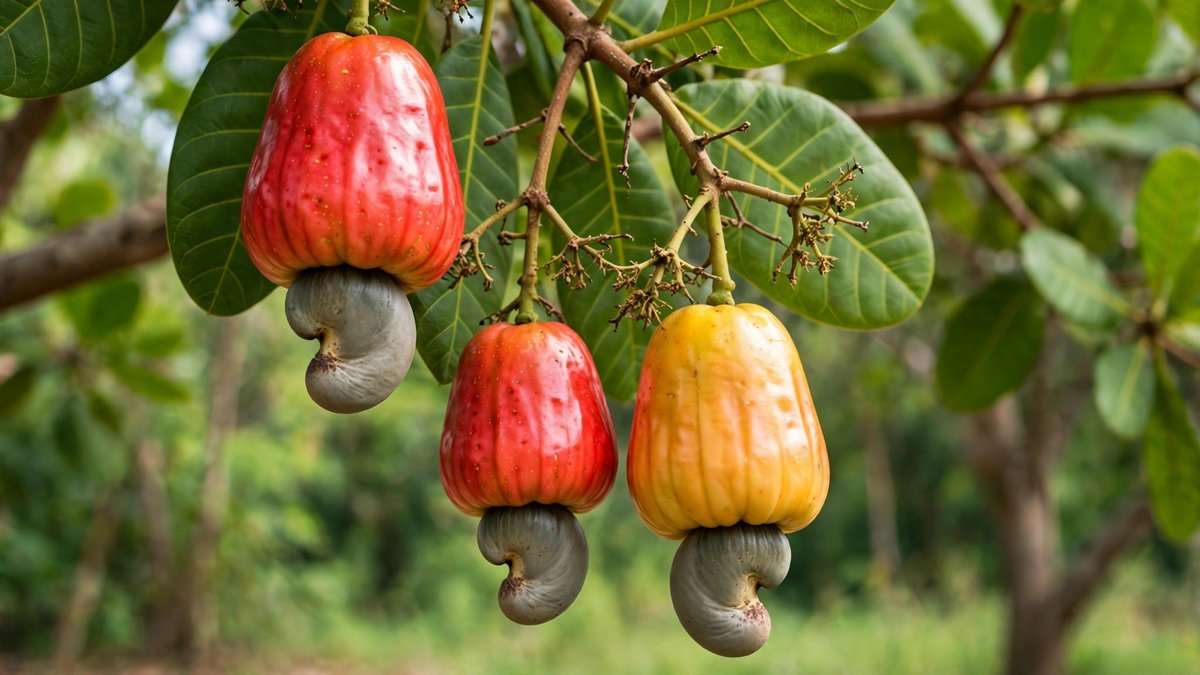
Every cashew hangs in a shell beneath a soft fruit called a cashew apple. The shell holds urushiol, the oil that makes poison ivy itch, which is why cashews are never sold in the shell.
Key points
- A cashew does not grow inside its fruit.
- The fruit on top is the cashew apple: a red or yellow, pear shaped, juicy fruit that ripens first.
- Between the layers of that shell sits an oil containing urushiol.
A cashew does not grow inside its fruit. It hangs underneath it, in a grey kidney shaped shell, and that shell is armed.
The fruit on top is the cashew apple: a red or yellow, pear shaped, juicy fruit that ripens first. The true seed dangles below it. Botanists count the apple as a swollen stem rather than a true fruit, and the dangling shell holds the single seed the world eats as a cashew. It is one of the strangest arrangements in any grocery store, a nut worn like a tail.
The shell is the problem
Between the layers of that shell sits an oil containing urushiol. Urushiol is the same irritant found in poison ivy, poison oak, and poison sumac, close relatives of the cashew tree in the Anacardiaceae family. Touching the raw shell oil can raise the same delayed, itchy, blistering rash as a walk through poison ivy.
That single fact shapes the whole cashew trade. Cashews are never sold in their shells, unlike walnuts, almonds, or peanuts. Workers who process the harvest handle the shells with protection, and the nuts are steamed or roasted at high heat before shelling is finished, because heat breaks down the urushiol and makes the kernel safe.
Even raw cashews are not raw
The bag at the store may say raw. It is not, in the strict sense. Cashews sold as raw have already been steamed or roasted once to remove the shell and clear any urushiol residue. A truly raw cashew, straight off the tree in its shell, is not a food anyone should handle barehanded, let alone eat. Healthline's review of cashew safety states it plainly: truly raw cashews are never sold in stores because of the urushiol risk.
The apple, meanwhile, is the half most of the world throws away. It is edible, sweet, and sharply astringent, and it spoils within about a day of falling, which is why it rarely travels. In parts of Brazil, India, and West Africa where the trees grow, the apple is eaten fresh or made into juice and drinks near the orchard, while the durable seed ships worldwide.
So the snack in the bowl crossed the world because it is the hard half of a soft fruit, and it arrived safe only because someone steamed the poison ivy chemistry out of its shell first. The cashew is not a nut that grows on a tree. It is a seed that grows under one, wearing armor made of itch.