
Myth Check: Ostriches Never Bury Their Heads in the Sand. They Would Suffocate.
The legend comes from good parenting and a flat hiding trick, misread from a distance. The real bird turns its eggs in a ground nest, runs at 43 mph, and sees danger just fine.
Key points
- No ostrich has ever buried its head in the sand.
- The myth survives because ostriches really do put their heads in places that look, from a distance, like holes in the ground.
- Ostriches do not build nests in trees or shrubs.
No ostrich has ever buried its head in the sand. It could not breathe down there, and it does not need to hide. The world's largest bird can run at 43 miles per hour and kick hard enough to defend itself, yet the cartoon of the headless ostrich has survived for about 2,000 years.
The myth survives because ostriches really do put their heads in places that look, from a distance, like holes in the ground.
Good parenting, misread
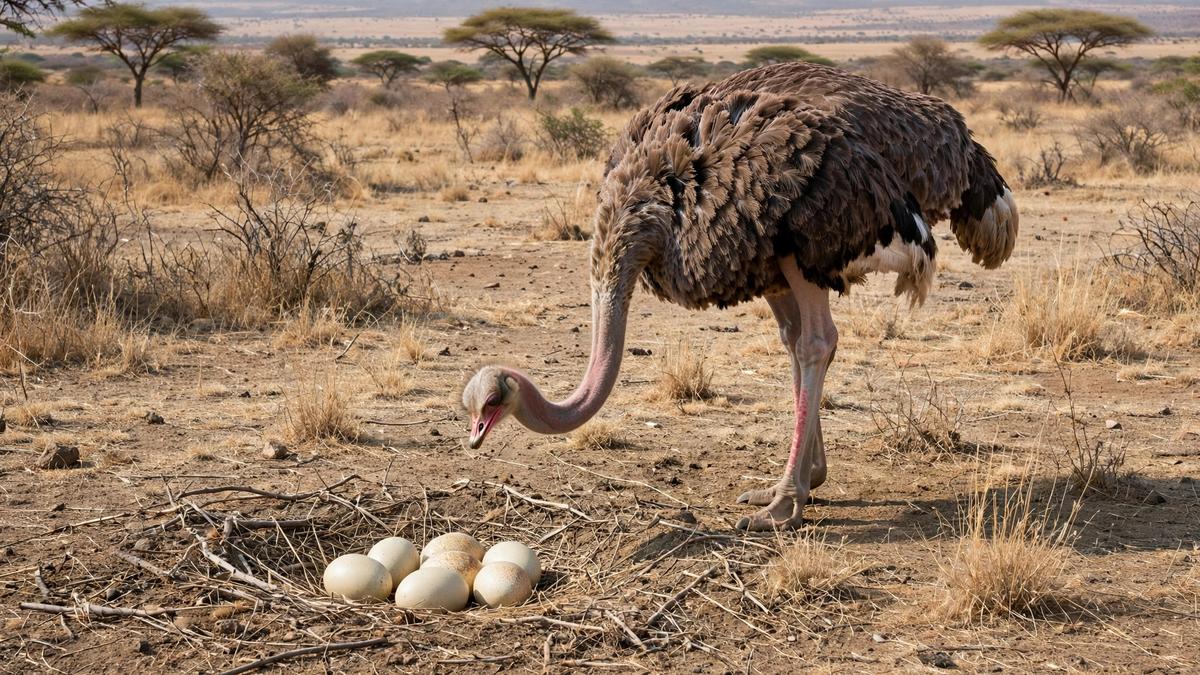
Ostriches do not build nests in trees or shrubs. They scrape a shallow hole in the ground and lay their eggs in it. Both parents then take turns sitting on the eggs, and several times a day the sitting bird reaches down with its beak and turns them, so the eggs warm evenly.
Watch that from far away and the picture writes itself. A huge body sits still. The long neck drops. The small head vanishes into the scrape. Roman writer Pliny the Elder recorded a version of the story in the first century, describing the bird thrusting its head into a bush and imagining its whole body was hidden. The sand version grew from the same misreading.
The flat trick
There is a second behaviour behind the legend. When an ostrich senses danger and cannot run, it sometimes flops to the ground and lies flat, neck stretched out along the earth. Its pale neck and head blend with dry ground and scrub. From a distance the bird can look like a body with no head at all, which reads as a head buried out of sight.
Put the two behaviours together and the myth has everything it needs: a head that disappears at the nest, and a head that disappears in a crisis. Neither involves sand over the head, and neither is about refusing to look at danger.
Built to run, not to hide
The real animal makes the story even odder. Ostriches are the largest living birds, up to 9 feet tall (2.7 meters) and 287 pounds (130 kilograms), according to San Diego Zoo figures cited by Live Science. Smithsonian's National Zoo puts their top running speed at 43 mph (70 km/h), the fastest of any bird on land. Their eyes are large, their hearing is sharp, and their first answer to trouble is to leave at speed.
So the saying has it backwards twice. The ostrich does not hide its head, and the head is not where the bird is vulnerable. Next time someone accuses you of burying yours, you can answer with the facts: the ostrich was turning its eggs, and it saw the danger just fine.