
A Sea Star Has an Eye at the Tip of Every Arm, and It Uses Them to Find Its Way Home
Each arm tip carries a small compound eye with up to 250 light sensing units. Blinded sea stars in reef experiments wandered. Sea stars with eyes walked straight home.
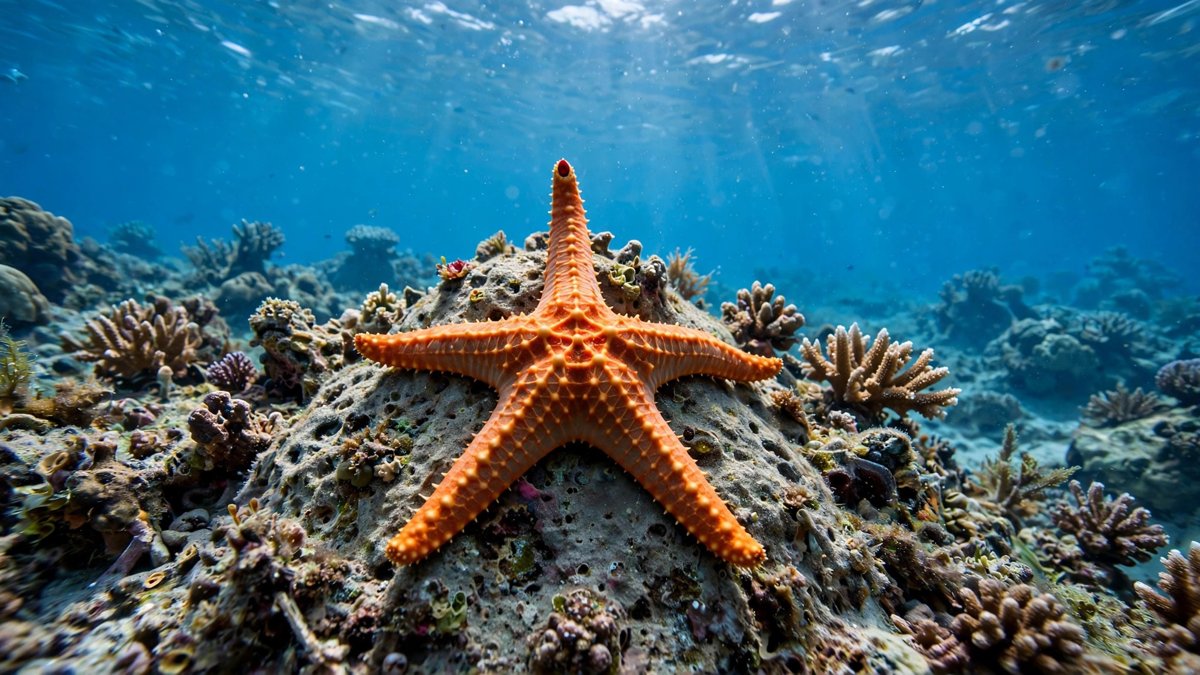
Key points
- A sea star sees the world five ways at once.
- The eye rides on a special short tube foot at the arm's end.
- Researchers Anders Garm and Dan-Eric Nilsson at the University of Copenhagen studied the blue sea star, Linckia laevigata, which lives on tropical coral reefs.
A sea star sees the world five ways at once. At the tip of each arm sits a small red eye, and the animal uses those eyes to navigate, not just to tell light from dark.
The eye rides on a special short tube foot at the arm's end. It is a compound eye, built from light sensing units called ommatidia, typically between 50 and 250 of them, resembling the eyes of insects except that it has no lens and no true optics. The image it forms is crude and low resolution, more a pattern of light and shadow than a picture. For an animal with no brain, only a ring of nerves, crude turns out to be enough.
The home test
Researchers Anders Garm and Dan-Eric Nilsson at the University of Copenhagen studied the blue sea star, Linckia laevigata, which lives on tropical coral reefs. They moved sea stars away from their home reef and watched what happened. Animals with working eyes headed back toward the reef. Animals whose eyes were covered or removed wandered without direction. The conclusion, published in Proceedings of the Royal Society B in 2014, was the first solid proof that a sea star uses true vision to navigate: the eyes exist to keep the animal from straying too far from home.
The crown of thorns sea star takes the design further. It carries 7 to 23 arms, each tipped with an eye, and later Copenhagen work found the eye sits on a movable knob that tilts the view up or down. On the leading arms the eyes aim about 33 degrees above the horizon; on trailing arms, about 44 degrees. The animal adjusts its own field of view as it walks.
Eyes in the dark
The surprise deepened in the deep sea. A survey of 21 brisingid sea star species, a group that lives in deep water, found eyes in 43 percent of them. One species, Brisingaster robillardi, packs more than 600 ommatidia into a single eye, the most found in any sea star. Why an animal in near darkness keeps such well built eyes is still an open question, with light from other glowing creatures as the leading suspect.
A sea star has no head, no front, and no brain to build a single picture from five viewpoints. Each arm samples the light in its own direction, and the ring nerve ties the reports together loosely enough to steer by. It is vision spread around a body like windows around a round house. Nobody inside sees the whole view. The house still finds its way home.