
A Dragonfly Relative Once Flew With Wings Wider Than a Hawk's
Meganeura monyi, a griffinfly from about 300 million years ago, had a wingspan of about 65 to 75 centimeters. It hunted other insects in the coal forests long before dinosaurs existed.
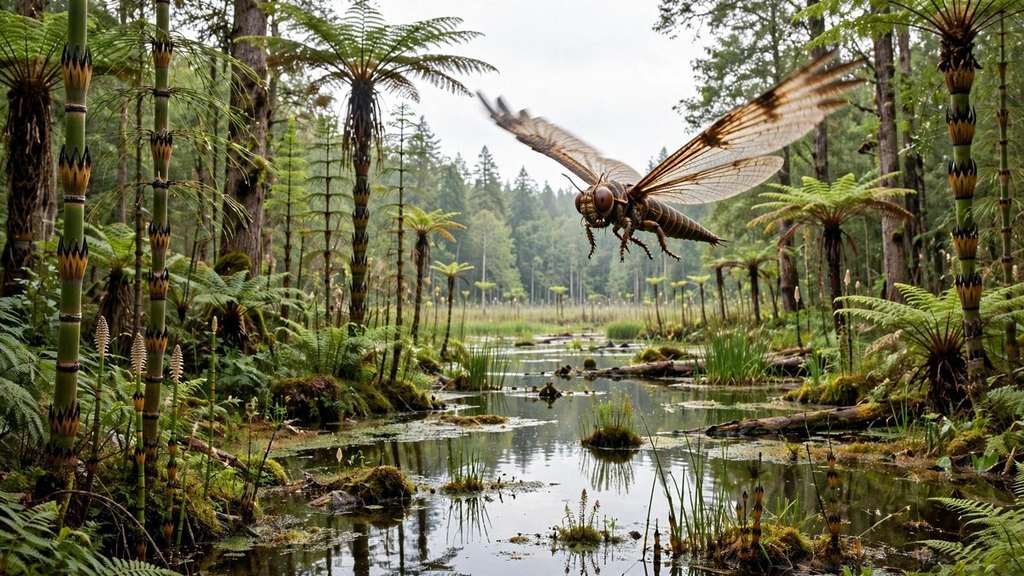
Key points
- About 300 million years ago, the largest flying insect known from that age crossed the coal forests on wings about as wide as a small hawk's.
- The Natural History Museum in London calls Meganeura monyi the largest early dragonfly known to exist, in its guide to griffinflies, the earliest flying insects.
- Fossils of Meganeura were first found in 1880, in the Late Carboniferous coal measures of Commentry in France.
About 300 million years ago, the largest flying insect known from that age crossed the coal forests on wings about as wide as a small hawk's. It was not a true dragonfly. It was a griffinfly, and its name is Meganeura monyi.
The Natural History Museum in London calls Meganeura monyi the largest early dragonfly known to exist, in its guide to griffinflies, the earliest flying insects. Fossil measurements put a single wing at about 32 centimeters long, giving a wingspan of roughly 65 to 75 centimeters. The museum notes that these aerial predators probably weighed 100 to 150 grams, about the weight of a large apple.
Found in French coal mines
Fossils of Meganeura were first found in 1880, in the Late Carboniferous coal measures of Commentry in France. French paleontologist Charles Brongniart described and named the genus in 1885. The name refers to the large network of veins in the wings. All valid specimens are held at the National Museum of Natural History in Paris.
Meganeura lived in the Late Carboniferous, about 305 to 299 million years ago, long before dinosaurs, birds, or flowers. Its world was warm swamp forest, the kind of forest that later compressed into coal seams. It belonged to the extinct order Meganisoptera, close relatives of modern dragonflies and damselflies within the wider group Odonatoptera.
A hunter, built like one
The Natural History Museum describes Meganeura as a predator that ate other insects, with spines on its legs to trap and capture prey, and large, sharp mandibles for slicing and chewing. A 2018 study in Scientific Reports, by Nel and colleagues, read the fossil anatomy of giant griffinflies as hawker predators: hunters that caught prey in flight, in the manner of modern hawking dragonflies.
Size helped, but size had a support system. Insects breathe through a network of tubes, and oxygen reaches their tissues by diffusion. In the Carboniferous, the air held far more oxygen than today, often estimated near 35 percent against about 21 percent now. Many researchers link that rich air to insect gigantism: oxygen could travel farther into a larger body, so a larger body could still breathe. Later, oxygen fell, and still later birds took to the air. The Natural History Museum notes that once birds evolved and began preying on large flying insects, the giants had to become smaller and faster to escape being eaten.
Why it still matters
Meganeura is a reminder that the rules of animal size are not fixed. They depend on the air, the food web, and the hunters overhead. Change the air and remove the birds, and an insect lineage can reach a size that no living dragonfly comes close to: the largest dragonflies today reach about 20 centimeters in wingspan, less than a third of Meganeura's spread.
The fossil itself is fragile and incomplete, which is why scientists combine its wing bones with better preserved relatives to rebuild the animal. Even with those gaps, the core fact stands on measured bone: a flying insect with a wing over a foot long patrolled the Carboniferous sky, hunting on the wing, in a world without birds.