
Horseshoe Crabs Are Older Than Dinosaurs by About 200 Million Years
Horseshoe crabs appear in the fossil record about 450 million years ago, long before the first dinosaurs. Their blue blood now helps test medicines and vaccines for safety.
Key points
- Horseshoe crabs were already crawling on sea floors about 450 million years ago.
- Despite the name, a horseshoe crab is not a true crab.
- The body explains the name.
Horseshoe crabs were already crawling on sea floors about 450 million years ago. The first dinosaurs did not appear until roughly 240 million years ago. That gap, about 200 million years, means horseshoe crabs are older than dinosaurs by a span longer than the entire age of mammals.
Not a crab at all
Despite the name, a horseshoe crab is not a true crab. It is an arthropod more closely related to spiders and scorpions than to crabs. Four species survive today. The Atlantic horseshoe crab lives along the east coast of North America, and three other species live along Asian coasts.
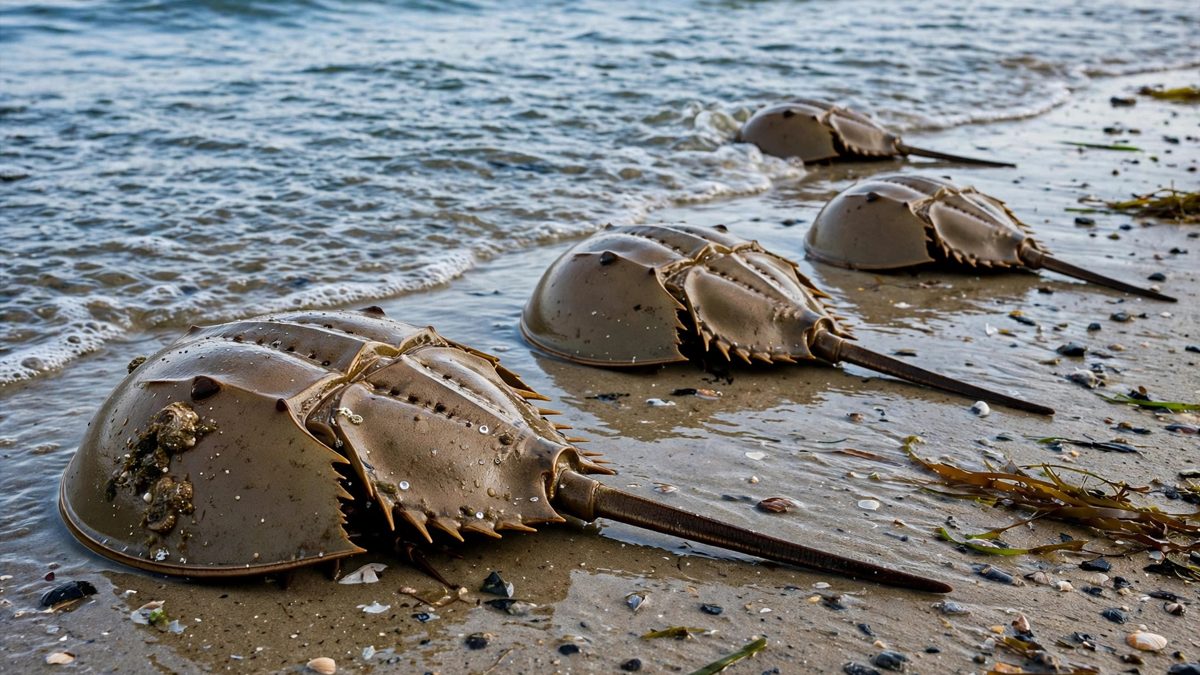
The body explains the name. A smooth, hard shell shaped like a horseshoe covers the front. A long pointed tail, called a telson, trails behind. The tail is not a weapon. The animal uses it as a lever to flip itself upright when waves turn it over. Under the shell sit ten legs and a set of simple and compound eyes, ten light sensing organs in total.
A design that barely changed
Fossils show the same basic body plan hundreds of millions of years ago. Scientists call animals like this living fossils, not because they stopped evolving, but because the shape that worked in ancient seas still works now. In that time horseshoe crabs lived through several mass extinctions, including the one that ended the dinosaurs about 66 million years ago.
Each spring, large numbers gather on beaches such as those around Delaware Bay to spawn. Females lay thousands of small eggs in the wet sand. Migrating shorebirds time their long flights to this feast and eat the eggs to refuel. Fish and sea turtles feed on them too, so a drop in horseshoe crab numbers travels quickly through the food web.
Blue blood that guards medicine
Their blood is blue because it carries copper instead of iron. That blood clots fast when it meets bacterial toxins. Laboratories use a test made from it to check that vaccines, intravenous drugs and medical devices are free of dangerous contamination. Crabs are caught, part of their blood is drawn, and most are returned alive to the sea, though the practice is debated and numbers are watched closely.
An animal that predates trees, flowers and dinosaurs now plays a part in modern hospital safety. Protecting its spawning beaches protects both an ancient lineage and a food source that migrating birds depend on.