
Some Greenland Sharks Were Swimming Before the United States Existed
Eye lens dating puts the oldest Greenland shark at about 392 years, with at least 272 years certain. It grows 1 centimeter a year and may not breed until age 150.
Key points
- Some Greenland sharks swimming today were born before the United States existed.
- That makes the Greenland shark the longest living vertebrate known to science.
- Greenland sharks gave researchers a problem.
Some Greenland sharks swimming today were born before the United States existed. The oldest one ever aged was estimated at about 392 years old, and even the cautious end of the estimate puts the species at 272 years or more.
That makes the Greenland shark the longest living vertebrate known to science. No other animal with a backbone comes close.
Aged by the lens of the eye
Greenland sharks gave researchers a problem. Most fish can be aged by counting growth rings in hard tissue, but this shark has soft cartilage and no calcified bones to read. The team led by Julius Nielsen at the University of Copenhagen turned to the eye instead.
The center of the eye lens forms before birth and does not change after that. By radiocarbon dating the lens proteins of 28 female sharks caught by accident in fishing nets, the team could work back to a birth window for each animal. The two largest sharks, each about 5 meters long, came out at roughly 335 and 392 years. Nielsen was careful about the range: with 95 percent certainty, the oldest shark was between 272 and 512 years old. Even the low end breaks the vertebrate record.
Slow is the whole strategy
The shark grows at about 1 centimeter a year. Adults reach 13 to 16 feet, and females may not be ready to breed until they are around 150 years old. A shark that takes a century and a half to grow up is playing a very long game.
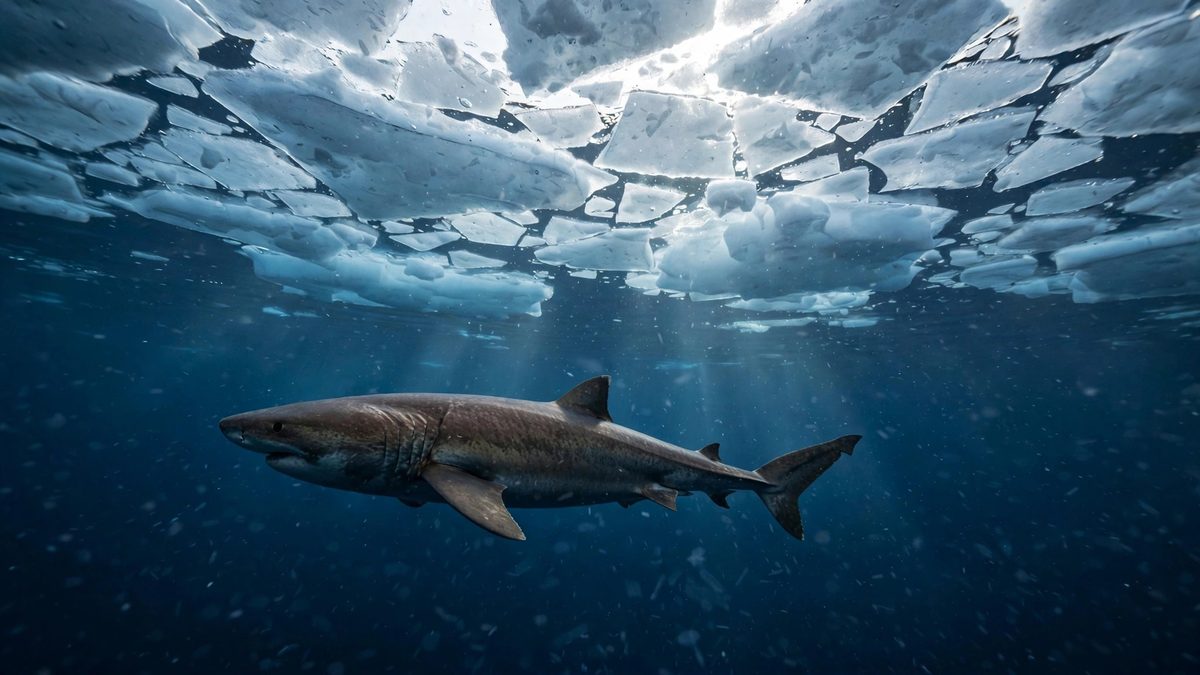
Its home helps. Greenland sharks live in the cold North Atlantic and Arctic, in water between about minus 1.8 and 10 degrees Celsius, and they cruise at a sleepy pace that earned them the nickname sleeper shark. Cold water and a slow metabolism go with long life across many species. In this shark, that pattern runs to an extreme.
What 392 years actually covers
A birth in the early 1600s means one animal could have been swimming while Shakespeare was still being read as a living author, long before steamships, electricity, or a single plastic bottle entered the ocean. It would have lived through the whole industrial age from below, in dark water, at less than walking pace.
Scientists still know little about these sharks. Most of what exists comes from animals caught by accident, not from planned observation. The age study changed one thing for good: the record for a long vertebrate life no longer belongs to a whale or a tortoise. It belongs to a slow shark in cold water that nobody was watching.