
Tardigrades Are the First Animals Known to Survive Open Space
About 3,000 dried water bears spent 12 days on the outside of an ESA spacecraft in 2007, exposed to vacuum and cosmic radiation, then revived back on Earth.
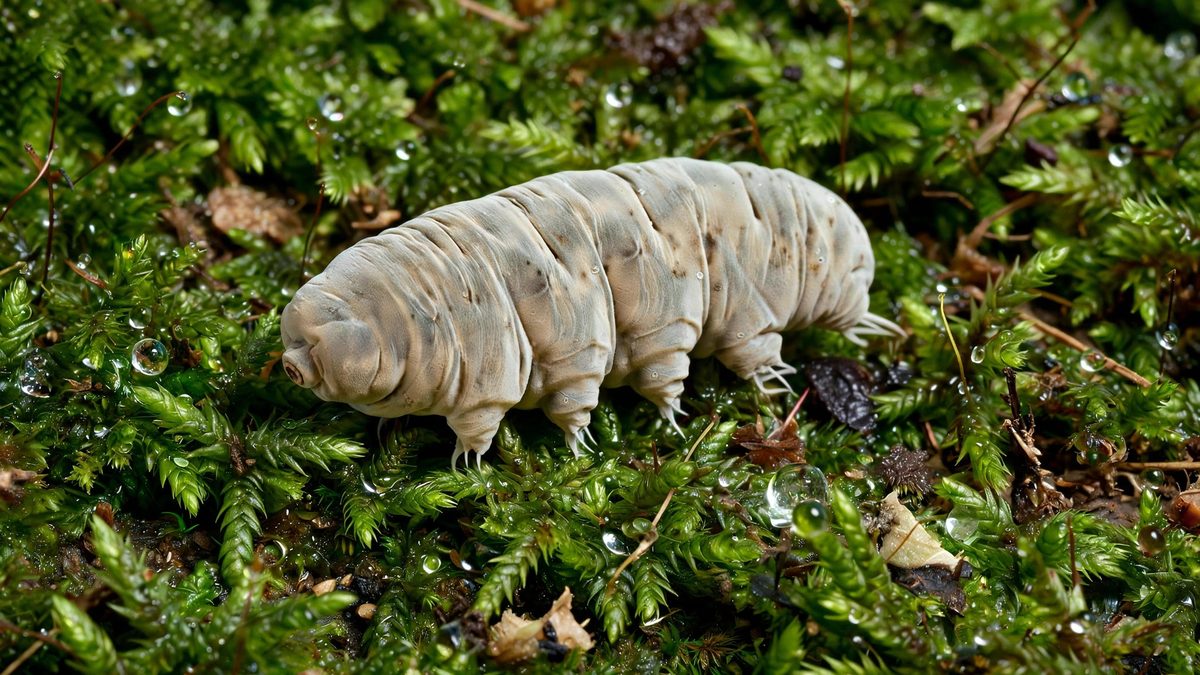
Key points
- In September 2007, about 3,000 tiny animals rode on the outside of a spacecraft, opened to open space, and came back alive.
- No suit.
- The largest tardigrade species is just over 1 millimeter long.
In September 2007, about 3,000 tiny animals rode on the outside of a spacecraft, opened to open space, and came back alive. They were tardigrades, also called water bears, and they became the first animals known to survive exposure to space itself.
No suit. No cabin. Just a dried animal, the vacuum of orbit, and cosmic radiation.
A passenger smaller than a grain of sand
The largest tardigrade species is just over 1 millimeter long. Most people never see one without a microscope. They live in temporary ponds, in droplets of water in soil, and on moist plants, and they feed and move like ordinary small animals when water is around.
Their trick starts when the water goes. A tardigrade dries out and falls into a deep suspended state. In that state it does not need to eat or breathe in any normal sense, and the near total loss of water that would kill most animals becomes a way to wait out bad conditions.
Twelve days on the outside of Foton-M3
The European Space Agency flew the TARDIS experiment on its Foton-M3 mission. For 12 days in September 2007, roughly 3,000 water bears orbited Earth exposed to the space environment. The point was simple: take an animal known to survive drying and radiation on Earth and test it where there is no air at all.
Project leader Ingemar Jonsson of Kristianstad University in Sweden reported the core result plainly: the space vacuum, with its extreme dehydration and cosmic radiation, was not a problem for the water bears. Samples exposed to vacuum came through, were rehydrated back on Earth, and revived. That had never been shown for any animal before. Bacteria and lichens had survived open space. An animal had not.
Built for conditions that kill almost everything
The space flight sits on top of a longer list. ESA notes that water bears can withstand temperatures from minus 272 degrees Celsius to plus 150 degrees, can go without water for a period of 10 years, and are extremely resistant to radiation. Each of those numbers comes from a separate hard test on Earth. Orbit added the one test no laboratory can fully copy: real vacuum, real cosmic radiation, and real space, all at once.
Survival is not the same as comfort. Many exposed animals died after solar ultraviolet was added in related tests, and researchers still study how tardigrade cells protect their membranes and DNA while dried. The open question is the mechanism. The closed question is the fact: an animal has survived open space, and it is an animal most people have never heard of.
That is why scientists keep flying them. If a water bear can protect its own cells through drying, freezing, radiation, and vacuum, the method it uses could teach researchers how to protect far more fragile living material.