
Why Popcorn Pops: Every Kernel Is a Tiny Sealed Pressure Cooker
Water sealed inside the kernel turns to steam, pressure breaks the hull at about 180 degrees Celsius, and the pop sound is the steam escaping, not the shell snapping.
Key points
- A popcorn kernel is a sealed pressure vessel with food inside it.
- That burst is not a small crack.
- A popcorn kernel holds starch and a small store of water inside a hard outer wall.
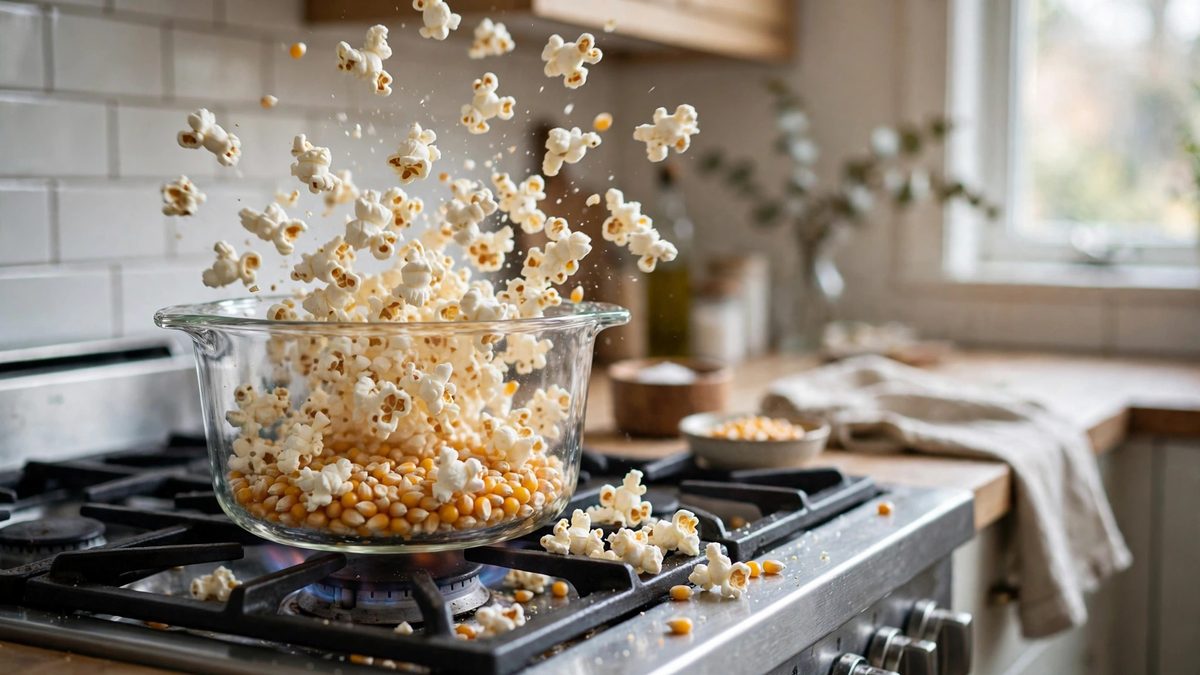
A popcorn kernel is a sealed pressure vessel with food inside it. Heat it, and the water trapped in the kernel turns to steam, the pressure climbs past what the hard hull can hold, and the whole thing bursts inside out in a fraction of a second.
That burst is not a small crack. The kernel jumps, flips, and lands as a white flake many times its starting size.
The water is sealed in on purpose
A popcorn kernel holds starch and a small store of water inside a hard outer wall. Ordinary corn cannot do this trick because its wall gives way too early or its insides are arranged wrong. Popcorn works because the hull seals tight and holds the pressure in while the inside heats up and softens.
As the temperature rises, the water becomes steam and pushes outward. The starch inside turns soft and stretchy under the heat and pressure. The kernel is, in effect, cooking its own contents under pressure that no kitchen pot at home ever reaches for so small a load.
180 degrees is the breaking point
Physicists who filmed popping corn with high speed cameras measured the moment in detail. Science News Explores, reporting on the work, puts the breaking point at 180 degrees Celsius, about 356 degrees Fahrenheit. At that heat, the pressure is too much for the wall. The wall breaks, the pressure drops all at once, and the soft starch rushes out and sets in the cooler air as the familiar white foam.
The cameras, running at 2,900 frames per second in the study reported by Smithsonian Magazine, caught a second surprise. As the flake forms, a compressed leg of starch pushes out of the kernel and launches it into a jump. Popcorn does not just split. It leaps, midway between a bursting seed and a jumping animal.
The pop sound is steam, not the shell
Most people assume the sound is the hull snapping. The synchronized sound recordings in the same research point somewhere else. The pop comes from the release of pressurized water vapor as the kernel opens. The shell breaking and the kernel bouncing were both tested against the audio, and neither matched the timing of the sound. The steam leaving under pressure did.
That detail explains the kitchen rhythm of a batch. Kernels pop one by one because each one reaches the breaking pressure at a slightly different moment, depending on its size, its water store, and where it sits in the heat. The last slow kernels are not lazy. They were cooler, drier, or sealed a little stronger than the rest.
Dry old kernels pop poorly for the same reason. Lose the trapped water in storage and there is not enough steam to break the wall or puff the starch. The science of a good batch is simple: fresh kernels, even heat, and enough time for every sealed vessel to reach 180 degrees.