
Zebra Stripes Do Not Scare Flies Away. They Stop Flies From Landing.
Horseflies land on zebras less than a quarter as often as on plain horses. Experiments that dressed horses in striped coats show the pattern breaks the landing, not the approach.
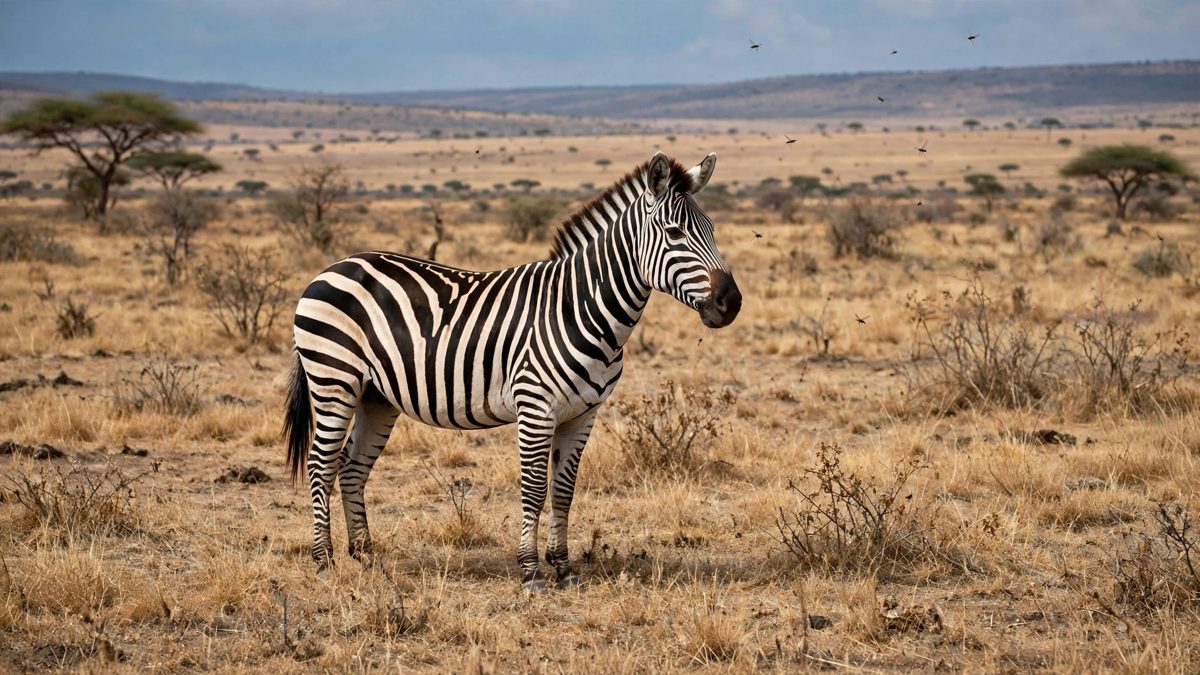
Key points
- Horseflies land on zebras less than a quarter as often as they land on plain horses, and the stripes are the reason.
- That result comes from a field study by researchers at the University of California, Davis and the University of Bristol, published in PLOS ONE in 2019.
- The flies circled zebras and horses at about the same rate.
Horseflies land on zebras less than a quarter as often as they land on plain horses, and the stripes are the reason. The flies are not scared off. They fly in just as fast, and then they fail to slow down, bump into the coat, and veer away.
That result comes from a field study by researchers at the University of California, Davis and the University of Bristol, published in PLOS ONE in 2019. The team watched tabanid horseflies around captive plains zebras and plain colored domestic horses kept in the same enclosures on a farm in Britain.
The flies come in, then blow the landing
The flies circled zebras and horses at about the same rate. They touched both animals at about the same rate too. The gap opened at the last step. Far fewer flies actually landed and settled on the zebras.
Video analysis showed why. A fly approaching a horse slows down before it lands, the way a plane flares before touchdown. A fly approaching a zebra kept its speed, failed to brake, and often hit the stripes and bounced off instead of landing.
The coat swap that settled it
The team then dressed the horses in cloth coats: black, white, and black and white striped. The same horses, on the same days, drew far fewer landings on the striped coat. Their bare heads, left uncovered, were attacked at the normal rate. The pattern on the body, not the animal wearing it, was doing the work.
A follow up study from the same Bristol group, published in Proceedings of the Royal Society B in 2020, tested striped and checked patterns on rugs and found that flies also avoided landing on checks. That result argues against one neat theory, that parallel stripes alone scramble the fly's sense of motion, and it keeps the exact visual trick an open question.
Why a landing matters
Horseflies are not a minor itch. Their bites drain blood, spread disease, and keep grazing animals moving instead of feeding. An animal that cuts successful landings to a quarter gains a daily advantage, meal after meal, across a whole lifetime. The researchers also noted that zebras swished their tails and ran from fly pressure more than the horses did, while the horses twitched their skin more. Stripes handle the landing. Behavior handles the rest.
For a century, people explained the stripes with camouflage, predator confusion, social signals, and cooling. The fly work is the explanation with direct experiments behind it: put the pattern on a horse, and the landings fall. Take it off, and they rise again.