
Why Garlic Turns Blue or Green in Pickles, and Why It Is Still Safe to Eat
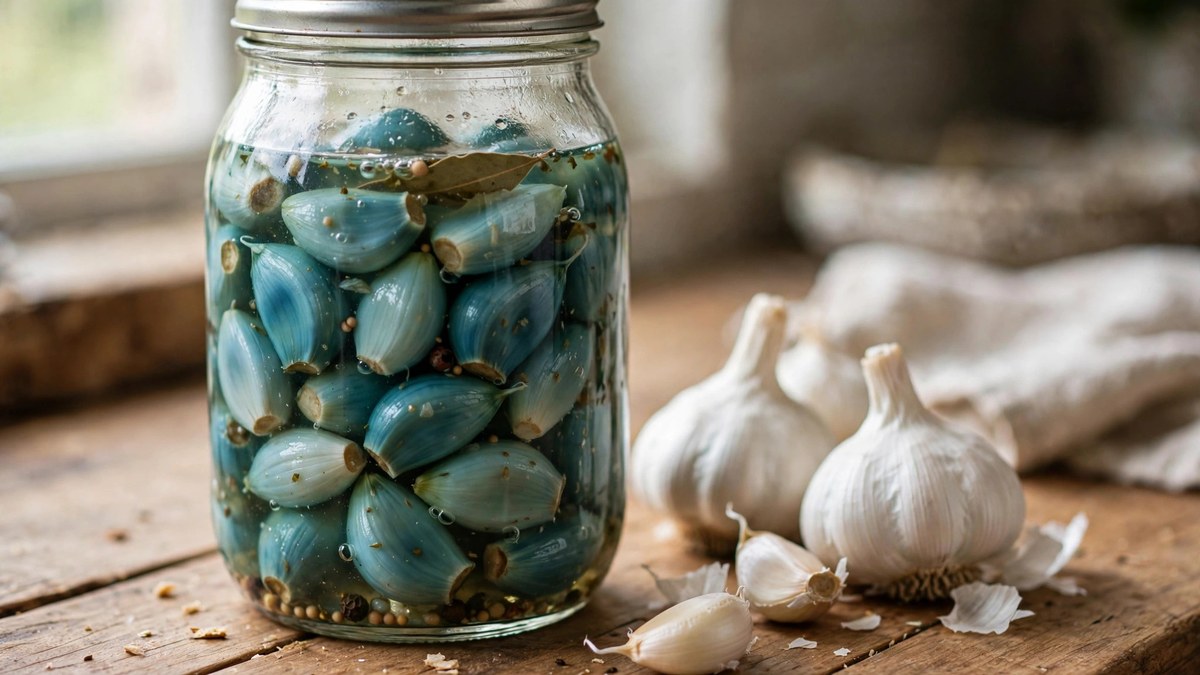
Blue garlic looks like spoilage. Extension services say it is chemistry: garlic sulfur compounds meet acid and trace metals, build blue and yellow pigments, and the cloves stay safe.
Key points
- Open a jar of home pickles and the garlic inside may be blue.
- Garlic carries its color kit inside itself.
- A second route runs through trace metals.
Open a jar of home pickles and the garlic inside may be blue. Not pale, not off white, but blue or green, sometimes turquoise. It looks like something went wrong. University extension services give the same answer across the country: the color is a chemical reaction, the garlic is still safe to eat, and the flavor holds.
Garlic carries its color kit inside itself. The cloves are rich in sulfur compounds, the same family of chemicals that gives garlic its sharp smell and bite. Whole cloves keep those compounds and the enzymes that work on them in separate cells. Cutting or crushing breaks the walls. Acid, such as the vinegar in a pickle jar, wakes the enzymes up, and the reactions that follow can build pigments. Some of the pigments are blue. Others are yellow. Blue and yellow side by side read to the eye as green or turquoise.
The metals in your water and pans play a part
A second route runs through trace metals. Clemson University's extension fact sheet on pickle problems notes that iron, tin or aluminum from a cooking pot, the water, or water pipes can react with pigments in garlic and turn cloves bluish or green. The amounts needed are tiny, the sort of trace that ordinary tap water carries without anyone noticing.
The same fact sheet adds a third factor: the garlic itself. Immature bulbs, picked before they were fully ready, are more prone to the color shift. The sheet advises curing immature bulbs for two to four weeks at about 70 degrees Fahrenheit. Garlic that has spent time in cold storage is also more likely to change color once acid arrives.
Safe, and in one place, prized
The safety answer is short. Extension guidance compiled by the University of California's agriculture division states that this blue or green garlic is safe to eat. Michigan State University Extension calls the change not a safety concern. The color is cosmetic. It does not signal spoilage, and on its own it is not a reason to throw the jar away. Normal food handling still applies, as with any home pickle: clean jars, proper acid, and no other signs of spoilage.
One culture skips the worry entirely and aims for the color. In northern China, laba garlic is made by soaking cloves in vinegar until they turn a vivid green, and the jars are prepared around the Lunar New Year season. There, green garlic is the goal, and researchers have studied how to get the brightest shade.
How to keep it white, if you care
Cooks who want pale garlic have a few levers. Use fresh, fully cured bulbs rather than immature or long-stored ones. Blanching or cooking the garlic before it meets acid helps, because heat deactivates the enzymes that start the pigment chain. Bringing raw garlic and strong acid together and leaving them to sit is the surest way to invite the blue.
Or leave it. The jar that startles the cook is, chemically, just garlic doing what garlic does when vinegar gives its sulfur compounds a new set of partners. The color changed. The garlic did not spoil.