
Koalas Have Fingerprints So Close to Ours That a Microscope Can Struggle to Tell Them Apart
Koalas are the only marsupials with true fingerprints, and they evolved them tens of millions of years after splitting from the primate line. Grip, not kinship, explains the match.
Key points
- A koala gripping a eucalyptus branch carries the same kind of ID you do.
- That should not happen.
- The discovery is recent.
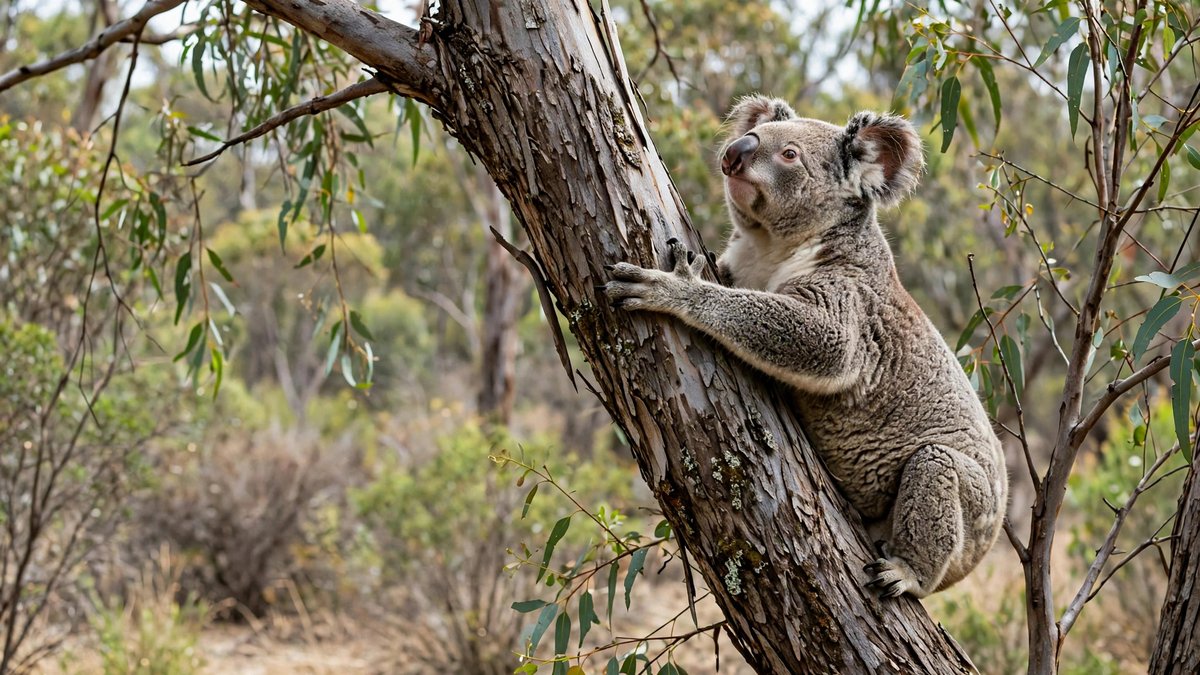
A koala gripping a eucalyptus branch carries the same kind of ID you do. Its fingertips are covered in loops, whorls and arches that look almost exactly like human fingerprints, and researchers say even careful study under a microscope can struggle to tell the two apart.
That should not happen. Koalas are marsupials from Australia. Their ancestors split from the primate line roughly 70 to 80 million years ago, long before either group had these ridges. The prints are not an inheritance. They are a reinvention.
Found in 1996, hiding in plain sight
The discovery is recent. In 1996, a team led by biological anthropologist Maciej Henneberg at the University of Adelaide reported that koalas had fingerprints. Working with colleagues Kosette Lambert and Chris Leigh, Henneberg compared koala, chimpanzee and human prints with a scanning electron microscope. The surprise was not just that koala prints existed. The koala prints came out looking even more like human prints than the chimp prints did, even though chimps are our close relatives and koalas are not related to us in any recent sense.
The team also found what koalas do not share. Their closest living relatives, wombats, have no such prints. Neither do kangaroos. Among marsupials, the koala stands alone with a fingertip pattern that mirrors ours ridge for ridge.
Why a climbing animal needs ridges
The best explanation is grip. Koalas climb vertically, reach out along thin branches and pull handfuls of eucalyptus leaves to their mouths. That is fine, demanding work for fingers. Ridges increase friction where skin meets bark and leaf, and they sharpen touch, so the animal can judge a leaf before it commits to eating it.
Primates arrived at the same tool for similar reasons: grasping branches and handling food with precision. Scientists call this convergent evolution, two distant lines solving the same physical problem and landing on the same design. The koala did not copy us, and we did not copy it. Physics pushed both species to the same answer.
A forensic puzzle that stays theoretical
The similarity raises an obvious question. Could a koala print at a scene be mistaken for a human one? Researchers raised the possibility early, because the ridge patterns are so close in size, shape and arrangement. In practice, context gives the game away: koala prints are smaller, and no documented case of a real investigation being fooled by one has been confirmed. The prints remain a scientific marvel rather than a police problem.
Still, the fact stands. Press a koala fingertip and a human fingertip side by side, and the swirling patterns that come back belong, unmistakably, to the same idea. Evolution had the idea twice.