
Why Fizzy Drinks Bite Your Tongue, and Why the Bubbles Are Not the Reason
The sting of a carbonated drink feels like bubbles popping on your tongue. Experiments in a pressure chamber show the bite stays when bubbles cannot form. The real source is an acid your mouth makes on contact.
Key points
- Take a sip of sparkling water and it bites.
- Researchers at the Monell Chemical Senses Center in Philadelphia tested the bubble story directly.
- Air bubbles told the second half of the story.
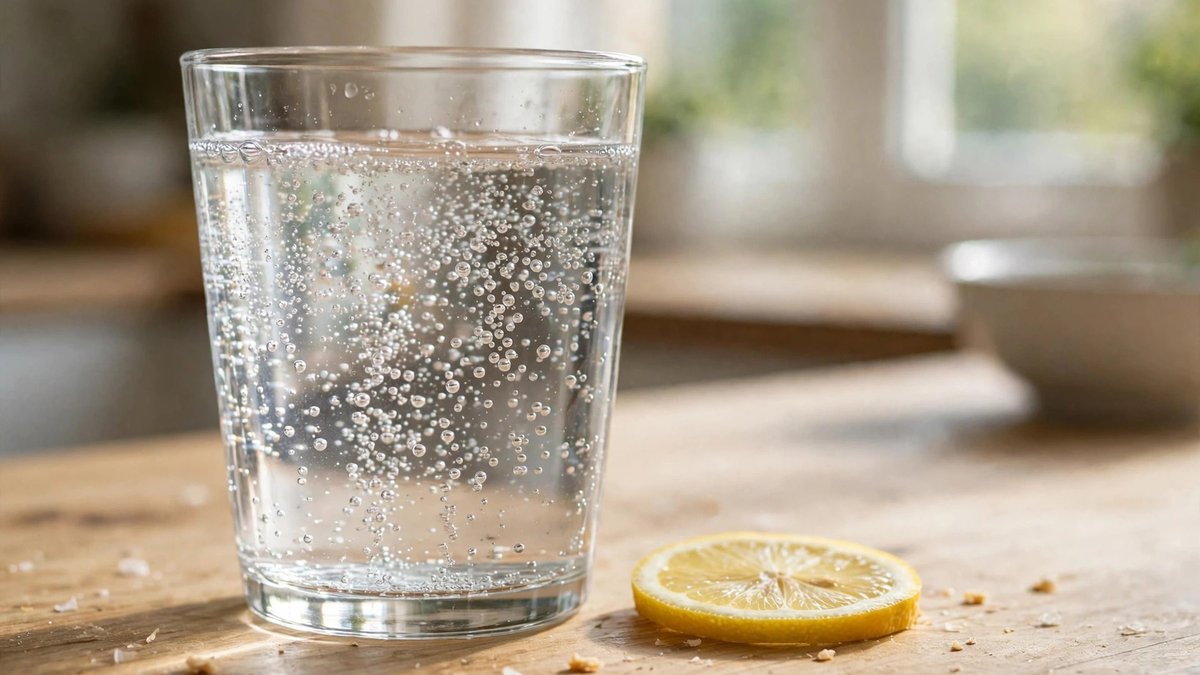
Take a sip of sparkling water and it bites. The sharp sting feels mechanical, as if thousands of tiny bubbles were bursting against your tongue. That picture is wrong. The bite of carbonation is mostly chemistry. Your mouth turns the gas in the drink into acid on contact, and that acid is what your nerves report.
The bubble-free test
Researchers at the Monell Chemical Senses Center in Philadelphia tested the bubble story directly. In a study published in PLOS ONE in 2013, Paul Wise and colleagues asked people to rate the bite of carbonated water at normal pressure, where bubbles form freely, and at two atmospheres of pressure, where bubbles cannot form. The ratings came out essentially identical. No bubbles, same bite.
Air bubbles told the second half of the story. When the team streamed plain air bubbles over the tongue in a mildly carbonated drink, the bubbles made the bite feel stronger, but air bubbles in a flat drink created no bite at all. Bubbles amplify the signal. They do not create it.
An enzyme builds the acid
The gas in every fizzy drink is carbon dioxide, held in the liquid under pressure. On your tongue sits an enzyme called carbonic anhydrase. It converts carbon dioxide into carbonic acid, a weak acid, right at the surface of the tissue. Work going back to a 2000 study in Chemical Senses showed the chain in both people and rats. When researchers blocked the enzyme with acetazolamide, the sensation from carbonated water dropped sharply, and nerve activity in the brainstem dropped with it.
That acid excites nociceptors, the nerve endings that report irritation and pain, carried by the trigeminal nerve. A separate line of work from the University of Southern California, published in the Journal of Neuroscience in 2010, found the sensor. Carbon dioxide switches on trigeminal nerve cells through a channel called TRPA1, the same channel that reacts to mustard oil. The channel opens when acid builds up inside the cell.
Taste cells join in
The sting is only half the flavour of fizz. A 2009 study in Science by Chandrashekar, Zuker, Ryba and colleagues found that the tongue's sour-taste cells also detect carbonation. Those cells carry an enzyme called carbonic anhydrase 4 on their surface, which turns carbon dioxide into bicarbonate and protons, the particles that make a liquid acidic. When the team removed the sour-sensing cells in mice, the taste response to carbon dioxide disappeared. The authors concluded that the acid made at the surface of sour cells is the main taste signal for carbonation.
So a fizzy drink hits two systems at once. Sour cells register it as a taste. Pain fibres register it as a mild irritation, close in kind to the burn of chilli or the bite of mustard, only weaker and shorter. The bubbles add touch and movement on top, which the brain reads as extra sharpness.
Why cold and flat matter
This is also why a warm, flat soda tastes wrong in a specific way. Warm liquid holds less dissolved gas, and gas that escapes before the sip never becomes acid on the tongue. Less carbonic acid means less bite and less of the sour edge, so the drink tastes sweeter and duller than the maker intended. The recipe did not change. The chemistry on your tongue did.