
Chameleons Change Colour Mostly to Talk, Not to Hide
The schoolbook story says chameleons change colour to match what they touch. Research shows colour change is mostly a signal to other chameleons, run by crystals in the skin that tune reflected light.
Key points
- A chameleon does not turn the colour of whatever it touches.
- National Geographic states the correction at the top of its chameleon reporting: it is a popular myth that chameleons take on the colour of what they touch.
- Watch two males meet and the language shows.
A chameleon does not turn the colour of whatever it touches. That is the myth. The real story is stranger: a chameleon changes colour mostly to speak. Bright shifts warn rivals, court mates and report stress, and the animal does it by retuning tiny crystals in its skin, like adjusting a mirror made of light.
The myth and the correction
National Geographic states the correction at the top of its chameleon reporting: it is a popular myth that chameleons take on the colour of what they touch. Some colour change does help a chameleon blend into its surroundings, and its resting colours are already a good match for leaves and bark. But the fast, dramatic changes are a physiological reaction used mostly for communication: courtship, competition and environmental stress.
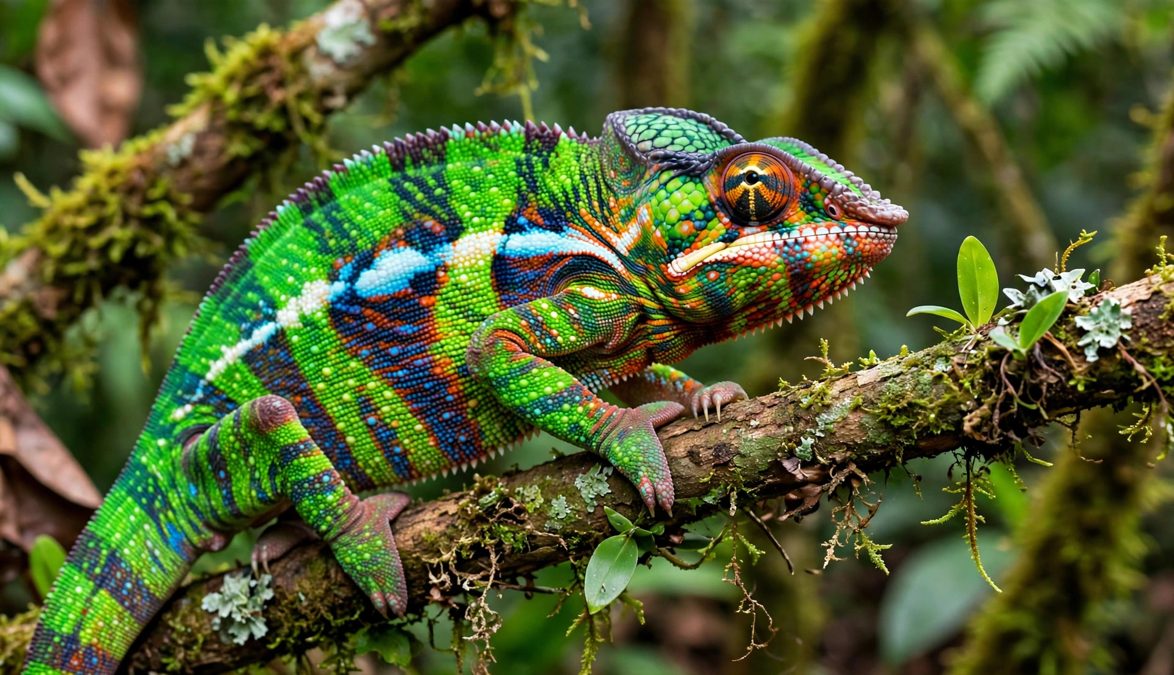
Watch two males meet and the language shows. Colours brighten and patterns sharpen as each animal signals size and intent. A calm animal wears one palette. An excited or stressed animal wears another. The skin is a billboard first and a curtain second.
Crystals that tune the light
The mechanism surprised even the scientists who found it. In 2015, a University of Geneva team led by Michel Milinkovitch published work in Nature Communications on panther chameleons. Under a layer of pigment cells sits a layer of skin cells packed with nanoscale crystals of guanine, arranged in a lattice. The crystals do not change colour themselves. They reflect light, and the colour they reflect depends on the spacing between them.
When the lattice is tight, it reflects shorter wavelengths, toward blue and green. When the animal excites the skin and the spacing widens, the reflected colour slides through green and yellow toward orange and red. Milinkovitch's team showed the shift by treating skin samples and watching the reflected colour move. A deeper second layer of the same crystal cells reflects infrared light, which likely helps the animal manage heat.
Temperature is the second job
Colour also works as a thermostat setting. A cold chameleon darkens in the morning, and dark skin absorbs more sunlight. A hot animal pales, and pale skin reflects more. Communication and temperature share the same hardware, which is why a stressed animal and a cold animal can both look dark for different reasons.
Why the myth survives
The myth is tidy and the truth is layered. A chameleon at rest does match its world well, because its base colours evolved for that background. It is easy to watch an animal on a branch and assume the branch set the colour. The tests say otherwise. Change the audience, a rival, a mate, a threat, and the colours move. Change only the background, and the animal mostly stays itself.