
Why Bright Light Makes Some People Sneeze, and Why It Runs in Families
Step out of a dark cinema into noon sun and some people sneeze two or three times, every time. The trait is called the photic sneeze reflex, it affects roughly one person in four, and parents pass it to children at coin flip odds.
Key points
- Some people cannot walk out of a dark building into bright sun without sneezing.
- The reflex has a formal name, the photic sneeze reflex, and a joke name scientists gave it themselves: ACHOO, for autosomal dominant compelling helio-ophthalmic outburst.
- Estimates of how many people carry it land between 18 and 35 percent.
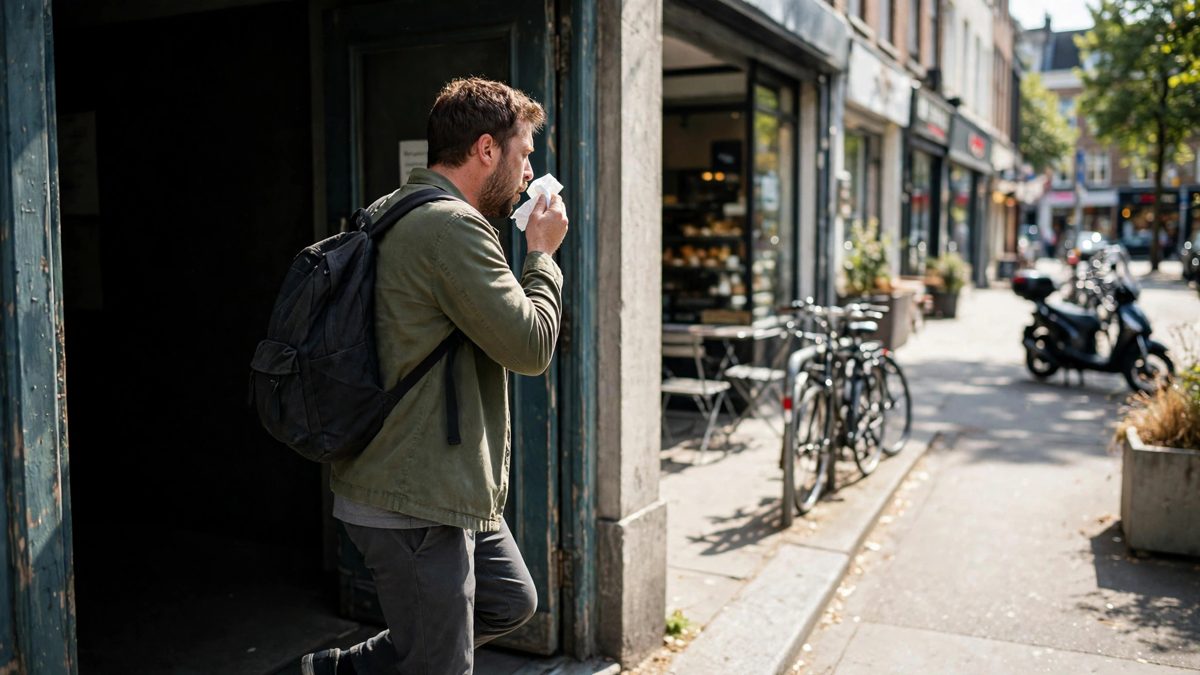
Some people cannot walk out of a dark building into bright sun without sneezing. Nothing is in their nose. Nothing is in the air. The light itself pulls the trigger, and it has been doing so, on the record, since Aristotle asked why looking at the sun makes people sneeze.
One person in four, roughly
The reflex has a formal name, the photic sneeze reflex, and a joke name scientists gave it themselves: ACHOO, for autosomal dominant compelling helio-ophthalmic outburst. A review in the Spanish neurology journal Neurologia, indexed by PubMed, describes sudden exposure to intense sunlight setting off long bursts of sneezing that the person cannot hold back.
Estimates of how many people carry it land between 18 and 35 percent. A British study indexed by the National Center for Biotechnology Information found sneezing on bright light in 25 percent of the sample it tested. The typical episode is short: one to three sneezes, a few seconds after the light hits, often the same count every time and the same count as other family members.
A coin flip inheritance
Family trees are what turned a curiosity into genetics. Doctors in the 1980s traced the reflex through several generations of the same families and found a dominant pattern: a parent who sun sneezes passes the trait to each child with about a 50 percent chance. A 1984 report in the New England Journal of Medicine documented one family across four generations, starting with a baby girl who sneezed twice every time she was carried into bright sunlight at four weeks old.
Modern genetics softened the simple story without breaking it. A genome wide study using 23andMe data, published in PLOS Genetics in 2010, linked the reflex to a DNA variant near a gene called ZEB2. A 2019 study of 3,417 people in China confirmed that link and found a second one. The trait is inherited, but more than one stretch of DNA seems to lean on the scale.
Crossed wires is the leading idea
Why would an eye reflex end in the nose? The mechanism is still not proven, and honest reviews say so. The leading idea is crossed signalling. Bright light makes the pupil constrict, driven by nerves that run close to the trigeminal nerve, the nerve that controls sneezing when the nose is irritated. In sun sneezers, a strong light signal may spill into the neighbouring sneeze circuit and fire it by mistake. A change in brightness is the trigger, not any single colour of light, which is why tunnels, cinemas and doorways set it off.
The reflex is harmless for most people. It matters where a sneeze at the wrong second costs control: drivers leaving tunnels and pilots facing low sun are the standard examples in the medical write-ups. Sunglasses that cut the sudden jump in brightness prevent it for many carriers.
So the next time someone sneezes at the cinema door, blame wiring, not allergies. About a quarter of the people around them carry the same wiring. Most just have not stepped into the light yet.