
Whipped Egg Whites Hold Peaks Because Their Proteins Unfold and Wrap Every Bubble
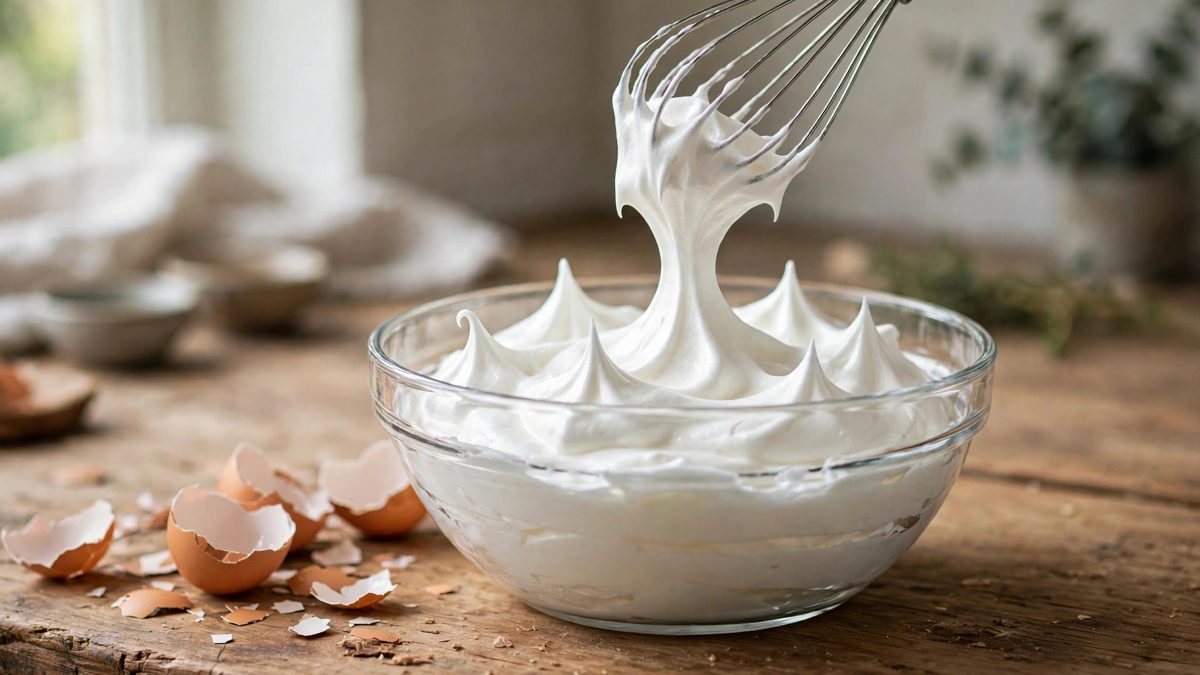
An egg white is about 90 percent water and 10 percent protein, with almost no fat. Beating unfolds those proteins so they line each air bubble like a skin, and the bubbles stack into a foam stiff enough to stand in peaks.
Key points
- A raw egg white is a clear, slippery liquid.
- Try to whip plain water and the bubbles pop at once.
- Beating does two jobs at once.
A raw egg white is a clear, slippery liquid. Beat it for two minutes and it turns into a white foam stiff enough to hold a peak upside down. Nothing was added. The change is architecture: air, water and protein rebuilt into a structure that plain water could never hold.
Water cannot foam, egg white can
Try to whip plain water and the bubbles pop at once. The Exploratorium, the San Francisco science museum, explains why in its Science of Cooking series on eggs. Water molecules cling to each other too tightly to spread into the thin film a bubble needs. Egg white solves the problem because it is about 90 percent water and 10 percent protein. Those proteins are long chains of amino acids, folded and curled into loose balls.
Beating does two jobs at once. The whisk forces air in as bubbles, and the beating pulls the protein chains open. Unfolding is called denaturing, and it exposes what was hidden inside the curl: some amino acids love water and some fear it. The water fearing parts flee the liquid and point into the air of the bubble, while the water loving parts stay in the liquid. Every bubble ends up wrapped in a coat of protein, water side in, air side out.
From coat to network
A coat alone would still drain and pop. The foam holds because the unfolded proteins also link to each other, building a network across the bubble walls. The Exploratorium notes that some egg proteins form bonds that create this stable web, and that when the foam is baked, another protein, ovalbumin, forms the bonds that set a meringue firm. That is why a souffle rises and then keeps its shape instead of sighing back into the dish.
The stages cooks name are the network tightening in plain sight. Soft peaks slump because the web is loose. Stiff peaks stand because the web is dense. Beat past that point and the proteins clump too tightly, squeeze out water, and the foam turns grainy and weeps. Overbeaten foam cannot be rescued, only started again.
Fat is the saboteur, acid is the guard
One rule of meringue making has a chemical address. Fat breaks the system. Even a speck of yolk, which is rich in fat, or a greasy bowl keeps proteins from coating bubbles cleanly, and the foam stays flat. The Chicago section of the American Chemical Society gives the second classic rule its chemistry: in a copper bowl, copper ions leave the metal and bind to an egg protein called conalbumin, also known as ovotransferrin. That copper complex is more stable, so the proteins unfold more slowly and the foam is harder to overbeat. Cream of tartar, an acid, guards the foam a different way, making overbeating damage less likely, as the Exploratorium describes.
Two kitchen habits now read as pure chemistry. Room temperature whites foam more easily than cold ones, because their proteins unfold more readily. And sugar added at the start can double the whipping time, the Exploratorium warns, so bakers beat the foam first and add sugar once the structure exists.
The peak on the whisk is not a trick of thickness. It is millions of bubbles, each one wrapped in unfolded protein, locked together in a web. You are not beating egg white into foam. You are persuading its proteins to build one.