
Who Are Serbia's Student List? The Protest Winners Explained
They have no party machine and no single leader, but they hold a projected 140 seats. How a movement born after the Novi Sad station collapse won Serbia, and what forming a government will demand of it.
Key points
- Serbia woke up Monday with a winner that has no party headquarters, no leader on the ballot posters, and no machine to run a state.
- So who are they, and what do they do now?
- The movement started with a disaster.
Serbia woke up Monday with a winner that has no party headquarters, no leader on the ballot posters, and no machine to run a state. The Student List, born in protest camps and university faculties, won Sunday's snap parliamentary election. President Aleksandar Vucic, in power since 2014, conceded in plain words: "It is clear that we have lost these elections, the Student List has won, they will have between 135 and 140 seats and we will have 105, no one else has entered parliament."
So who are they, and what do they do now? Those are the two questions Serbian voters, and the European Union, are asking this week.
Where the Student List came from
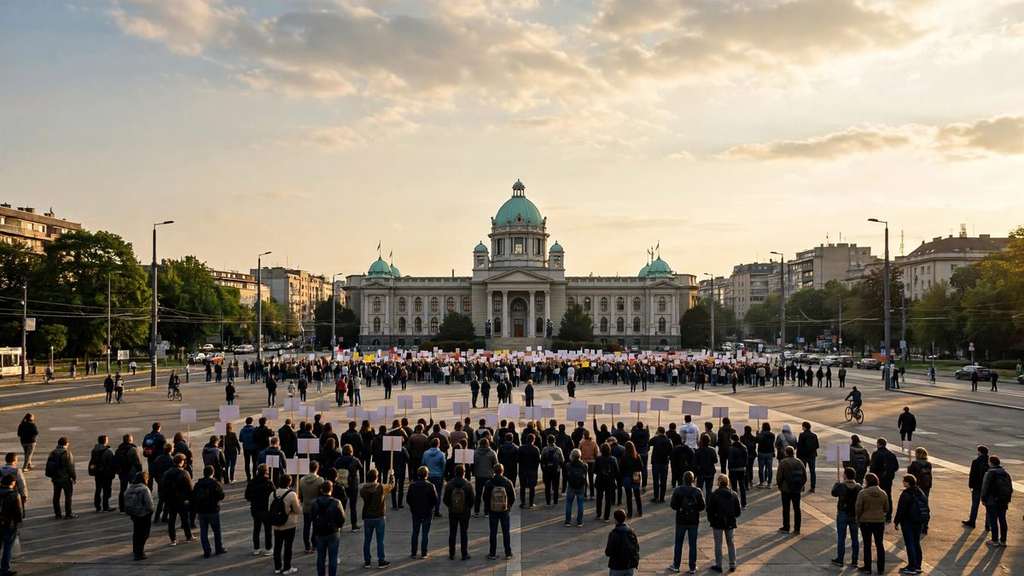
The movement started with a disaster. In 2024, a railway station canopy in Novi Sad collapsed and killed 16 people. Students led the protests that followed. The first demand was accountability: who signed off on the station work, and who would answer for the deaths. Over nearly two years the protests widened. Corruption, captured institutions and media pressure became the targets. The demand grew from answers about one station to a new election.
That origin explains the shape of the list. It is not a party built around one personality. It grew campus by campus and town by town, through assemblies and protest networks. Its public face has been collective, which protected it during the campaign and now complicates the work of governing.
What the numbers say
The CeSID-Ipsos projection, based on 96 percent of its sample of polling stations, put the Student List at 52.9 percent of the vote and about 140 seats. United Serbia, the bloc around Vucic, took 38.8 percent and about 103 seats in the 250-seat parliament. Turnout was near 70 percent, reported as the highest since Yugoslavia broke up. A majority needs 126 seats. On the projection, the Student List clears that line on its own, with room to spare.
The context
Vucic has dominated Serbian politics since 2014, first as prime minister and then as president. His Serbian Progressive Party controlled the government, most major media access and the state institutions the protesters accused of failing over Novi Sad. Sunday's result ends that run. It also leaves the new majority with a state built by the people it campaigned against.
Europe reacted within hours. European Commission President Ursula von der Leyen congratulated the Student List and offered EU support on rule of law, media freedom and anti-corruption. Alain Berset of the Council of Europe sent a similar congratulation. Those three topics are not random praise. They are the exact tests Brussels will apply to the new government.
What happens next
Forming a government comes first. The list must agree on a prime minister, a cabinet and a program, then pass them through the parliament it now controls. The early choices to watch are the justice and interior portfolios, because the movement's founding promise was accountability for Novi Sad. An investigation that reaches real names would prove the change is structural. A slow or quiet inquiry would raise the opposite question.
Money and media come next. A new government inherits budgets, state companies and public broadcasters shaped by 12 years of one-party rule. Changing editors and boards is fast. Changing how institutions behave takes longer, and it is where protest movements often lose their early support.
The EU path is the third test. Serbia's accession talks have been stuck for years over rule of law and media freedom, the same ground von der Leyen named in her message. A government that moves on those files can unlock real progress. One that stalls will hear the offer cool.
Why it matters
For ordinary Serbians, the change is concrete: courts, police and public media may start answering to new people, and the Novi Sad case becomes the measure of whether Sunday meant anything. For the region, Serbia is the largest state in the western Balkans, and a government formed by a protest movement is new ground. For Europe, the result offers a partner that asked for the EU's own standards, and a risk if delivery fails.
The movement won by being united against something. Governing asks it to be united for specific things, on a clock, with a state to run from the first morning.
Timeline
- Nov 1, 2024A railway station canopy collapses in Novi Sad, killing 16 people. Protests follow.
- Oct 25, 2026Serbia votes in a snap parliamentary election after nearly two years of protests.
- Oct 25, 2026Vucic concedes defeat. The CeSID-Ipsos projection gives the Student List about 140 seats.