
Seahorse Fathers Carry the Babies, Not the Mothers
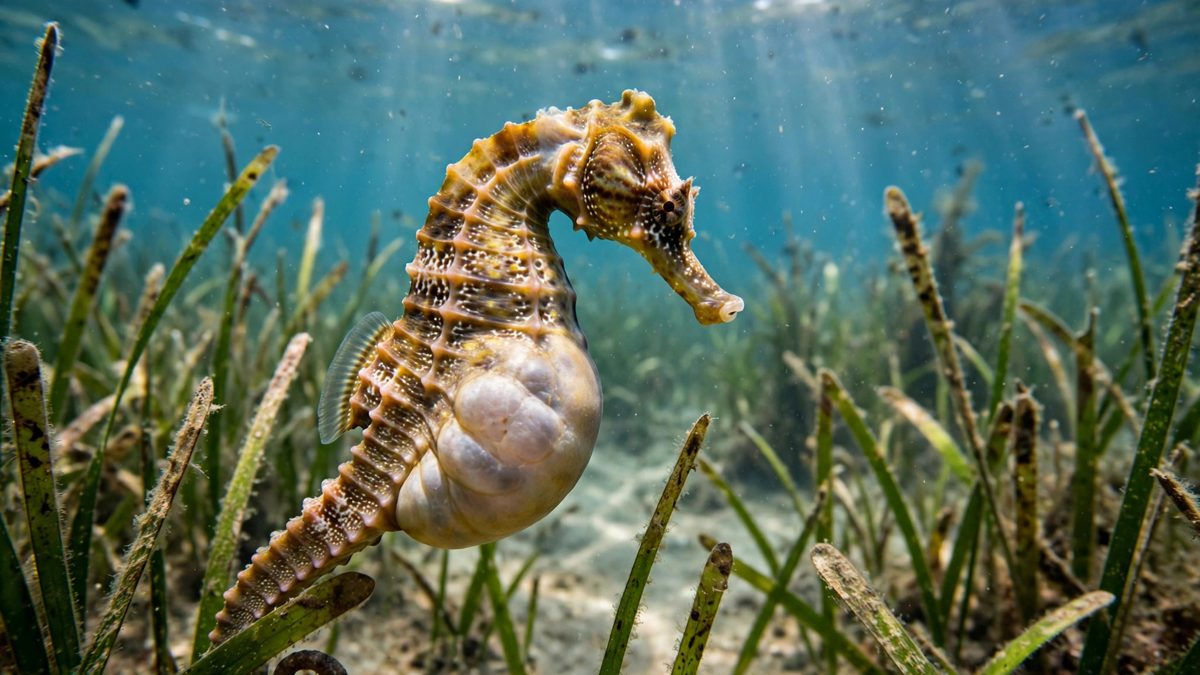
In seahorses the male gets pregnant. The female places her eggs in his brood pouch, he fertilises them there, carries them for weeks, and gives birth to fully formed young.
Key points
- In the seahorse family, the father is the one who gets pregnant.
- The brood pouch sits on the front of the male's abdomen.
- The father does more than hold them.
In the seahorse family, the father is the one who gets pregnant. The female transfers her eggs into a special pouch on the male's body. He fertilises the eggs inside that pouch, carries the young while they grow, and then pushes out live baby seahorses, fully formed and ready to swim. NOAA calls male pregnancy in seahorses and sea dragons a unique adaptation in the animal kingdom.
A pouch that works like a womb
The brood pouch sits on the front of the male's abdomen. After a courtship dance that can run for hours or days, the female places her mature eggs into the pouch. The eggs settle into its wall, and fluid in the pouch feeds them and supplies oxygen while they develop.
The father does more than hold them. National Geographic reports that he regulates the water salinity inside the pouch as the young grow, tuning it toward sea water so the babies are ready for the ocean on the day they leave. The pouch, in effect, runs a small nursery with controlled conditions, built into the father's own body.
Hundreds of babies, almost no survivors
A pregnancy usually lasts two to four weeks, depending on the species. At the end, the male's abdomen ripples and strong contractions eject the young, from a few dozen to as many as 1,000 fully formed baby seahorses in NOAA's count. Some species carry even more in a single pouch.
Then the care stops. The newborns must fend for themselves from the first minute, and NOAA puts survival to adulthood at about 0.5 percent. The huge litter is the strategy. The father produces numbers on a scale that lets a tiny fraction survive, and the mother, freed from carrying the brood, can prepare the next batch of eggs while he is pregnant.
Why evolution flipped the job
Seahorses and their relatives, the pipefish and sea dragons, are the only animals known where the male carries the pregnancy this way. One reading of the system is speed. While the male carries one brood, the female can build the next, so the pair produces young faster than a system where she does both jobs in sequence.
The seahorse also breaks a rule people assume is fixed. Pregnancy looks like a female job across almost all of nature. Here it is male work, complete with a pouch that feeds, oxygenates and prepares the young. The shape of the family follows the plumbing, not the assumption.