
The Sahara Desert Feeds the Amazon Rainforest With Dust From a Dead Lake
About 27.7 million tons of Saharan dust land on the Amazon each year. It carries roughly 22,000 tons of phosphorus, close to what the rainforest loses to rain and floods.
Key points
- The largest hot desert on Earth feeds the largest rainforest on Earth.
- NASA measured the flow with its CALIPSO satellite, which used laser pulses to scan the atmosphere from 2007 to 2013.
- About 182 million tons of dust leave the Sahara each year.
The largest hot desert on Earth feeds the largest rainforest on Earth. Every year, wind lifts dust from the Sahara, carries it across the Atlantic Ocean, and drops it on the Amazon basin in South America.
NASA measured the flow with its CALIPSO satellite, which used laser pulses to scan the atmosphere from 2007 to 2013. The team, led by atmospheric scientist Hongbin Yu of the University of Maryland and NASA Goddard Space Flight Center, published the results in Geophysical Research Letters in 2015. It was the first multiyear satellite count of the trip.
The numbers cross an ocean
About 182 million tons of dust leave the Sahara each year. Most of it falls back to Earth along the way. About 27.7 million tons settle over the Amazon basin. Mixed into that dust is a small share of phosphorus, about 0.08 percent of the load. Small share, big total: roughly 22,000 tons of phosphorus a year.
That number matters because of what it matches. Yu and his co-authors estimated that the Amazon loses about the same amount of phosphorus each year to rain and flooding. Rivers wash the nutrient out of the soil and carry it away. The desert dust puts it back.
Why the rainforest is hungry
The Amazon looks rich. Its soils are not. Heavy rain has washed through them for a very long time, and phosphorus, a nutrient plants need to grow, is in short supply across much of the basin. The forest recycles what it has with great care. Fallen leaves rot and feed new growth. But recycling cannot replace what the rivers remove. Without a steady supply from outside, the forest would slowly run short of the nutrient that limits its growth.
The dust comes from a lake that died
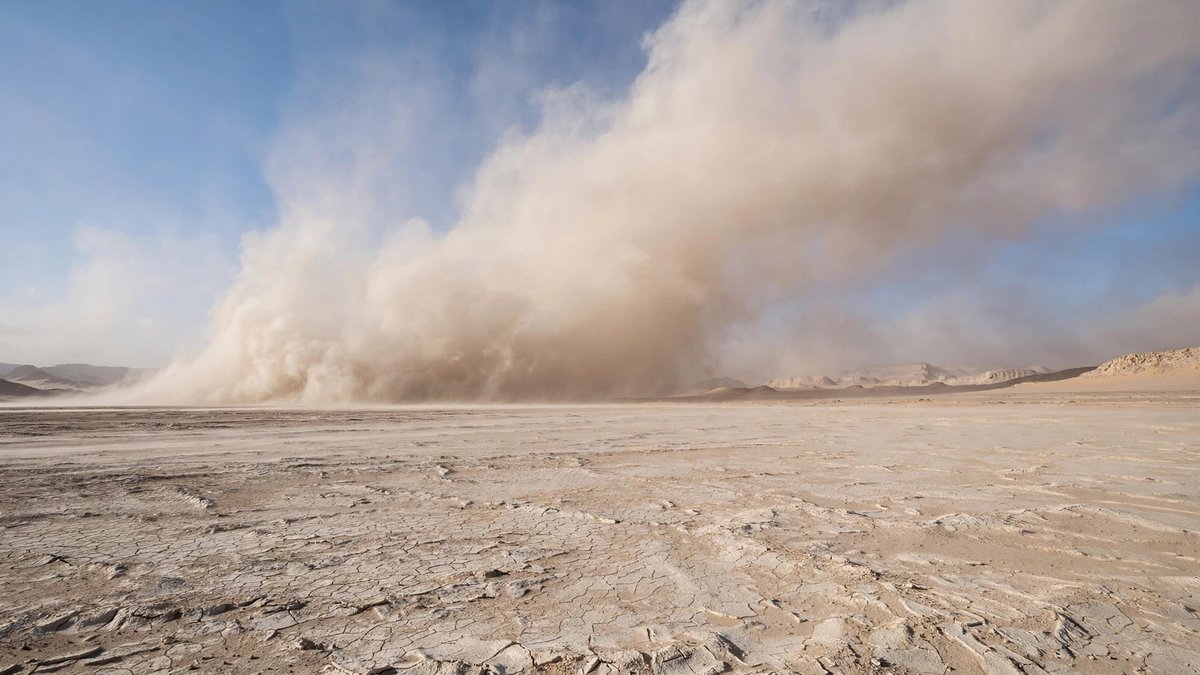
The richest source is not a dune field. It is a dry lakebed in northern Chad called the Bodele Depression. Thousands of years ago this basin held part of Lake Mega-Chad, a huge freshwater lake. The lake shrank and dried. It left behind sediment packed with the remains of tiny freshwater organisms called diatoms. Those remains are rich in phosphorus. The Bodele is now one of the most active dust sources on the planet, and its pale floor is the start of the supply line.
Wind does the rest. Storms lift the fine sediment. High air currents carry it west over the Atlantic, a crossing of thousands of miles, and rain and gravity bring part of it down over the forest.
A supply line that swings
The flow is not steady. NASA found that dust transport changed by as much as 86 percent between 2007 and 2011, and the yearly amount tracks rainfall in the Sahel, the dry belt south of the Sahara. A wet year there holds the dust down. A dry year lets more of it fly. Scientists watch the link for that reason. A shift in African rainfall can reach, years later, into the health of a forest on another continent.
So the picture most people carry is wrong in a useful way. The desert is not the opposite of the rainforest. It is one of its suppliers, and the goods it ships are the ground-up remains of a lake that vanished thousands of years ago.