
Rats Laugh When Tickled, and You Cannot Hear It
Tickle a young rat and it answers with 50 kilohertz chirps, far above human hearing. Researchers read those chirps as a sign of a positive mood, close in function to laughter.
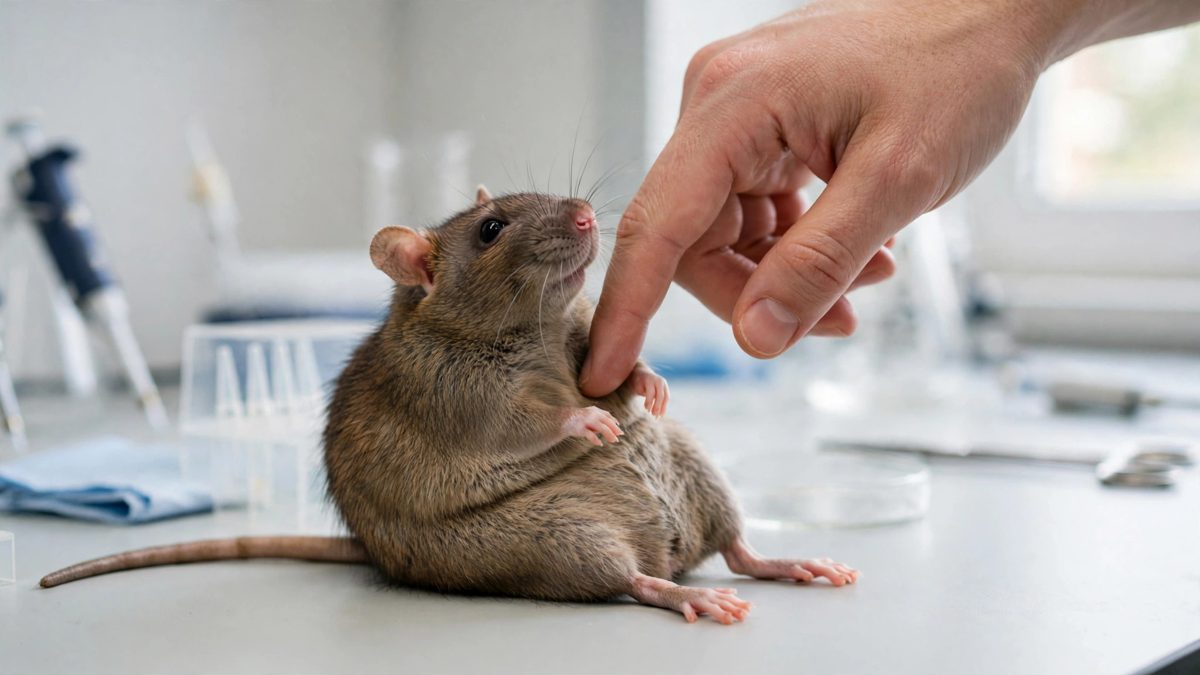
Key points
- Tickle a young rat in the right spot and it laughs.
- Rats talk in ultrasound.
- Tickling pushes the play call to its peak.
Tickle a young rat in the right spot and it laughs. You will not hear a thing. The sound sits at about 50 kilohertz, far above the top of human hearing, and it takes a special microphone to catch it. Rats make the same high chirps when they play with each other, and scientists who study animal emotion treat the sound as one of the clearest signs of a good mood in a lab animal.
A laugh at 50 kilohertz
Rats talk in ultrasound. A frightened or hurt rat calls at about 22 kilohertz, a long low tone for a rodent. A rat at play calls at about 50 kilohertz, in short bright bursts. The American Museum of Natural History lays out the split plainly: the 22 kilohertz call marks a threat, pain or a predator nearby, while the 50 kilohertz call follows a positive event such as play or mating.
Tickling pushes the play call to its peak. In work published in Behavioural Brain Research in 2000, Jaak Panksepp and Jeffrey Burgdorf measured 50 kilohertz chirps in young rats during rough and tumble play and during gentle tickling by a human hand. The tickled rats chirped at high rates. Rats kept alone chirped the most and learned fast to work for more tickling, pressing toward the hand that had tickled them before.
Why researchers take it seriously
A chirp is not proof of joy on its own. What makes the case stronger is the pattern around it. The chirps rise before play, as if the rat expects fun. They fall when a bright light startles the animal or when the smell of a predator reaches the cage. Fear shuts the sound off. Play turns it back on.
Later work linked the chirps to how rats judge the world. Rats tickled before a test treated an unclear tone as good news more often than handled rats did. The team behind that study described the tickled rats as more optimistic, and used the 50 kilohertz calls as the measure of the mood that came first.
What it changes in the lab
The finding gave animal research a practical tool. A handler can now score a rat's state by listening on an ultrasonic microphone instead of guessing from body language alone. Housing, handling and new test setups can be checked against the chirps. If the play calls drop, something in the setup is costing the animals, even when they look fine to a human eye.
It also reframes a familiar scene. A child tickling a pet rat is not just playing at a human game. The rat answers in its own register, at a pitch our ears were never built to hear, with the same call it uses for its own kind at play.