
The Platypus Glows Blue and Green Under Ultraviolet Light
The platypus was already the animal with a duck bill, a beaver tail and venom. In 2020 researchers shone ultraviolet light on museum specimens and the brown fur glowed blue and green. It was the first glow of its kind found in an egg laying mammal.
Key points
- Under ordinary light a platypus is plain brown.
- Paula Spaeth Anich of Northland College and her colleagues had already found that flying squirrels glow pink under ultraviolet light.
- All three glowed.
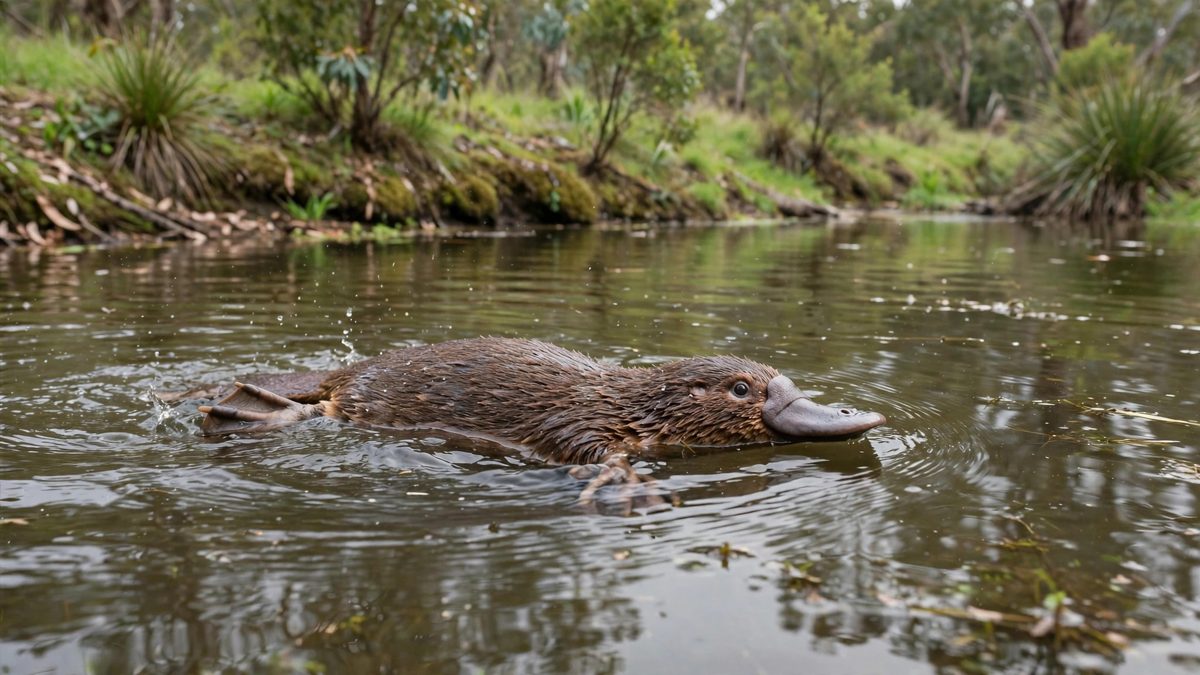
Under ordinary light a platypus is plain brown. Under ultraviolet light it glows blue and green. The animal did not change. The light did, and the fur answered in a colour nobody had recorded before 2020.
A museum drawer test
Paula Spaeth Anich of Northland College and her colleagues had already found that flying squirrels glow pink under ultraviolet light. Working in museum collections, they turned the same lamp on platypus specimens. The team examined three animals: a male and a female held by the Field Museum of Natural History in Chicago, and a second male held by the University of Nebraska State Museum.
All three glowed. The study, published in the journal Mammalia in 2020, reports that platypus fur absorbs ultraviolet light with wavelengths between 200 and 400 nanometres and re-emits it between 500 and 600 nanometres, the blue and green part of the spectrum people can see. Absorbing one colour and giving back another is called biofluorescence. It is not the same as making light: the glow stops when the lamp stops.
First among the egg layers
Biofluorescence was already known in two mammal groups. Opossums, which are marsupials, glow. Flying squirrels, which are placental mammals like us, glow pink. The platypus made it a clean sweep of the three great mammal lines. Monotremes, the egg laying mammals, split from the other lines about 150 million years ago, so the trait is either very old or it evolved more than once.
Both the male and the female specimens glowed with the same pattern and strength. That detail matters. A glow used to attract mates or signal sex would likely differ between males and females. This one does not, so the authors rule out the simplest mating story.
About the same time, an independent Australian report described a platypus killed on a road that also glowed under a black light. The glow is therefore not an artifact of old museum skins. It shows up in a fresh animal too, as Britannica notes in its summary of the work.
Why glow at all?
Nobody knows yet, and the paper says so plainly. One idea is camouflage by subtraction. Many predators see ultraviolet light well. Fur that absorbs ultraviolet and returns only a dim visible colour may make the animal harder to pick out at night, when the platypus feeds. The glow was strongest on the pale belly fur, which fits an absorption story better than a display story.
The honest limit is that all the evidence so far comes from lamps in dark rooms, most of it on specimens. The researchers themselves call for field work on wild animals before anyone claims a function. What is settled is the glow itself, measured on three specimens in two museums and matched by a fresh animal in Australia. The strangest mammal on Earth had one more strange trait, and it was hiding in light our eyes cannot see.