
This Shrimp Snaps a Bubble Into Existence That Reaches 5,000 Kelvin and Flashes With Light
A pistol shrimp no longer than your thumb fires a water jet so fast that the bubble it leaves behind collapses with a bang, a shock wave, and a tiny flash of light.
Key points
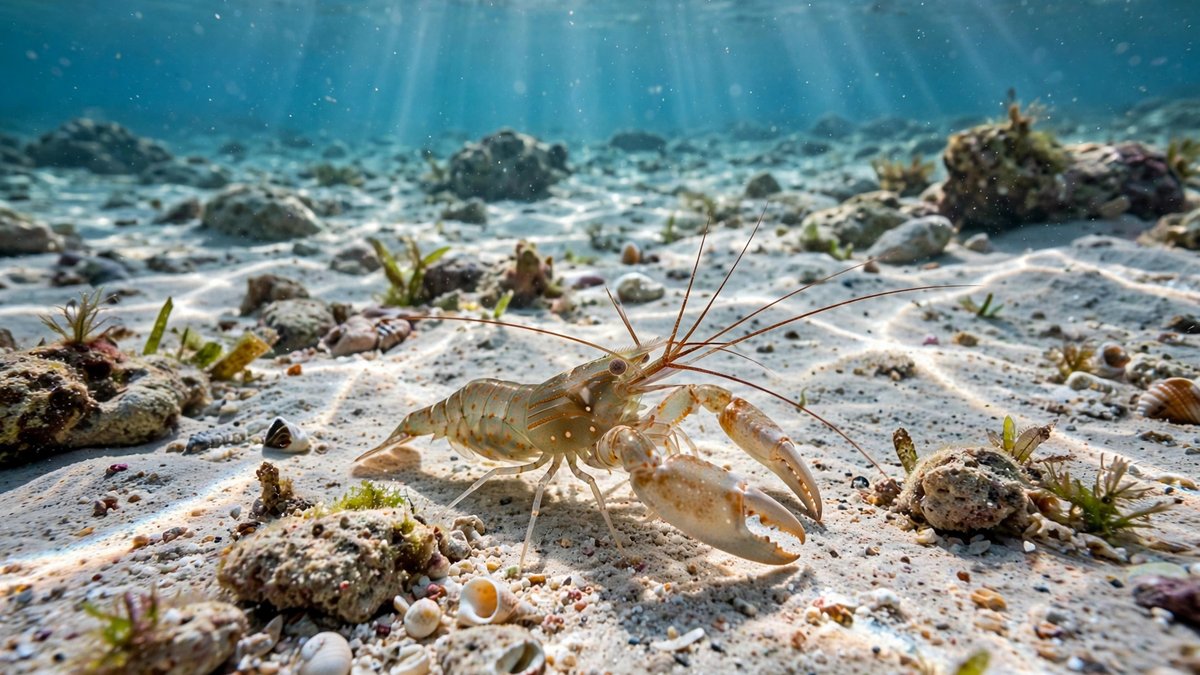
- A pistol shrimp is three to five centimetres long, and one of its claws is absurdly large.
- For decades, scientists assumed the crack came from the two parts of the claw striking each other.
- The claw works like a water pistol built into the body.
A pistol shrimp is three to five centimetres long, and one of its claws is absurdly large. When that claw snaps shut, it does not hit anything. It fires a jet of water so fast that a bubble forms, collapses, and goes off like a tiny charge. The collapse stuns prey, makes one of the loudest sounds on a reef, and for a split second heats the gas inside the bubble to at least 5,000 kelvin.
The sound is not the claw
For decades, scientists assumed the crack came from the two parts of the claw striking each other. High-speed cameras settled it in 2000. Michel Versluis, Detlef Lohse and colleagues at the University of Twente filmed a snapping shrimp at 40,000 frames per second and matched the pictures to underwater microphones. The sound arrives when a bubble collapses, not when the claw closes.
The claw works like a water pistol built into the body. A plunger-shaped part rams into a socket and drives out a jet of water at about 25 metres per second. The jet moves so fast that the pressure behind it drops below the point where water turns to vapour. A vapour-filled cavity opens in its wake. That is cavitation, the same effect that chews up ship propellers.
A bubble that bangs, shocks and glows
The cavity grows for a fraction of a millisecond, then the surrounding water crushes it. The collapse is violent and focused. It produces the sharp snap, which recordings place above 200 decibels measured in water, and a pressure pulse strong enough to stun or kill a small fish, worm or crab a few centimetres away. The shrimp then collects a meal it never had to touch.
In 2001, Lohse, Barbara Schmitz and Michel Versluis reported in Nature that the collapse also emits a short, intense flash of light. Light from a collapsing bubble is called sonoluminescence. The team dubbed the shrimp version shrimpoluminescence. A flash that bright implies extreme conditions at the centre of the collapse, with temperatures of at least 5,000 kelvin inside the bubble at the point of collapse. That is close to, but below, the roughly 5,772 kelvin at the surface of the Sun.
Why the shrimp is not cooked
The heat sounds impossible until the scale is clear. The hot region is smaller than a pinhead and lasts a tiny fraction of a second. The energy spreads into the surrounding water almost at once. The shrimp feels the shock wave it aimed, not a fireball. Nothing around it boils.
Colonies of snapping shrimp are so loud that their constant crackle fills tropical and temperate shallows around the world. During the Second World War, naval crews learned that shrimp beds could mask sonar, and the crackle is still part of the background noise scientists must filter out of ocean recordings. All of that noise comes from a claw, a jet of water, and a bubble that lives and dies in less than a millisecond.