
Peru Has a River That Runs Near Boiling, With No Volcano Anywhere Near It
The Shanay-timpishka in the Peruvian Amazon averages 86 degrees Celsius along its hot stretch. The nearest active volcano is about 700 kilometres away, so the heat has to come from somewhere else.
Key points
- Steam rises off this river in the middle of the rainforest.
- Geoscientist Andrés Ruzo heard about the river as a boy in Peru, in a story his grandfather told about Spanish conquerors and a river that boiled.
- His aunt told him she had been to the river herself.
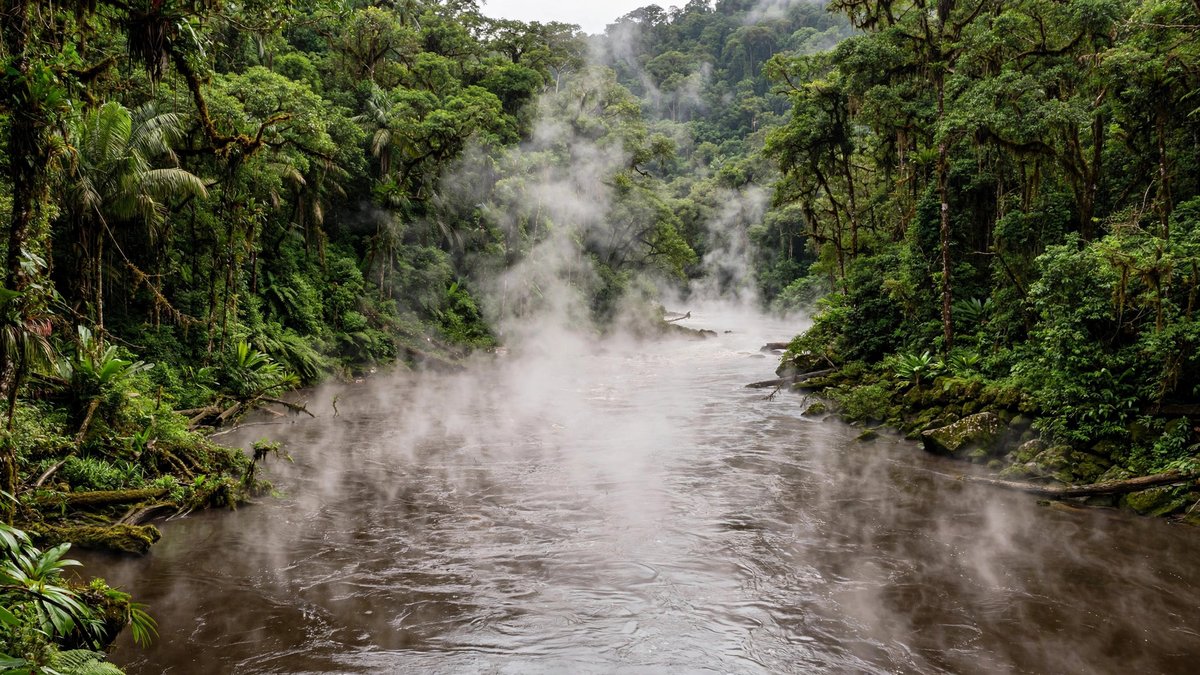
Steam rises off this river in the middle of the rainforest. Dip a thermometer in and the average reading is 86 degrees Celsius, or 187 degrees Fahrenheit. Small animals that fall in die in the water. The Shanay-timpishka, in the Peruvian Amazon, runs hot enough to cook for roughly four miles, and there is no volcano within about 700 kilometres to explain it.
A legend with a thermometer
Geoscientist Andrés Ruzo heard about the river as a boy in Peru, in a story his grandfather told about Spanish conquerors and a river that boiled. He filed it away as a legend. Years later, as a doctoral student at Southern Methodist University in Dallas working on a geothermal map of Peru, he asked experts about it. Geologists, mining companies and oil firms all gave the same answer. A river like that could not exist without a volcano nearby.
His aunt told him she had been to the river herself. In November 2011 Ruzo travelled into the jungle to the healing centre of Mayantuyacu, whose Asháninka healers guard the site. The shaman gave him permission to study the water, making him the first scientist granted that access. Ruzo picked his way along the bank in sandals with a thermometer. The legend was real.
How big, how hot
The river starts as an ordinary cold jungle stream, at about 27 degrees Celsius. Then it crosses a fault zone and changes character. Over a hot stretch of about 6.24 kilometres, hot springs feed the channel until the whole river steams. It runs up to about 25 metres wide in places. The average temperature Ruzo measured was 86 degrees Celsius. One hot spring on the river has read 99.1 degrees, a step below boiling at that altitude.
Ruzo has warned that a hand in the water can pick up second or third degree burns in seconds. Frogs and other small animals that slip in are cooked where they fall. The local name explains how it feels from the bank. Shanay-timpishka means boiled by the heat of the sun.
Where the heat actually comes from
The sun does not do it. Chemical tests on the water show it began as rain. The working explanation is a long underground loop. Rainwater seeps down through cracks and faults in the rock, in places kilometres deep. Rock gets hotter the deeper it sits, so the water heats as it travels. Pressure then pushes it back up along the faults, where it pours into the river through hot springs.
That makes the river a fault-fed hydrothermal system, not a volcanic one. National Geographic describes it as an entirely natural, non-volcanic geothermal feature flowing at unusually high rates. No magma chamber is known anywhere near it.
Why it matters now
The river is sacred to the Asháninka community at Mayantuyacu, and Ruzo founded the Boiling River Project to study it and to press for protection of the forest around it, which faces logging pressure. Scientists have also begun using the hot ground beside the river as a natural test site. The forest there already lives with heat the rest of the Amazon may face in a warming century, and a 2024 study in Global Change Biology used the site to watch how plants cope.
A river that should not exist turned out to be real, measurable and still only partly explained. The legend had the facts right for centuries. Science just had to catch up.