
Most Wasabi Is Not Wasabi. It Is Dyed Horseradish.
The green paste beside your sushi is, in most restaurants, horseradish mixed with mustard and colouring. Real wasabi is a rare mountain-stream plant that loses its flavour minutes after grating.
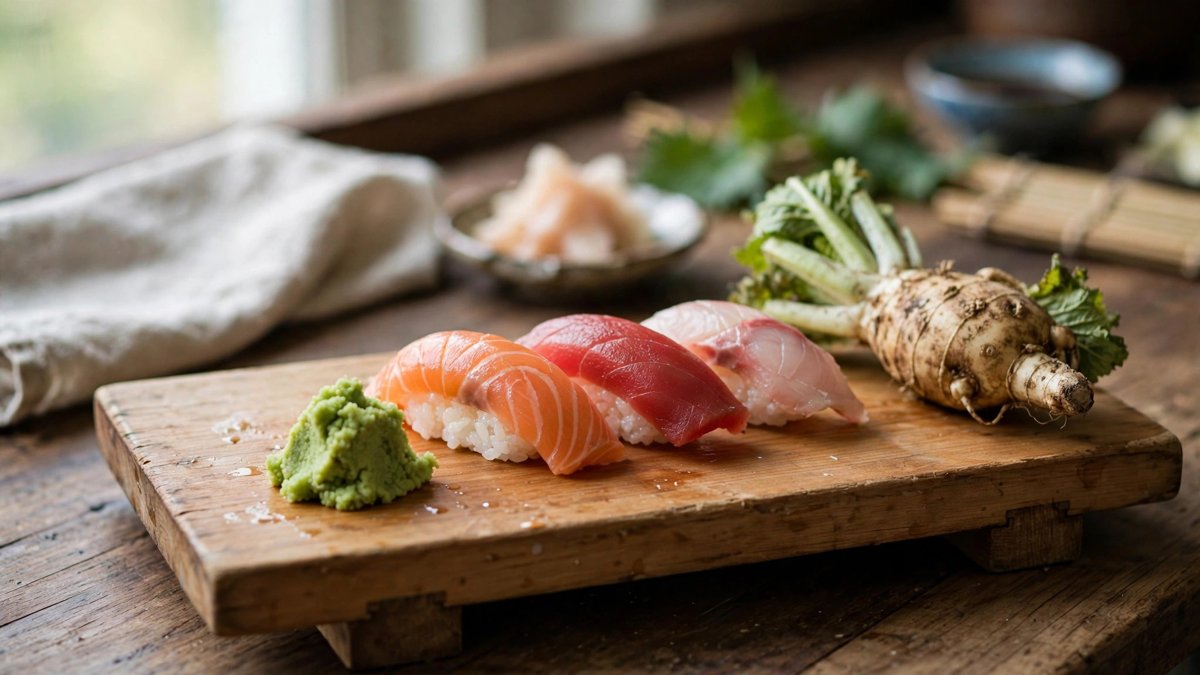
Key points
- The green paste on your sushi tray has a secret.
- Real wasabi comes from the rhizome of Wasabia japonica, also listed as Eutrema japonicum, a plant in the same cabbage family as horseradish and mustard.
- That slow, narrow way of growing explains the price.
The green paste on your sushi tray has a secret. In most restaurants, in most countries, it contains little or no wasabi at all. It is horseradish, sharpened with mustard, thickened with starch and dyed green.
What real wasabi actually is
Real wasabi comes from the rhizome of Wasabia japonica, also listed as Eutrema japonicum, a plant in the same cabbage family as horseradish and mustard. In Japan it is called hon-wasabi, true wasabi. In the wild it grows along cold mountain streams, and farmed wasabi is still raised in flowing spring water, shaded, in beds where the water temperature holds steady through the year. Growers in Shizuoka and other mountain regions tend plants for well over a year before a rhizome is ready to cut.
That slow, narrow way of growing explains the price. Specialist growers price fresh rhizomes in the range of hundreds of dollars per kilogram, which puts real wasabi among the most expensive vegetables in the world by weight. A single fresh rhizome can cost more than a case of the paste most restaurants use.
Why the substitute took over
Horseradish is wasabi's hardy cousin. It grows in ordinary fields across Europe and North America, stores well, and delivers a similar blast of heat up the nose. Both plants make their burn from the same family of chemicals, the isothiocyanates, released when the tissue is cut or grated. That shared chemistry is what makes the swap work on the tongue.
As sushi spread across North America and Europe in the 1980s and 1990s, restaurants needed a cheap, shelf-stable green paste, and Japan's small wasabi harvest could not supply it. The industry answer was a blend: ground horseradish as the base, mustard flour for extra burn, starch for body and green colouring to match the look. Industry and media estimates consistently put the imitation share of served wasabi above 90 percent outside Japan, and high inside Japan as well. Audited market data is thin, so treat the exact figure with care. The direction of the claim is not in doubt: the genuine rhizome is the rare exception on the plate, not the rule.
Japanese labels admit the split in fine print. Rules described by the Japan Processed Wasabi Association set two claims: a product marked as made with hon-wasabi must contain at least half real wasabi, while a lower claim marks products with some real wasabi but less than half. Many everyday tubes sit below both, horseradish first on the ingredient list. In Japan, horseradish even carries the nickname seiyo-wasabi, western wasabi.
A flavour that lasts minutes
Fresh wasabi is also at its best within minutes of grating. The sharp aroma fades fast once the rhizome is cut, which suits a sushi counter where a chef grates to order and fails any supply chain built on storage. Cooks who have had both describe the same contrast: real wasabi tastes aromatic and faintly sweet under a clean heat that clears quickly, while the horseradish paste hits harder, flatter and longer. A Tokyo sushi master quoted by AFP said he would never serve the imitation. His restaurant can charge for the real rhizome. Most cannot.
How to spot the real thing
Check the texture and the label. Freshly grated real wasabi looks slightly grainy and pale green, not smooth and neon. On a packaged product, read the ingredient order: if horseradish, mustard and colouring lead the list, it is the substitute, whatever the front of the tube shows. And if a full sushi meal is cheap, the economics have already made the decision. The paste is horseradish wearing green, and now you know why.