
A Mushroom Is More Closely Related to You Than to a Plant
Mushrooms grow out of the ground like plants, but DNA says fungi and animals are sister groups. You share a more recent ancestor with a mushroom than a mushroom shares with a tree.
Key points
- A mushroom sits still, grows out of the soil and never hunts anything, so for centuries it was filed with the plants.
- The mistake was reasonable.
- What fungi do is unlike plants in the way that counts most.
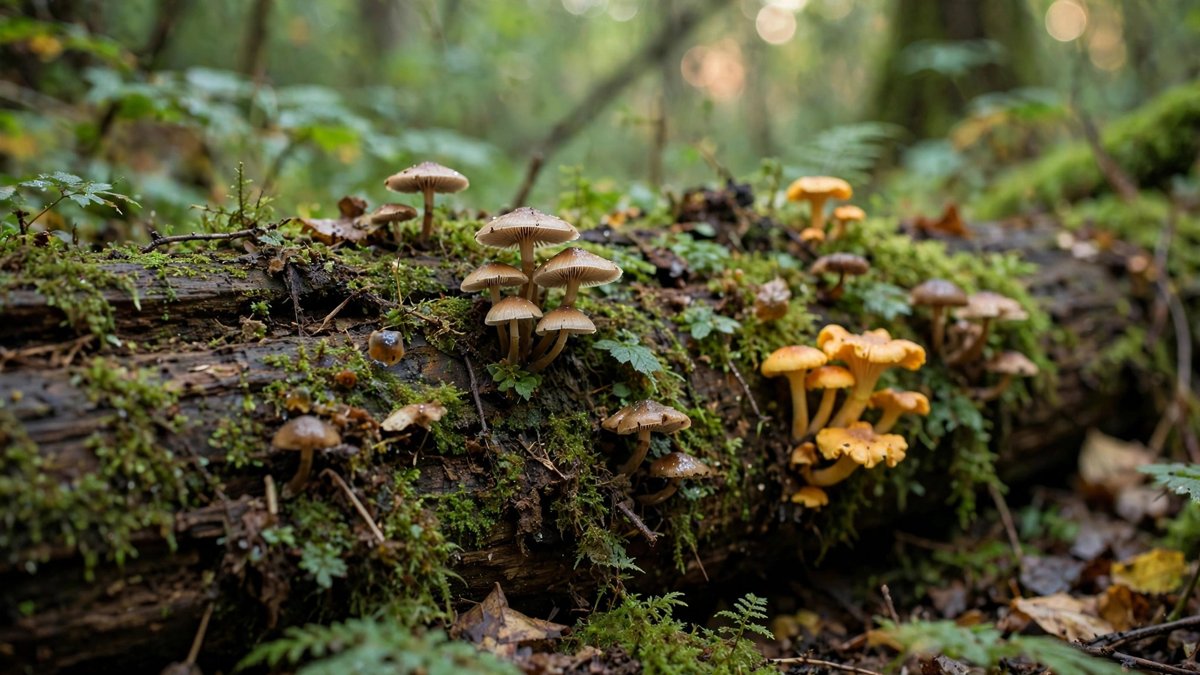
A mushroom sits still, grows out of the soil and never hunts anything, so for centuries it was filed with the plants. The DNA tells a different story. A mushroom is more closely related to you than it is to the tree it grows beside.
The old filing error
The mistake was reasonable. Fungi stay in one place, many grow upward from the ground, and early naturalists sorted living things by what they could see. Plants made one pile, animals made another, and fungi landed in the plant pile because they did not walk away.
What fungi do is unlike plants in the way that counts most. Plants build their own food from sunlight. Fungi cannot. A fungus feeds the way an animal does, by taking in food made by other living things. It digests dead wood, fallen leaves and other organic matter outside its body, by releasing enzymes and absorbing the result, then recycles the nutrients into the soil. No fungus photosynthesises. That single fact already puts fungi on the consumer side of the living world, with animals.
What 25 proteins said
The hard proof came from molecules. In a 1993 study published in the Proceedings of the National Academy of Sciences, Sandra Baldauf and Jeffrey Palmer compared the sequences of 25 proteins across plants, animals and fungi. Four small insertions and deletions in those proteins were shared by animals and fungi, and by none of the other groups tested. When they built family trees from four of the most widely sequenced proteins, actin, the two tubulins and elongation factor 1 alpha, every tree placed animals and fungi together as one group, with plants on a separate branch. The statistical support for the animal and fungus pairing ran at 93 to 96 percent in their tests.
Work at the Marine Biological Laboratory in Woods Hole, reported by New Scientist the same year, reached the same answer from ribosomal RNA: plants branched off first, and animals and fungi came later from a shared ancestor that resembled modern single-celled organisms called choanoflagellates.
A shared ancestor about a billion years back
Biologists now group animals and fungi together in a large branch of life called the Opisthokonta. The Royal Society journal Proceedings B describes the shared marks of the group, including a single rear-facing whip-like tail on their swimming cells and a distinctive flattened shape inside their mitochondria. Those details sound minor. They are the kind of deep structural traits that do not change by accident, and plants do not have them.
The split is old. The New Scientist report put the animal divergence at roughly a billion years ago, and the fungi and animal lines have been separate ever since. Separate is the point. A mushroom is not close to a human in any everyday sense. It is close in the family-tree sense: the last ancestor shared by fungi and animals lived long after the last ancestor shared by fungi and plants.
Why it matters beyond trivia
The kinship shows up in the laboratory. Because fungal cells work in ways that resemble animal cells more than plant cells, medicines that kill fungi can be hard on human cells too, which is one reason antifungal drugs are difficult to design. The same closeness helps researchers use simple fungi such as yeast as stand-ins for basic processes in animal cells.
So the next time a mushroom comes up through the leaf litter, the old picture needs one correction. It is not a strange kind of plant. It is a distant cousin on your own side of the family tree, running a body plan that parted from yours about a billion years ago and never looked back.
Sources
- PNAS: Animals and fungi are each other's closest relatives, congruent evidence from multiple proteins (Baldauf and Palmer, 1993)
- Proceedings of the Royal Society B: The opalozoan Apusomonas is related to the common ancestor of animals, fungi, and choanoflagellates
- New Scientist: Animals and fungi closer than anyone expected