
Lightning Can Turn Sand Into Glass, and the Tube Keeps the Shape of the Bolt
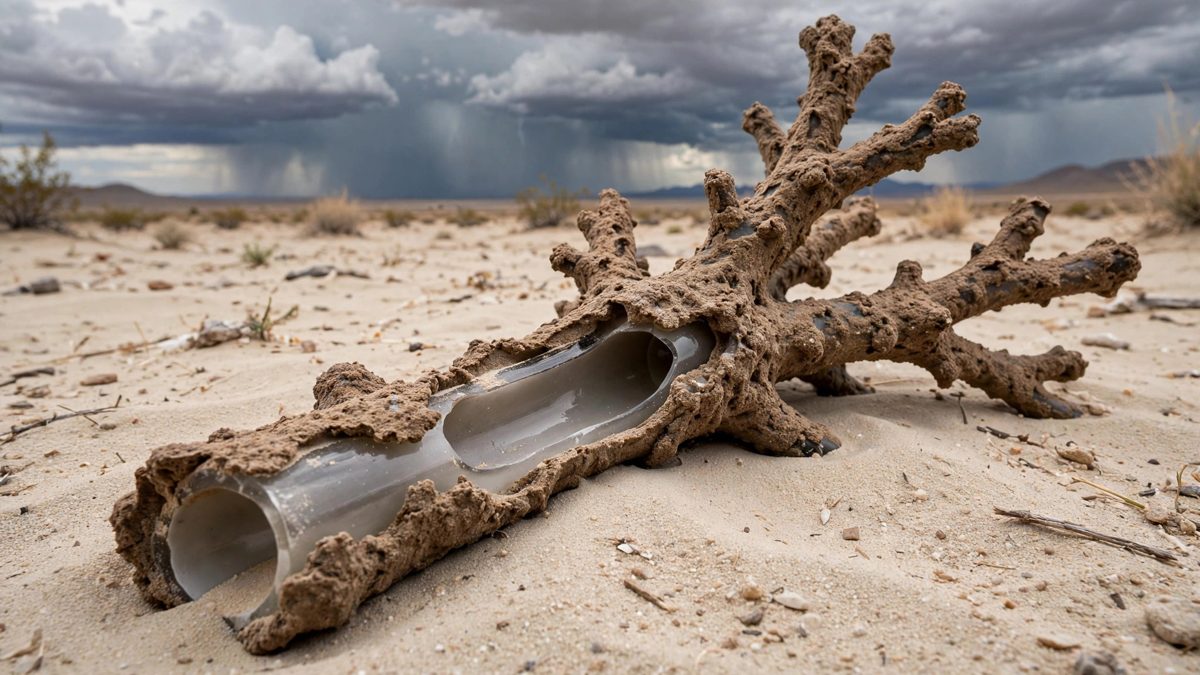
A strike melts a branching path through sand and leaves a hollow glass tube called a fulgurite. Museums hold them, scientists read the air trapped inside them.
Key points
- When lightning hits the right sand, it leaves a copy of itself behind in glass.
- The word comes from fulgur, the Latin word for thunderbolt.
- Sand is mostly silica, and silica melts at temperatures a lightning channel passes easily.
When lightning hits the right sand, it leaves a copy of itself behind in glass. The bolt melts a narrow path through the ground, and the melted sand cools into a hollow, branching tube called a fulgurite. Dig one up and you are holding the shape of a single strike.
The word comes from fulgur, the Latin word for thunderbolt. Museums Victoria, which holds one of the longest fulgurites found in the Australian state of Victoria, describes the same process: an intense strike on the right sandy surface partly melts and fuses grains of sand as the charge enters the earth, and leaves glassy, irregular branching tubes behind.
Hot enough to melt stone ground down to sand
Sand is mostly silica, and silica melts at temperatures a lightning channel passes easily. The Weather Guys, a long running science column from the University of Wisconsin Madison, explain that the bolt vaporizes the material at its core and heats the sand around it until the grains fuse, which leaves a tube lined with smooth glass on the inside and rough, sandy crust on the outside.
That structure is the tell. The inside of a fulgurite is hollow and glassy because the strike blasted and melted a channel. The outside is gritty because grains further from the channel only partly fused and stuck to the wall. The finished tube follows the path the charge took through the ground, forks included, which is why fulgurites look like glass roots or frozen branches of the bolt itself.
A specimen that took 220 pieces to rebuild
The Karnak fulgurite, found in 1959 in sandhills in western Victoria, ran more than five feet long. It was so brittle that it reached Museums Victoria in fragments, and conservators counted more than 220 pieces in storage before a 2016 project rebuilt it. The museum calls fulgurites among the most difficult items in its care, because the walls are thin and the glass breaks under its own handling.
Most fulgurites never get that treatment because most are small. The Wisconsin column notes that tubes can run longer than 10 feet, but most measure a few inches. Texas Parks and Wildlife rangers at Monahans Sandhills State Park describe the same find at ground level: strange lumps rising out of the dunes that turned out to be glass tubes left by strikes.
Why scientists keep them
A fulgurite is more than a curiosity. The glass traps tiny bubbles of the air that was in the ground when the strike hit. The Wisconsin researchers note that old fulgurites can be used to study the composition of air in ancient times, because those bubbles were sealed in the moment the sand melted.
So the next storm leaves more behind than noise and light. On the right patch of sand, it leaves a fragile glass cast of the bolt, buried where it struck, waiting for someone to dig carefully.