
Ketchup Began as a Fermented Fish Sauce With No Tomatoes at All
The red sauce on fries started as ke-tsiap, a dark fermented fish sauce from southern China and Southeast Asia. Tomatoes did not enter the recipe until 1812.
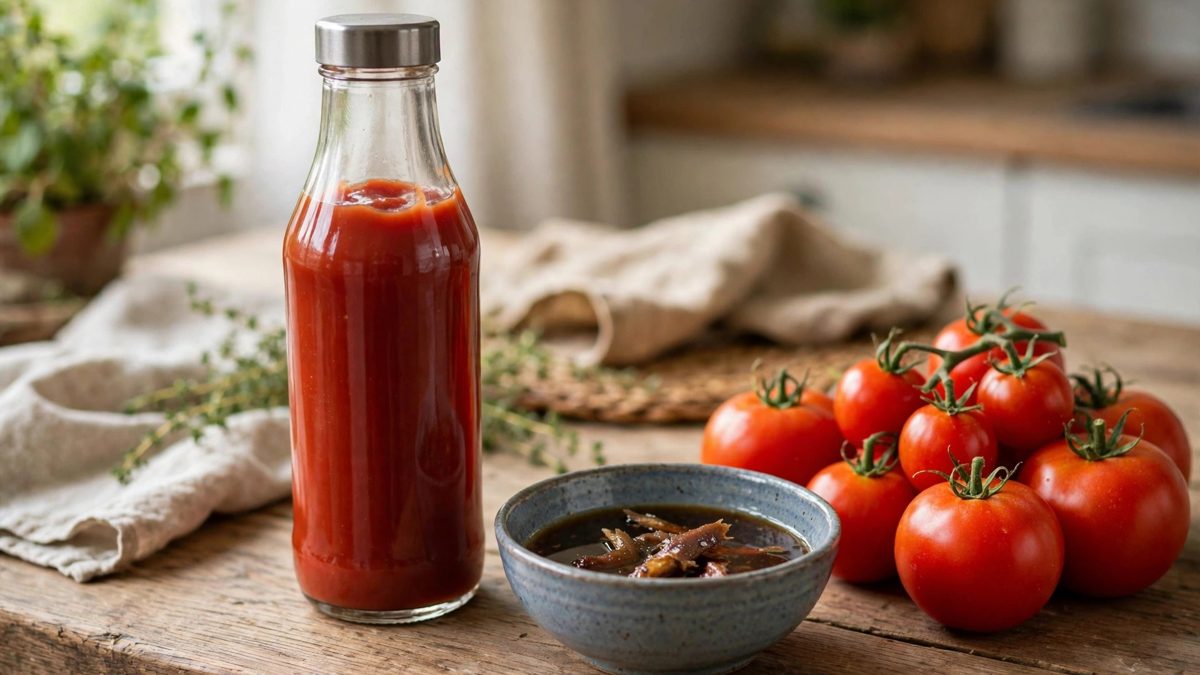
Key points
- The first ketchup had no tomatoes, no sugar, and nothing red about it.
- Its name tells the story.
- Back in Britain, cooks tried to copy the imported sauce with what they had.
The first ketchup had no tomatoes, no sugar, and nothing red about it. It was a dark, salty, fermented fish sauce, built to survive long sea voyages and to wake up bland ship food.
Its name tells the story. Traders in southern China and Southeast Asia sold sauces called ke-tsiap or koe-cheup, made from fermented fish. British sailors met the sauce in the 1600s and 1700s, liked its deep savory taste, and carried it home.
A name that covered many sauces
Back in Britain, cooks tried to copy the imported sauce with what they had. They used mushrooms, walnuts, oysters, and anchovies. For a long stretch, the word ketchup meant almost any dark, salty, bottled sauce, not one fixed recipe. Mushroom ketchup was a standard kitchen item, and cookbooks of the early 1800s carried several kinds of ketchup side by side.
The taste they chased has a name now: umami. Fermented fish is rich in glutamic acid, the compound behind that savory depth. That is why so many substitutes worked. Mushrooms and anchovies carry savory compounds of their own, so a cook far from Southeast Asia could still land close to the original flavor.
The tomato arrives late
Tomatoes came to Europe from the Americas, and many people long treated them with suspicion. They only joined ketchup in the 1800s. In 1812, James Mease, a Philadelphia physician, published the first known tomato ketchup recipe, using tomato pulp, spices, and brandy. An early British tomato version in 1817 still mixed tomatoes with anchovies and shallots, a clear bridge between the fish sauce past and the tomato future.
Tomatoes fit the job for a chemical reason. They are rich in glutamates, the same family of compounds that made fish sauce taste so deep. The new sauce kept the old one's savory punch while turning red, thick, and sweet-sour.
Bottles made it American
Tomato ketchup became a mass product once it went into bottles. Henry J. Heinz began selling his version in 1876, and his company later pushed a recipe built on ripe tomatoes and more vinegar instead of chemical preservatives. Shelf-stable bottles turned a shifting family of sauces into one standard red sauce, and that sauce spread with burgers and fries around the world.
So the bottle in the fridge is a layered invention. The name and the savory idea came from fermented fish sauce in Asia. The copies came from British kitchens. The tomato, the bottle, and the standard recipe came from the United States. Every squeeze carries all three stops.