
Japan Launches the First Mission to Bring Back Samples From a Mars Moon
The uncrewed MMX spacecraft lifted off from Tanegashima before dawn on Tuesday, bound for Phobos. It aims to collect at least 10 grams of material and return it to Earth in 2031, a first for the Mars system.
Key points
- Japan launched an uncrewed spacecraft toward Phobos, the larger of the two moons of Mars, before dawn on Tuesday.
- If the mission succeeds, MMX will be the first spacecraft to collect samples from Phobos and return them to Earth.
- The launch was also a first for the rocket.
Japan launched an uncrewed spacecraft toward Phobos, the larger of the two moons of Mars, before dawn on Tuesday. The Martian Moons eXploration spacecraft, known as MMX, lifted off at 4:41 a.m. local time on Oct 20, 2026, aboard an H3 rocket from the Tanegashima Space Center in southwestern Japan. The Japan Aerospace Exploration Agency, JAXA, said the rocket flew as planned and the spacecraft separated from it about 71 minutes later, on its path to Mars.
A first for the Mars system
If the mission succeeds, MMX will be the first spacecraft to collect samples from Phobos and return them to Earth. Reuters reported that JAXA aims to collect at least 10 grams of material from the surface. Scientific American reported that MMX will also be the first spacecraft to enter orbit around Phobos. The European Space Agency, one of the partners on the mission, says samples studied in labs on Earth can answer questions that no camera or instrument in space can settle on its own.
The launch was also a first for the rocket. Reuters said it marked the first interplanetary mission for Japan's H3, the country's flagship launcher. The H3 failed on its first flight in 2023, when its second stage engine did not ignite. It has since completed a series of mostly successful launches.
Why scientists want a piece of Phobos
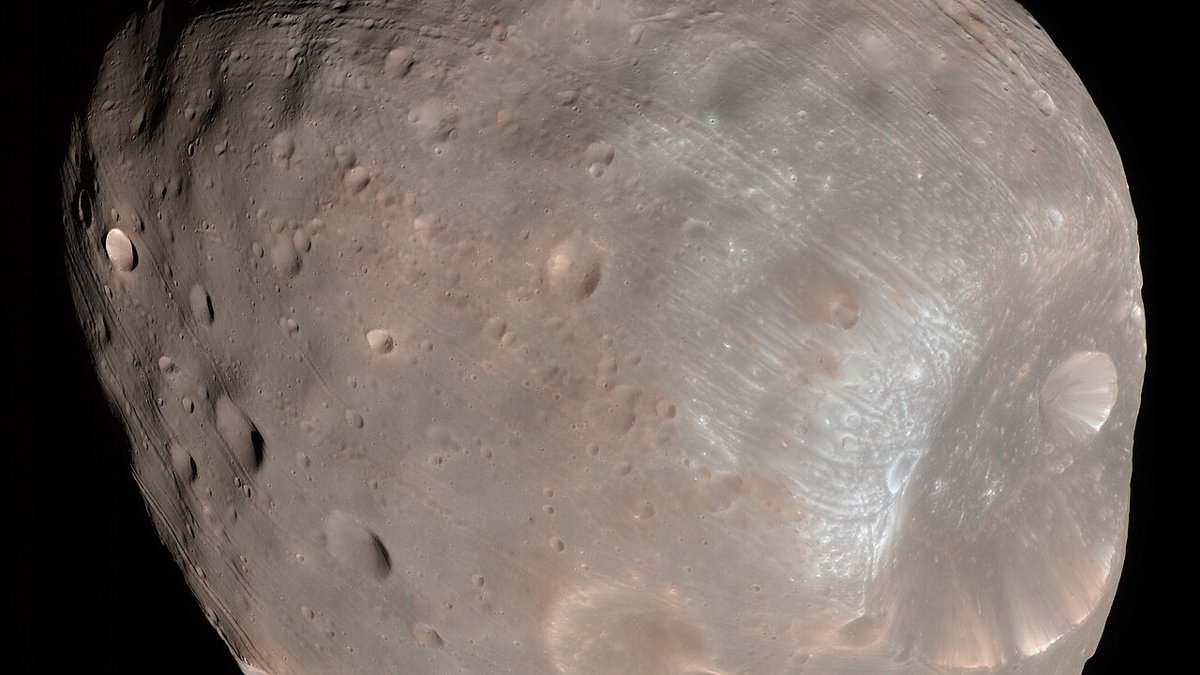
Phobos is a small, uneven body, about 27 kilometres by 22 kilometres by 18 kilometres. It orbits about 6,000 kilometres above the surface of Mars and circles the planet three times a day, Reuters reported. Nobody knows for sure how Mars got Phobos and its smaller companion, Deimos. One idea is that they are asteroids captured by the gravity of Mars. Another is that they formed from debris thrown into orbit when a large object hit Mars long ago. A sample brought home for lab analysis could help settle that question, and could also carry clues about how water and organic material moved around the early solar system.
MMX project manager Kawakatsu Yasuhiro has called Phobos an unexplored frontier for humankind. He said bringing home samples should help explain how the Martian moons formed and how the Mars system evolved.
Partners, a rover and a long road to 2031
JAXA leads the mission, with NASA, the French space agency CNES, the German Aerospace Center DLR and the European Space Agency as partners. NASA supplies a spectrometer and a pneumatic sampler that uses a puff of gas to lift loose material into a container. A small rover named Idefix, built by France and Germany, will ride to Phobos and check the surface before the main spacecraft lands.
The spacecraft is expected to reach Mars in Aug 2027 and enter orbit around Phobos from Sep 2027. After years of study from orbit, the main spacecraft plans to land on Phobos in 2030 and collect its sample. The return capsule is due to come back to Earth in 2031 and land in Australia. That is a five year round trip for at least 10 grams of rock and dust from another planet's moon.
Timeline
- 2023Japan's H3 rocket fails on its first flight when its second stage engine does not ignite.
- Oct 20, 2026MMX lifts off at 4:41 a.m. local time from Tanegashima Space Center aboard an H3 rocket and separates about 71 minutes later.
- Aug 2027MMX is expected to reach Mars, then enter orbit around Phobos from Sep 2027.
- 2031The return capsule is due to bring at least 10 grams of Phobos material back to Earth, landing in Australia.