
Hippos Do Not Sweat Blood. They Secrete Their Own Sunscreen.
The red fluid is a skin secretion that starts clear and turns red within minutes. Its two pigments, hipposudoric acid and norhipposudoric acid, absorb ultraviolet light and fight bacteria.
Key points
- Hippos do not sweat blood.
- The secretion leaves the skin colorless.
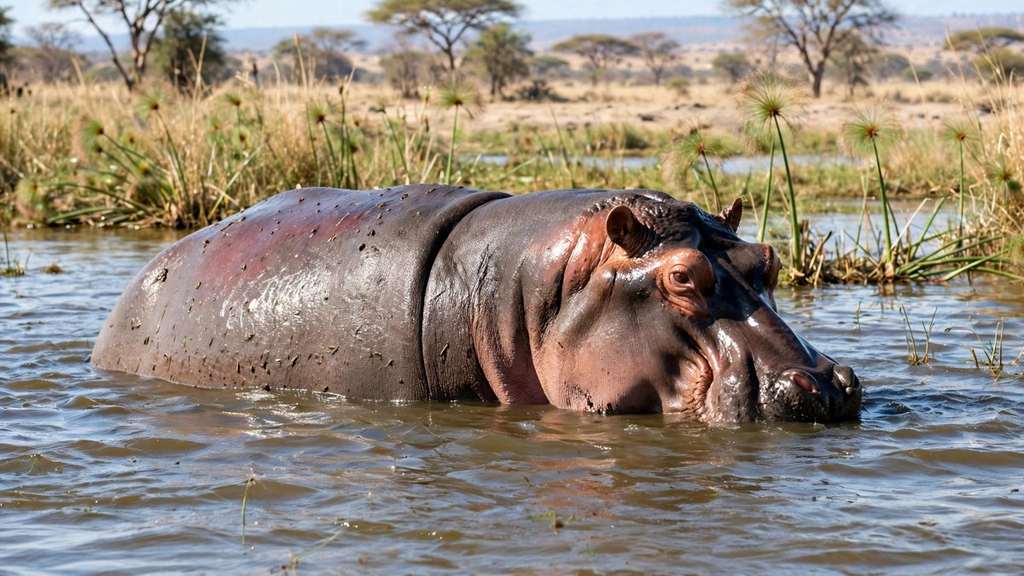
- Hippo skin is mostly bare, and the animal spends the bright part of the day in shallow water or on open banks under strong African sun.
Hippos do not sweat blood. The red fluid that runs over a hippo skin is a skin secretion of its own, and it works as sunscreen and antibiotic at once. A 2004 study in the journal Nature took the fluid apart and named the two pigments inside it.
Clear first, red within minutes
The secretion leaves the skin colorless. Within a few minutes it turns red, and then brown as its pigments link up and change. The Nature team collected the fluid by wiping the face and back of a hippo with gauze, then isolated the pigments. The red one they named hipposudoric acid. The orange one is norhipposudoric acid. Both are acidic, and both are unstable on their own, which is why the color keeps shifting after the fluid leaves the skin. The fluid is not blood, and it is not sweat in the human sense either. Hippos lack true sweat glands. The secretion comes from glands under the skin and spreads in a thick, mucus rich layer that stays on the animal during long soaks.
A sunscreen the animal makes itself
Hippo skin is mostly bare, and the animal spends the bright part of the day in shallow water or on open banks under strong African sun. The two pigments absorb ultraviolet light across the range that burns skin, so the layer works as a screen the animal renews from its own body. National Geographic, reporting on the same 2004 study, sums up the split of labor: the red pigment carries an antibiotic, and the pigments absorb ultraviolet rays, so together they guard the animal against bacterial infection and sun damage at the same time. Lab tests in the Nature work found the red pigment slowed the growth of disease causing bacteria, a useful trait for an animal whose skin takes cuts and scrapes in muddy water shared with a whole herd.
Why the blood story lasted so long
The old story came from the sight itself. A large grey animal standing in the heat with red streaks running down its face looks wounded, and early European accounts took the fluid for blood. The name blood sweat stuck because it is vivid, not because it was ever checked. Once chemists wiped a hippo face with gauze and ran the sample, every part of the old story failed. No blood cells drive the color. The color is chemistry, two named pigments doing two named jobs.
What it means for the animal
A hippo cannot seek shade the way a smaller animal can, and it cannot leave the water for long without its skin drying and cracking. The secretion covers the gap. It keeps the surface moist, screens the sun while the animal rests in the shallows, and fights bacteria at the skin line. It is one of the clearest cases in animal biology of a single fluid doing the work of a medicine cabinet, made on site, renewed daily, and mistaken for blood for centuries.