
Myth Check: Old Windows Are Not Thicker at the Bottom Because Glass Flowed Down
The claim says glass is a slow liquid and cathedral panes have sagged over centuries. Glass scientists at the Corning Museum say the panes were made uneven, and the maths gives medieval glass about one nanometre of flow in a billion years.
Key points
- Old cathedral windows really do have panes that are thicker at one edge.
- The Newport Restoration Foundation put the question to two specialists at the Corning Museum of Glass, Stephen Koob and Dr. Robert Brill.
- Old mirrors, bottles and vessels make the same point without a laboratory.
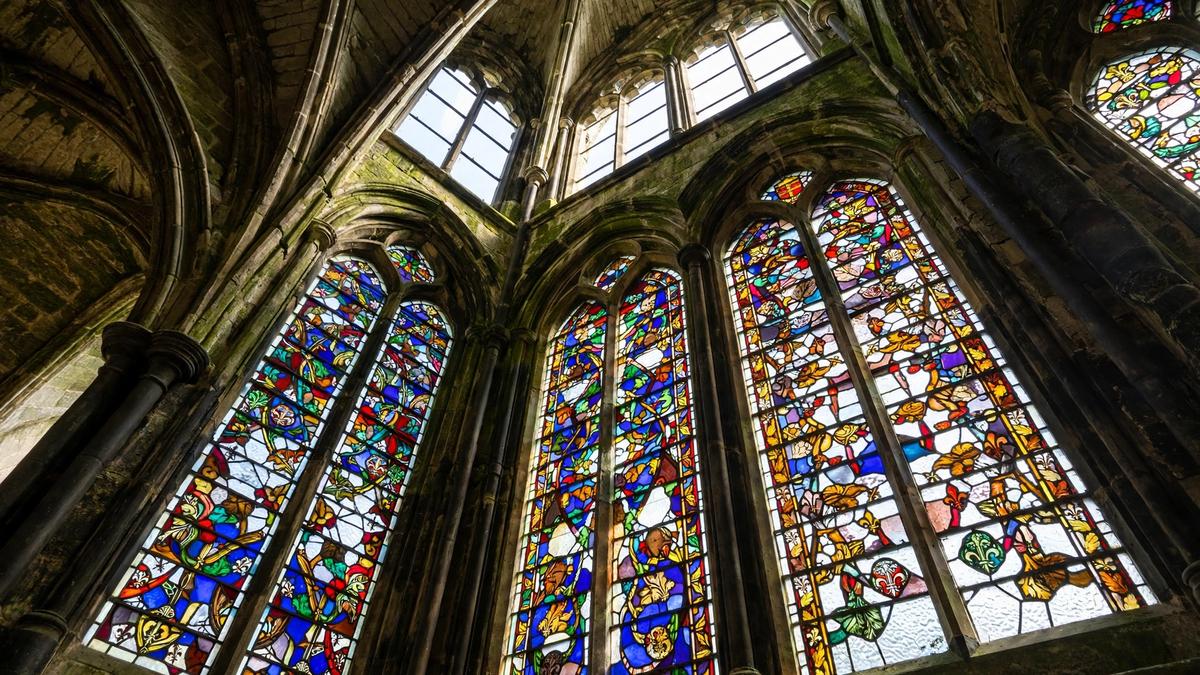
Old cathedral windows really do have panes that are thicker at one edge. The popular story says that proves glass is a liquid in disguise, flowing so slowly that only centuries reveal it. The story is wrong. The panes were uneven the day they were made, and glass at room temperature does not flow in any way a building could show.
The Corning verdict
The Newport Restoration Foundation put the question to two specialists at the Corning Museum of Glass, Stephen Koob and Dr. Robert Brill. Their answer was direct. Glass is not really a supercooled liquid, because it does not display the characteristics of a liquid. It is an amorphous solid. Its atoms lack the neat repeating order of a crystal, but they are locked in place, and the material behaves as a solid.
Old mirrors, bottles and vessels make the same point without a laboratory. They hold their shape for centuries. Window glass does not sag over time, and it cannot become less solid unless it goes back into a furnace and melts.
Blame the glassmaker, not gravity
Before the modern float process, flat glass was made by hand, and hand methods never gave a uniform sheet. In the crown method, a blob of molten glass was spun into a disc. The disc came out thinner near the outer edge and thicker toward the centre. In the cylinder method, glass was blown into a tube, cut open and flattened, with its own uneven profile.
Glaziers cut panes from these sheets and fitted them into lead frames. A tapered pane had to go one way or the other, and the thicker edge often went at the bottom, where it looked and felt more stable. Some surviving panes sit with the thick edge at the top or the side, which the flow story cannot explain. Gravity had no pattern to follow. The glassmaker had already decided the shape.
The maths closes the case
A peer-reviewed study by Ozgur Gulbiten, John C. Mauro, Xiaoju Guo and Olus N. Boratav modelled a medieval glass composition of the kind used at Westminster Abbey. The calculated viscosity at room temperature ran to roughly 10 to the power of 24 or 25 pascal-seconds. Their model gives the glass a deformation of no more than about one nanometre in a billion years. A nanometre is a billionth of a metre. Eight centuries of cathedral history cannot produce a visible sag at that rate. The glass would need timescales far longer than the age of the universe to rearrange itself into the melted look.
Ancient glass older than any cathedral agrees. Egyptian vessels thousands of years old show no sagging at all, Brill has noted. If glass flowed at room temperature, the oldest pieces would show it most. They show nothing.
Why the story survives
The myth has good raw material. The panes really are thicker at one end, the surface really can look wavy, and the disordered atomic structure really does resemble a frozen liquid. Put those together and the flow story feels like an observation instead of a guess. It is still a guess. The uneven pane is a record of how it was made and fitted, not of where it has been going.