
Dung Beetles Steer by the Milky Way, the First Animal Proven to Navigate by a Galaxy
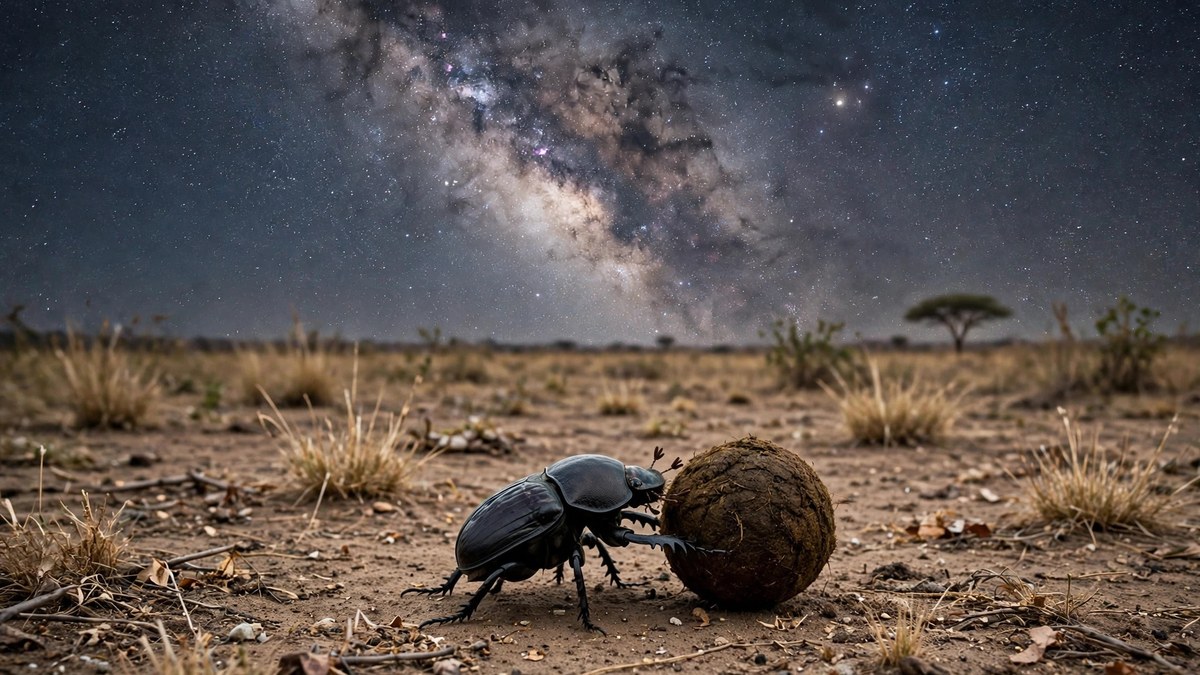
An African dung beetle cannot pick out single stars. It does not need to. It reads the bright band of the Milky Way like a road sign and rolls its dung ball in a straight line under it.
Key points
- A beetle the size of a thumbnail navigates by our whole galaxy.
- The straight line is a matter of survival.
- Marie Dacke of Lund University in Sweden and colleagues in Sweden and South Africa tested the beetles in the field and then inside the Johannesburg planetarium.
A beetle the size of a thumbnail navigates by our whole galaxy. The African dung beetle Scarabaeus satyrus rolls its food ball in a straight line at night, and a 2013 study showed it holds that line by reading the Milky Way. It was the first documented case of any animal using the Milky Way, rather than single stars, to find its way.
The straight line is a matter of survival. A dung beetle builds its ball at a crowded dung pile where rivals wait to steal finished balls. The fastest escape is a straight run away from the pile. Any curve risks looping back into the crowd. By day the beetles steer by the sun. On moonlit nights they use the moon and the pattern of polarized moonlight. The puzzle was how they kept straight on clear, moonless nights, when neither cue exists.
A planetarium for beetles
Marie Dacke of Lund University in Sweden and colleagues in Sweden and South Africa tested the beetles in the field and then inside the Johannesburg planetarium. Outdoors, the beetles rolled straight under a starlit sky and lost the ability under an overcast sky. In the planetarium, the team could switch parts of the sky on and off. The beetles oriented just as well under a full starlit sky as under a sky showing only the Milky Way. When the projection showed only the 18 brightest stars, their paths became much less direct.
That result is the heart of the finding. The beetle is not reading a constellation or following one bright star. Its eyes are too weak to resolve single stars well. It uses the broad band itself, the bright streak and the gradient from light to dark across it. Keeping that band fixed in view keeps the beetle on a straight course, the same way a walker can hold a line by keeping a distant ridge in the same place.
Why it matters
Birds, seals and people were already known to use stars. This study, published in Current Biology on January 24, 2013, was the first convincing demonstration of star orientation in an insect, and the first documented use of the Milky Way for orientation in the animal kingdom. A brain smaller than a grain of rice solves a problem that took human sailors thousands of years of charts to master, and it solves it with a smear of light most city readers can no longer even see.