
Dolphins Sleep With One Eye Open and Half Their Brain Awake
A dolphin cannot afford to fall fully asleep, because breathing is a choice it makes on purpose. So it rests one half of its brain at a time and keeps swimming.
Key points
- Sleep with one eye open is an insult people throw at light sleepers.
- Scientists call it unihemispheric slow-wave sleep.
- A human breathes on autopilot.
Sleep with one eye open is an insult people throw at light sleepers. For a dolphin, it is a plain description of the night. One half of its brain sleeps. The other half stays awake, swims the body, and keeps one eye on the world.
Scientists call it unihemispheric slow-wave sleep. Brain recordings from bottlenose dolphins show one hemisphere sinking into the slow waves of deep sleep while the other shows the pattern of a waking brain. Then, after a stretch, the halves trade places.
Breathing is the problem sleep had to solve
A human breathes on autopilot. Sleep through the night and the body keeps pulling air without a single decision. A dolphin does not have that autopilot. Dolphins are conscious breathers. Each breath is a deliberate act: rise, open the blowhole, breathe, sink again. An animal that fell into full, deep, both-halves sleep the way a person does could fail to surface in time.
Water adds two more problems. A sleeping body that stops moving sinks and chills. And the sea holds predators, plus a pod that keeps moving. Rest had to work while the animal stayed in motion, warm, and in formation.
What the awake half does
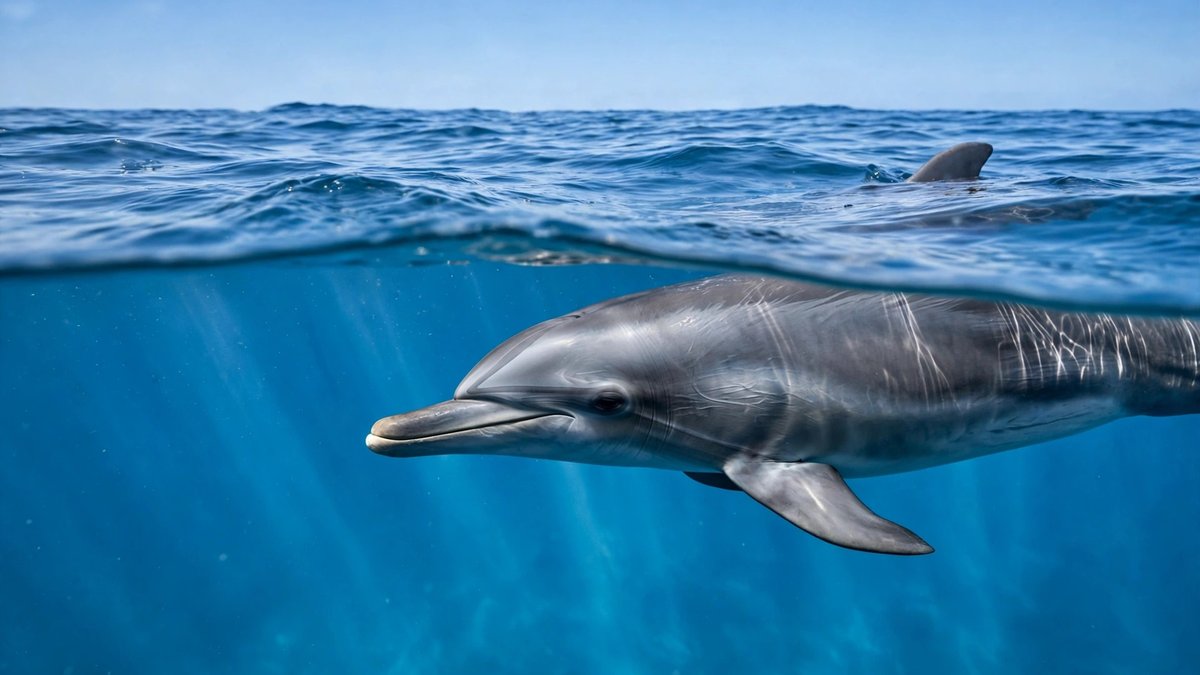
The waking hemisphere runs the shift. It steers slow swimming, times the trips to the surface, and works the flippers and tail enough to hold position and body heat. The eye on the opposite side of the awake half stays open. The eye tied to the sleeping half closes.
Pod behavior shows what that open eye is for. Researchers who watched dolphins resting in groups, including P. Dawn Goley at Humboldt State University in 1999 and Guido Gnone and colleagues at the Aquarium of Genoa in 2001, found that a resting dolphin tends to keep its open eye turned toward its companions. If a partner moved to the other side, the eye pattern flipped. The open eye is not mainly watching for danger. It is keeping track of family, so the sleeper does not drift away from the group.
Found by watching, proved by wires
The idea started with an observation in 1964, when researcher John C. Lilly noticed dolphins resting with only one eye closed. Later work by Lev Mukhametov and colleagues at the Severtsov Institute in Russia put electrodes on bottlenose dolphins and recorded the two halves of the brain doing two different things at once. That split state, not the eye alone, is the proof.
The recordings also found something missing. Land mammals cycle between slow-wave sleep and REM sleep, the stage tied to dreaming. The dolphin recordings showed no clear sign of REM sleep at all. Dolphins seem to run their whole rest program on one stage, taken half a brain at a time.
Birds, by the way, landed on the same trick for a different reason. Many birds can rest one hemisphere while the open eye watches for predators. Two lineages, one ocean and one sky, both solved the same hard problem: how to sleep without ever fully letting go.
So the dolphin is never all the way asleep and never all the way awake. It lives in between, one half resting, one half on duty, trading shifts inside a single skull. Tonight, in oceans all over the world, half a brain is keeping that watch.