
Coffee Beans Are Not Beans. They Are Seeds Inside a Fruit
Every coffee bean you have ever ground was one of two seeds packed inside a small red fruit called a coffee cherry. The bean name is a mix-up that stuck.
Key points
- There is no bean in your coffee.
- Britannica puts it plainly.
- A coffee plant is an evergreen shrub or small tree, native to tropical Africa.
There is no bean in your coffee. What you grind, brew and drink starts as the seed of a fruit, and the fruit has a name most coffee drinkers never hear: the coffee cherry.
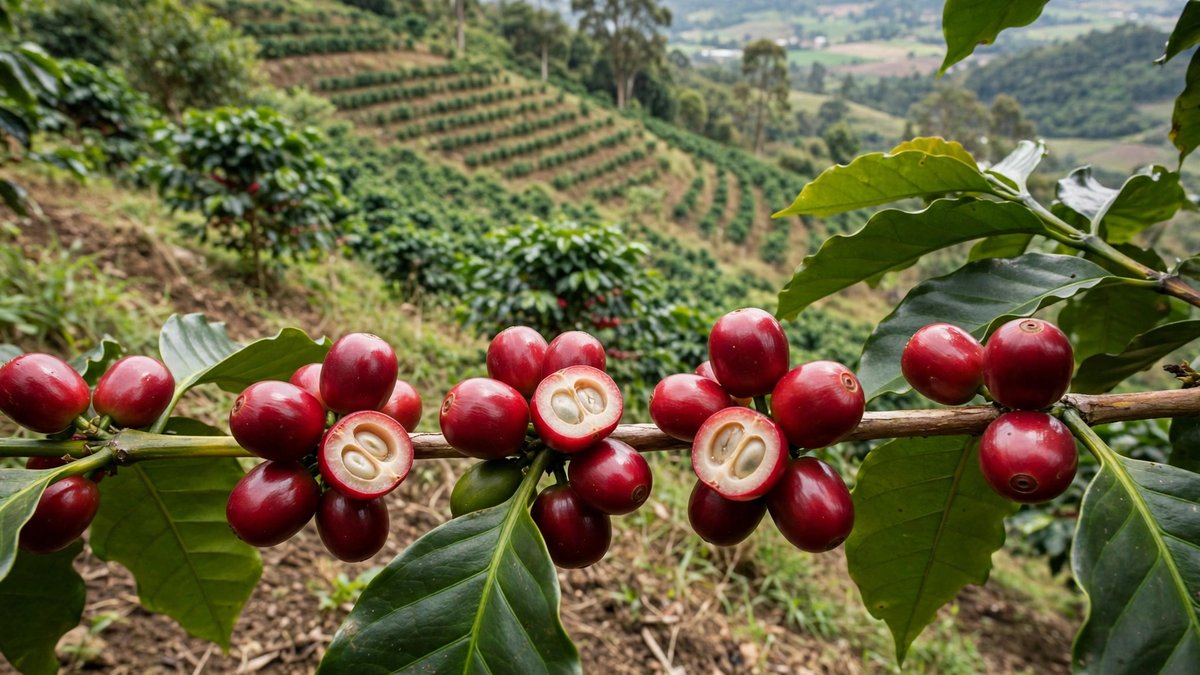
Britannica puts it plainly. The coffee cherry is the fruit of plants in the genus Coffea. It looks like a small cherry in shape, color and size, and inside it, wrapped in pulp and skin, sit two seeds. Those two seeds are what the world calls coffee beans.
Two seeds in every cherry
A coffee plant is an evergreen shrub or small tree, native to tropical Africa. Two species carry almost the whole trade: Coffea arabica and Coffea canephora, the second widely known as robusta. The plant flowers, the flowers fade, and the fruit swells and ripens from green to red.
Cut a ripe cherry open and the layout is familiar to anyone who has pitted a peach or a cherry, with one twist. A normal cherry holds one stone. A coffee cherry usually holds two seeds, pressed flat against each other in the middle of the fruit. That flat side is the flat side you see on every roasted bean. Now and then a cherry forms a single round seed instead. Growers call it a peaberry.
True beans are something else. A bean is the seed of a legume, a plant in the pea family, grown in a pod. Coffee is not a legume and grows no pods. The seed only looks a bit like a bean, and the nickname won.
From fruit to the bag
The UC Davis Library's coffee history exhibit walks the harvest through. Ripe cherries are picked, by hand on many farms, by stripping, or by machine. Then the fruit has to come off. In the dry method, whole cherries dry in the sun and the seeds come out at the end. In the wet method, water and washing strip the pulp away early. Either way, what remains is the bare seed, still pale and soft at that stage. Workers call it green coffee. It rests, gets milled to remove a thin parchment layer, and only then travels to roasters.
Roasting is where the seed turns into the thing you recognize. Heat browns it, builds the aroma, and makes it brittle enough to grind. Everything before that moment is fruit handling, closer to processing cherries than to shelling beans.
Why the mix-up matters a little
Calling it a bean hides how coffee is grown, and why it costs work. Each cherry holds just two seeds. A bag of coffee is the inside of a very large number of small fruits, each picked at ripeness because cherries on the same branch do not ripen together. It also explains the flavor language of coffee. Tasters talk about fruit notes in a cup because the seed spent its whole formation inside a sweet pulp, absorbing the character of the plant and the place.
So the daily cup is a fruit drink twice removed: a roasted seed, from a red cherry, on a tropical shrub. The bean was never a bean. It just had a good nickname and three centuries of habit behind it.