
One Lake in Venezuela Gets 233 Lightning Flashes per Square Kilometer Every Year
Lake Maracaibo holds the world record for lightning density, counted by a NASA satellite over 16 years. Warm lake air and cold mountain wind rebuild the storm on most nights of the year.
Key points
- One spot on Earth gets more lightning than anywhere else, and it is not close.
- The storms gather where the Catatumbo River flows into the lake, in the state of Zulia.
- For years, the Congo Basin held the title of the world's lightning capital.
One spot on Earth gets more lightning than anywhere else, and it is not close. Over Lake Maracaibo in northwestern Venezuela, satellite instruments counted an average of 233 lightning flashes per square kilometer per year. The runner-up, at Kabare in the Democratic Republic of Congo, recorded 205. Every other place on the planet ranked below that.
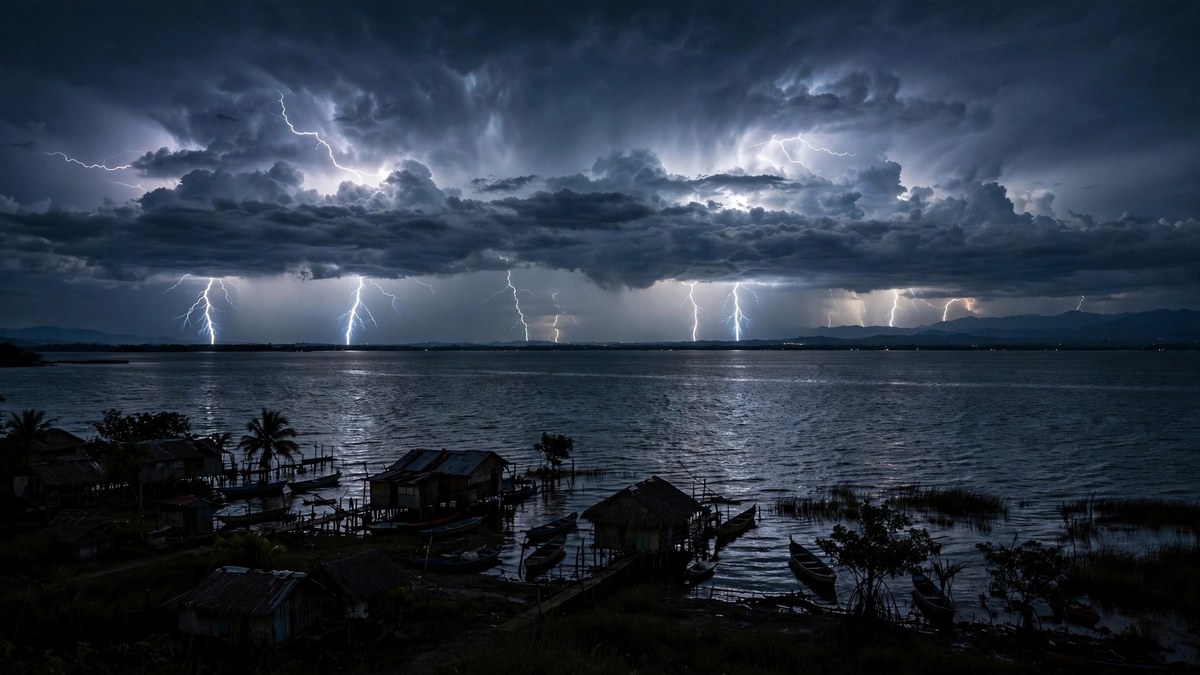
The storms gather where the Catatumbo River flows into the lake, in the state of Zulia. Local people call the display the Catatumbo lightning, or the Beacon of Maracaibo, because the flashes light the night sky so often that the glow works like a landmark. The storms form mostly after dark and can keep firing for hours.
What the satellite counted
For years, the Congo Basin held the title of the world's lightning capital. The correction came from orbit. A team led by Rachel Albrecht of the University of Sao Paulo reworked 16 years of readings from the Lightning Imaging Sensor aboard the Tropical Rainfall Measuring Mission, a satellite run by NASA and the Japan Aerospace Exploration Agency.
Their study, published in the Bulletin of the American Meteorological Society in 2016, ranked 500 lightning hotspots around the world at far sharper resolution than earlier work. Lake Maracaibo came first. Africa still holds six of the top ten hotspots, and 283 of the 500 ranked sites sit on that continent, but the single busiest patch of sky is Venezuelan.
Why this lake, why so often
The geography does the work. Lake Maracaibo is the largest lake in South America, and it sits in a bowl ringed by mountains, including arms of the Andes. Warm, wet air rises off the lake surface during the day. At night, cool air slides down from the mountains and pushes under that warm air, forcing it up fast. Rising warm air builds tall storm clouds, and tall storm clouds make lightning.
The pattern repeats because the ingredients reset every day. The lake stays warm, the mountains stay cool at night, and the wind keeps arriving from the Caribbean side. Activity peaks in the wet season, around September and October, and eases in the drier months of January and February.
The storms are mostly a night show. They build after sunset, fire through the dark hours, and fade toward morning. People living on the southern shore, in stilt villages over the water, grow up treating the flashing sky as normal weather.
Why scientists care about one stormy lake
A hotspot this steady is a natural laboratory. Because the storms return to the same place so reliably, researchers can test lightning forecasts against a place that almost always delivers. The 2016 hotspot study also showed that lightning over land peaks in the afternoon in most places, which makes Maracaibo, a nighttime maximum, an instructive exception.
The record also corrected a habit of guessing. The world's lightning capital was not settled by traveler tales or by which storm looked angriest from the ground. It was settled by 16 years of counted flashes, the same instrument watching the whole planet. The lake won on arithmetic.