
Dolphins Answer to Their Own Name. It Is a Whistle They Invented as Calves.
Each bottlenose dolphin builds its own signature whistle, and wild dolphins played a recording of theirs called straight back. Other dolphins can copy the whistle to call that one animal.
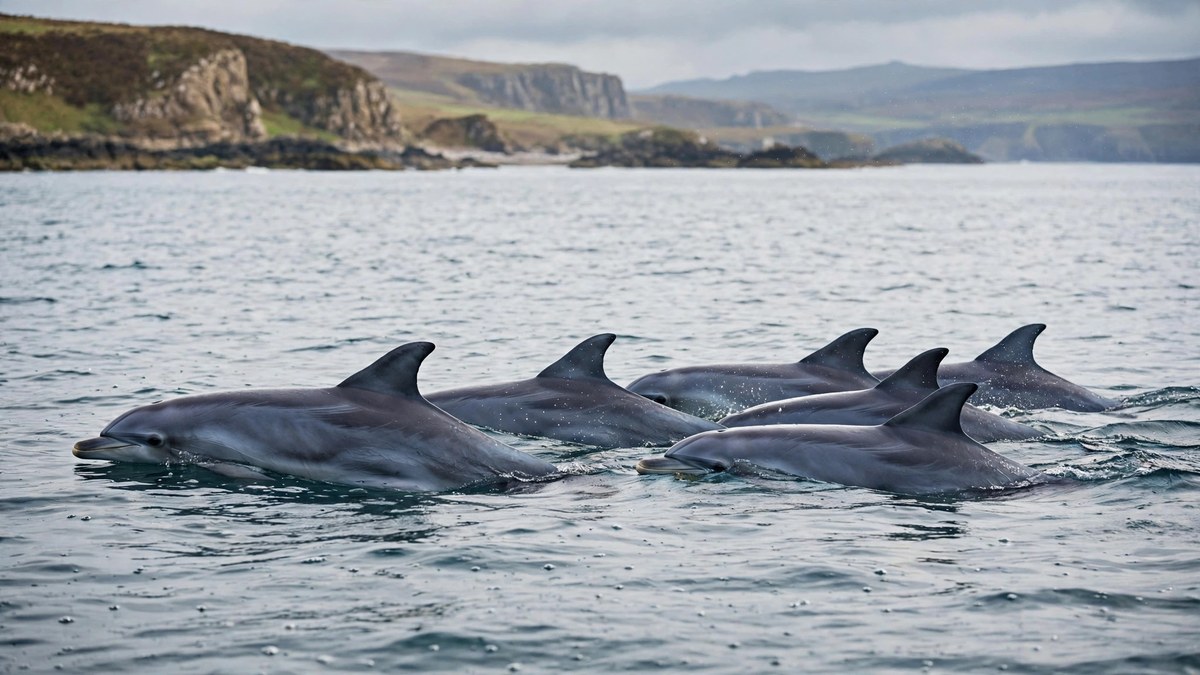
Key points
- A bottlenose dolphin carries a name of its own making.
- The whistle is learned, not fixed at birth.
- Stephanie King and Vincent Janik, biologists at the University of St. Andrews in Scotland, spent about a decade recording wild bottlenose dolphins off the Scottish east coast.
A bottlenose dolphin carries a name of its own making. Early in life, each calf develops a signature whistle, a short, distinct tune unlike any other dolphin's. The animal keeps that whistle for life, broadcasts it when it meets others at sea, and answers when it hears the tune played back. Researchers who tested this in the wild describe it as the closest thing to a name outside human language.
The whistle is learned, not fixed at birth. Calves shape their own sound during their first months, and the result sets them apart from their mother and from every other dolphin in the group. Other dolphins learn it too. A dolphin that wants a specific companion can copy that animal's signature whistle, using the copy the way a person calls a friend by name across a room.
The playback test off Scotland
Stephanie King and Vincent Janik, biologists at the University of St. Andrews in Scotland, spent about a decade recording wild bottlenose dolphins off the Scottish east coast. They cataloged each animal's signature whistle, then played the recordings back through underwater speakers.
The design was plain. Some groups heard a copy of one of their own members' whistles. Others heard the whistle of a familiar dolphin from a nearby group, or of a stranger from a distant population. The dolphins answered their own whistle by whistling it back. They stayed silent, or made unrelated sounds, for the others. In eight of the 12 trials that used a group member's whistle, at least one dolphin answered with the same whistle. Across 22 control trials with familiar or unfamiliar whistles, that happened only twice. Dolphins were also more likely to swim toward the speaker when the tune was one of their own group's.
The finding, published in the Proceedings of the National Academy of Sciences in 2013, was the strong version of the name test. The animals did not just recognize a familiar sound. They treated their own whistle as a label for themselves and replied to it.
Mothers call calves by copying them
Earlier work by the same team found another piece. When mothers and calves were separated during research captures, mothers were more likely to copy the calf's distinctive whistle. In other words, the mother called the calf by the calf's own name, not by hers.
Why a name matters in the ocean
The sea is a hard place to keep track of anyone. Visibility is short, groups split and rejoin, and an animal can be a body length away and still hidden in murky water. A learned label that travels through water solves the problem. A dolphin can announce itself to a scattered group, and a companion can call one animal out of many.
That is why the signature whistle draws so much attention. It is one of very few cases in the animal world where an individual invents its own label, keeps it for life, and hears others use it back. The name is not given. The dolphin composes it.