
Candy Corn Was Sold as Chicken Feed, and the Joke Was the Point
The Halloween staple began in the 1880s as a sweet shaped like animal feed, aimed at a country where about half the workforce still lived on farms.
Key points
- Candy corn was not invented for Halloween.
- The candy appeared in the 1880s.
- The name was not an insult.
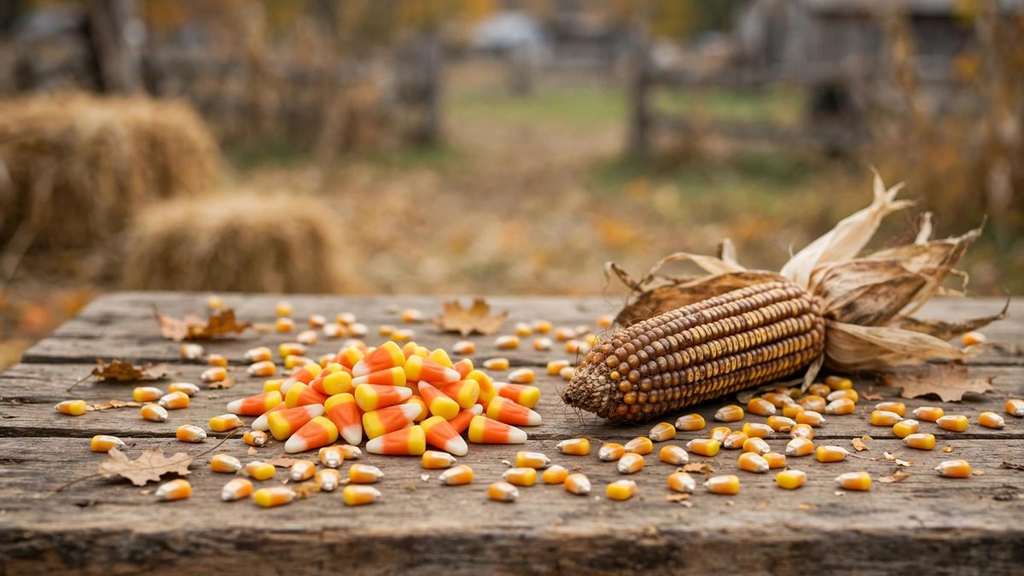
Candy corn was not invented for Halloween. It was invented for farmers, and for years it was sold under a name that told buyers exactly what it copied: Chicken Feed.
The candy appeared in the 1880s. The invention is credited to George Renninger, who worked for the Wunderle Candy Company in Philadelphia, according to the National Confectioners Association history cited by Smithsonian Magazine. In 1898 the Goelitz Confectionery Company, the firm known today as Jelly Belly, took up the recipe and sold the kernels as Chicken Feed.
A candy shaped like feed, for a nation of farms
The name was not an insult. It was the sales pitch. At the turn of the 20th century, about half the American labor force lived on farms, and corn was not yet a normal food for people. Before World War I, most corn went to chickens and pigs, as the University of Georgia College of Agricultural and Environmental Sciences notes in its history of the candy. Candy makers of the era sold farm shaped sweets of all kinds, including pumpkins, turnips, chestnuts and clover leaves, because farm life was the world most buyers knew.
A sweet that looked like a corn kernel, sold as chicken feed, was a small joke every farm family would get at once. The box leaned into it, with a rooster on the package.
Three colors, poured by hand
Candy corn also stood out on the shelf. Most candy of the period came in one color. This one stacked three: a wide yellow base, an orange middle and a white tip. Workers made it by hand, pouring each colored layer separately into kernel shaped molds, a slow process that limited how much could be produced. The recipe has stayed close to the original ever since. Smithsonian Magazine reports that the formula used by Brach's, now the largest maker, is built on sugar, corn syrup, confectioner's glaze, salt, dextrose, gelatin, sesame oil, artificial flavor and honey, and that the recipe is essentially the same as it was in the late 19th century.
Halloween claimed it later
For its first half century, candy corn was a year round penny candy tied to the harvest, not to October 31. The Halloween link came in the 1950s, when trick or treating became a national habit and candy took over the holiday. Candy historian Samira Kawash, quoted by the University of Georgia, points to a sharp rise in October advertising for candy corn in that decade. The harvest colors did the rest. A candy colored like autumn, shaped like a crop, was an easy fit for the season.
So the kernels in the bowl tonight carry an older America inside them: a country of farms, where corn fed animals, where a candy named after chicken feed counted as a treat worth crowing about, and where nobody had yet thought to connect it to ghosts.