
Why Sour Candy Hits in Waves: Three Acids Running on Three Clocks
Citric acid strikes first and fades fast. Malic acid builds slowly and stays. Fumaric acid dissolves so slowly that it keeps the sour going after the others quit.
Key points
- Sour candy does not hit your tongue all at once.
- The sour in a Sour Patch Kid or a Warhead comes from food acids, mainly citric, malic and fumaric acid.
- Citric acid is the acid in lemons and oranges, and candy makers produce it by fermenting sugar with microorganisms.
Sour candy does not hit your tongue all at once. It arrives in waves, and the waves are timed on purpose.
The sour in a Sour Patch Kid or a Warhead comes from food acids, mainly citric, malic and fumaric acid. When an acid dissolves in saliva it releases hydrogen ions, the particles chemists call protons. Your tongue reads those protons as sour. In 2018 a team at the University of Southern California led by Emily Liman found the exact doorway they use: a protein channel called OTOP1, which sits in sour taste cells and lets protons through. The finding was published in the journal Science. Mice bred without a working copy of the gene barely respond to sour tastes at all, the team later confirmed.
The first wave is citric
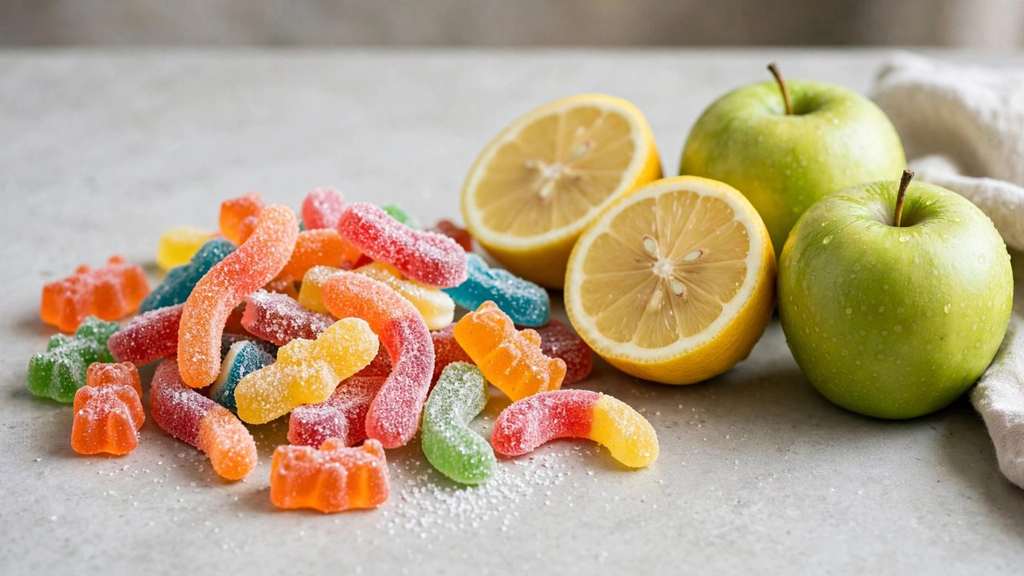
Citric acid is the acid in lemons and oranges, and candy makers produce it by fermenting sugar with microorganisms. It hits fast and bright, peaks in seconds, and fades almost as quickly. That is why the gritty coating on sour gummies, a layer of acid and sugar applied in a process called acid sanding, delivers a sharp jolt the moment the candy lands on your tongue. The strongest dose sits on the surface, where saliva reaches it first.
The second wave is malic, and it refuses to leave
Malic acid is the acid that makes a Granny Smith apple tart. Its sourness builds more slowly than citric acid and holds on far longer. Candy makers stretch it even further by coating malic acid in hydrogenated palm oil. The oil melts slowly in your mouth, so the acid leaks out in stages, a time release built into a hard candy. Warheads use the layering openly: a company spokesperson explained to Scholastic Science World that the citric acid comes first, the malic acid delivers the main jolt, and ascorbic and fumaric acids close the show, because each acid dissolves in saliva at a different rate.
Fumaric acid is the anchor. It dissolves so slowly that it keeps feeding protons to your tongue after the faster acids are spent. Blend the three and you get a sour curve with a spike, a plateau and a long tail, from ingredients that each do only one simple thing.
Why your mouth waters and puckers
Sour is an old warning signal. Acid shows up in unripe fruit and in food that has started to spoil, so the body treats a strong sour taste with suspicion. Saliva floods in, which dilutes the acid and starts washing it away. The pucker is the reflex that comes with it. Holding a sour candy still on your tongue beats the defense for a while, because the acid keeps dissolving in one spot faster than saliva can clear it. That is also why the last candy in the bag tastes stronger than the first: the system is already primed, the saliva is already flowing, and every new proton gets reported at full volume.