
Birds Can Eat the Hottest Chili Peppers and Feel No Burn at All
Capsaicin, the compound that sets a human mouth on fire, does not trigger the bird version of the heat sensor. Peppers evolved that trick on purpose: birds spread their seeds, mammals chew them up.
Key points
- A bird can eat a chili pepper that would send a person reaching for milk, and feel nothing.
- The heat of a chili comes from capsaicin, a compound packed into the pale ribs inside the fruit.
- Birds have the same sensor.
A bird can eat a chili pepper that would send a person reaching for milk, and feel nothing. The burn is not in the pepper. It is in the eater, and birds are built without the switch that turns it on.
The heat of a chili comes from capsaicin, a compound packed into the pale ribs inside the fruit. In mammals, capsaicin binds to a sensor on pain nerves called TRPV1. That sensor also fires for real heat, which is why a pepper feels like a burn. Your brain is not wrong about the signal. It is wrong about the cause. No tissue is cooking.
One sensor, two versions
Birds have the same sensor. Their version just ignores capsaicin. In 2002, Sven-Eric Jordt and David Julius at the University of California, San Francisco cloned the chicken version of the channel and tested it in the lab. It responded to real heat and to acid, as it should. It did not respond to capsaicin at all. A small stretch of the protein, the part capsaicin grips in mammals, differs in birds. The key does not fit the lock.
The feeding tests are blunt. Mammals start avoiding food with capsaicin at about 100 to 1,000 parts per million. Birds will happily eat food at 20,000 parts per million or more. That is why some of the wildest peppers carry a simple name among growers: bird peppers.
The pepper planned it this way
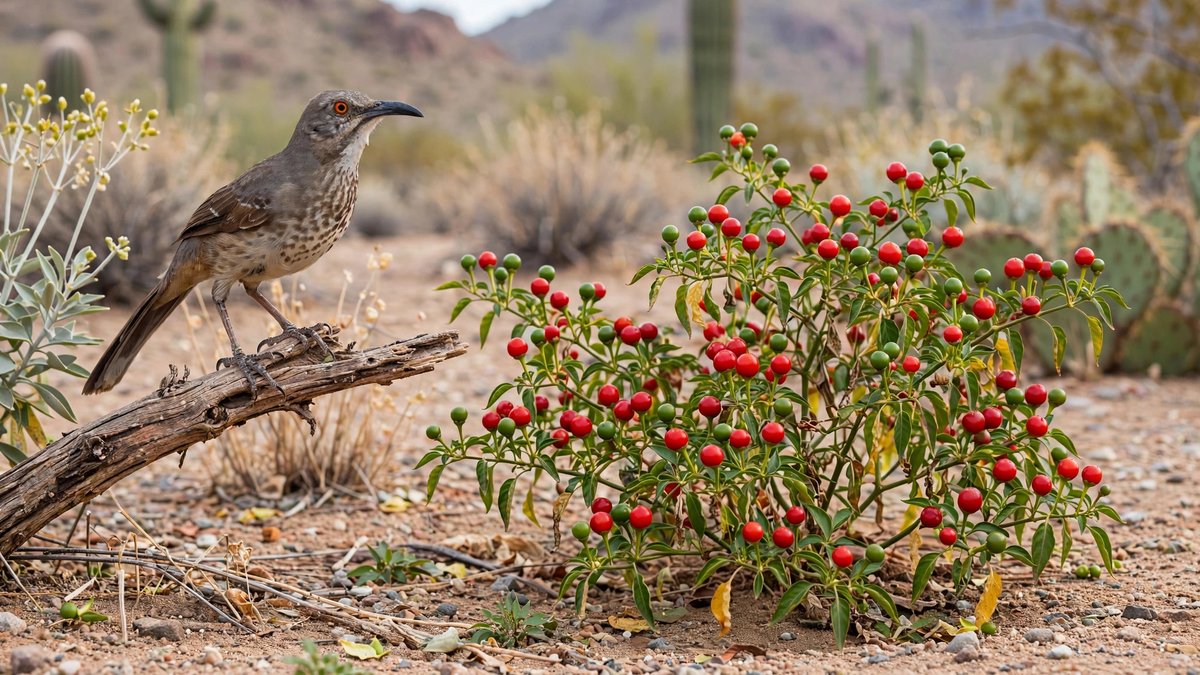
This is not an accident of bird biology. It is the plant's strategy, and it has a name: directed deterrence. In a 2001 study in Nature, Joshua Tewksbury and Gary Nabhan watched wild chiltepin peppers in southern Arizona. Curve-billed thrashers ate the fruit freely. Cactus mice and packrats, the local mammals, would not touch the hot fruit at all.
The split serves the plant twice. A mammal chews. Its teeth grind the small seeds, and seeds that pass through a mammal gut in their tests failed to sprout. A bird swallows the fruit whole. The seeds pass through unharmed, land in droppings away from the parent plant, and germinate as well as seeds never eaten. Often they land under the bushes where thrashers roost, in shade that suits a young chili plant.
So the heat is a filter, not a wall. Capsaicin bars the customers who destroy the product and waves through the ones who deliver it. Humans crashed the arrangement later. We sought out the burn, bred peppers far hotter than any wild fruit, and spread them worldwide ourselves. The birds, unbothered then and now, still eat the hottest of them like berries.
Next time a pepper lights you up, remember what the pain means. The plant was talking to mammals. It was never talking to birds, and it was not really talking to you either. You just happen to carry the same sensor as a packrat.