
Sunsets on Mars Are Blue. The Red Planet Reverses the Evening Sky.
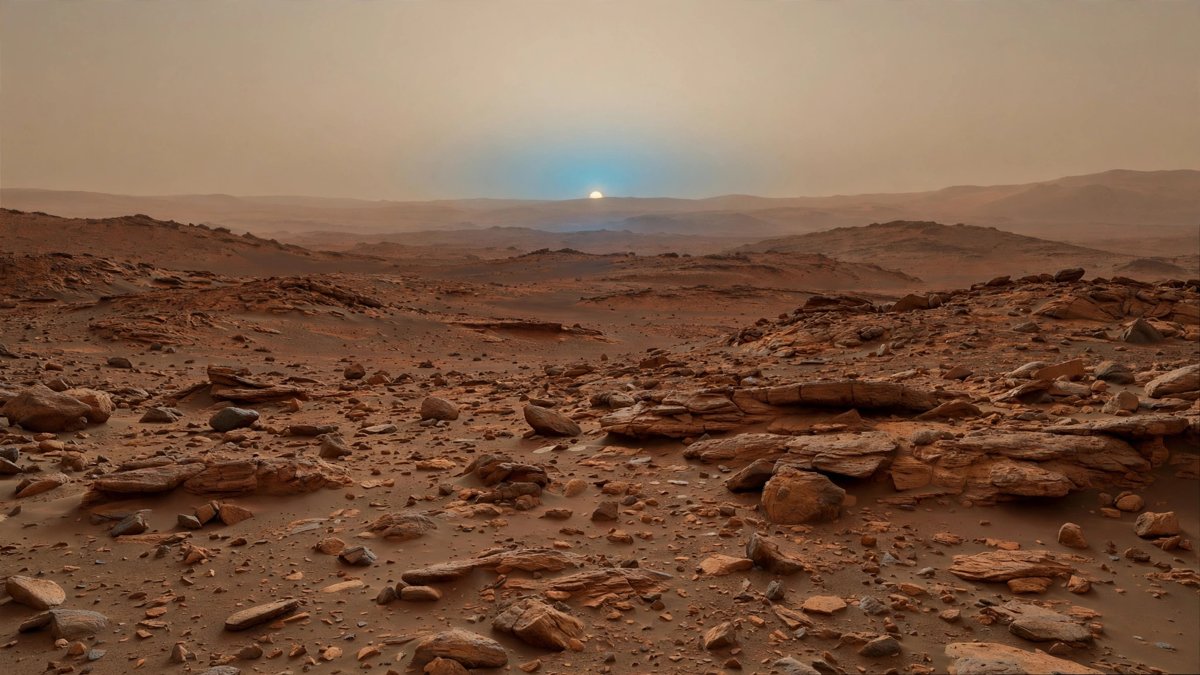
NASA's Curiosity rover watched its first sunset in color on April 15, 2015, and the glow around the Sun was blue. Fine Martian dust, not air, paints the evening.
Key points
- On Mars, the day ends in blue.
- Earth runs the same scene in reverse.
- Earth's sky gets its colors from gas.
On Mars, the day ends in blue. When NASA's Curiosity rover recorded its first sunset in color on April 15, 2015, the glow around the sinking Sun was a cold blue, set in a dusty tan sky above Gale Crater.
Earth runs the same scene in reverse. Our daytime sky is blue and our sunsets burn red and orange. Mars flips both halves, and the reason is what floats in its air.
Dust does the painting on Mars
Earth's sky gets its colors from gas. Air molecules are tiny, and they scatter short blue wavelengths of sunlight far more strongly than red ones. At sunset, sunlight crosses a long slant of air, most of the blue is scattered away from the direct view, and the reds and oranges are what reach your eyes.
Mars has almost no air to do that work. Its atmosphere is less than one percent as thick as Earth's, so gas scattering is weak. What Mars has instead is dust: fine grains of iron rich mineral, lifted off the rusty surface and held in the sky for months. That dust gives the daytime sky its butterscotch tan color, and it handles sunset light in its own way.
Curiosity science team member Mark Lemmon of Texas A&M University explained the effect when NASA released the images. The fine dust is the right size for blue light to penetrate the atmosphere slightly more efficiently than other colors. When blue light scatters off the dust, it stays closer to the direction of the Sun, while yellow and red light spread all over the sky. The result is a blue halo tight around the setting Sun, with the rest of the sky staying yellow to orange.
A six minute sunset, watched by a robot
Curiosity caught the sequence with its Mast Camera between dust storms, late in its 956th Martian day. It was the first sunset the rover had observed in color. The images were more than a postcard. The science team uses sunset views to study how high dust reaches in the Martian atmosphere and how it is layered, because the light path at dusk cuts through the dust at a long angle.
The blue is real, but it is a local effect. Step your gaze away from the Sun and the sky returns to tan and rust tones. A person standing in Gale Crater would see a small, pale Sun dropping through a dusty sky, wrapped in a ring of steel blue light, on a planet famous for being red.
Why it sticks in the mind
The picture breaks a rule most people never knew they had learned: that sunset colors are fixed by the Sun itself. They are not. They are fixed by whatever the light has to travel through. Change the air, and the same Sun sets in a different color. Mars, with its thin air and red dust, runs the experiment for us every single evening.