
Saturn Would Float: It Is the Only Planet Less Dense Than Water
The second largest planet averages 0.687 grams per cubic centimeter against water at 1, so in a big enough bathtub it would bob. NASA uses the bathtub line itself.
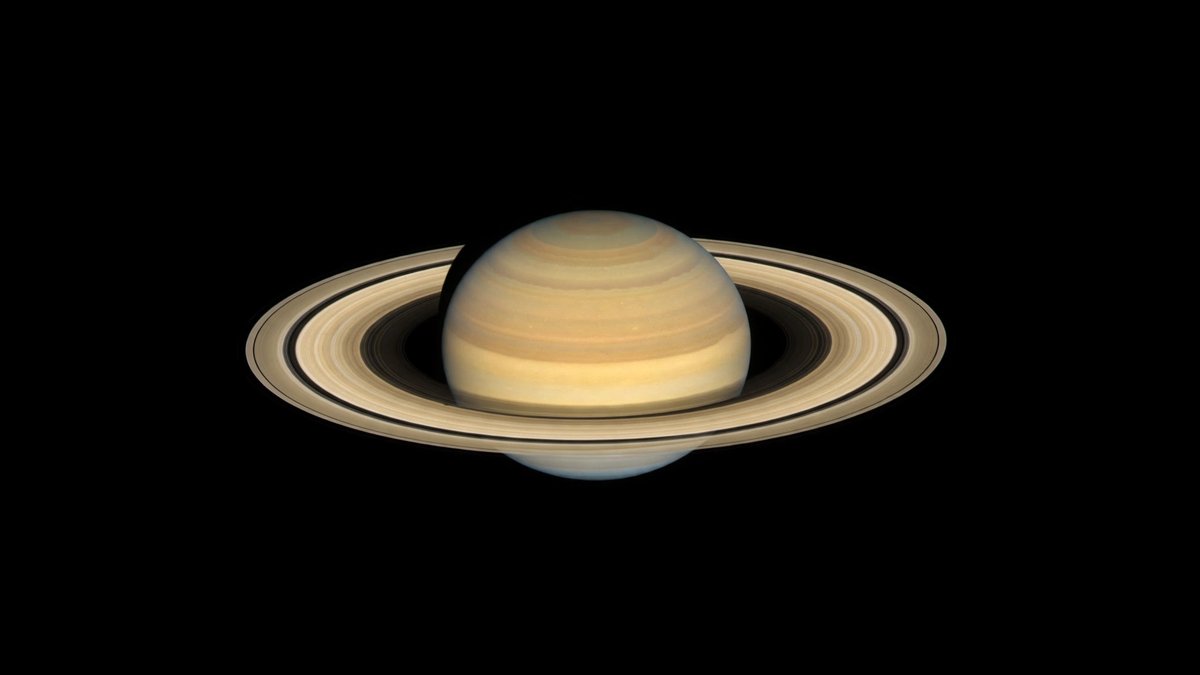
Key points
- Saturn is the second largest planet in the solar system, and it would float.
- NASA states the point plainly: Saturn is the only planet in our solar system with an average density less than water.
- Saturn is about 9 times wider than Earth, with an equatorial diameter of about 120,500 kilometers, and it carries about 95 times Earth's mass.
Saturn is the second largest planet in the solar system, and it would float. Its average density is 0.687 grams per cubic centimeter. Water sits at 1 gram per cubic centimeter. In a bathtub big enough to hold it, Saturn would bob like a beach ball.
NASA states the point plainly: Saturn is the only planet in our solar system with an average density less than water. Every other planet, rock or gas, would sink.
Big is not the same as heavy
Saturn is about 9 times wider than Earth, with an equatorial diameter of about 120,500 kilometers, and it carries about 95 times Earth's mass. Those two facts sound like a recipe for a dense world. They are not, because the volume grows so much faster than the mass. Spread 95 Earth masses through a ball that size and the average comes out light.
What the ball is made of does the rest. Like Jupiter, Saturn is mostly hydrogen and helium, the two lightest elements there are, and the same main ingredients as the Sun. There is a dense core of metals and rock deep inside, wrapped in layers of hydrogen pressed into liquid form. But the core is a small share of the whole. Most of Saturn is light gas, loosely held compared with a rocky planet. Gravity squeezes it, yet not enough to push the average density past water.
Jupiter shows the contrast. It is also a hydrogen and helium giant, but it is far more massive, and its own weight compresses it harder. Its average density lands above water. Saturn sits in a sweet spot: huge, but not heavy enough to crush itself dense.
The bathtub is a thought experiment
No real bathtub exists, and none could. BBC Sky at Night Magazine did the playful math: a tub for Saturn would need to be about 120,000 kilometers wide. The water for it would outweigh the planet many times over, and a body of water that large would not behave like bathwater at all. Saturn also has no solid surface to rest on the water. The floating claim is a statement about average density, nothing more, and scientists use it because it makes an abstract number instantly clear.
The low density leaves a visible mark anyone can see in a telescope photo. Saturn spins fast, and its soft, light body bulges at the equator more than any other planet. It is the most flattened planet in the solar system, wider across the middle than from pole to pole by a wide margin. The rings get the fame. The strange part is the planet inside them: a giant so light for its size that, on paper at least, it floats.