
The Sahara Was Once Green, With Lakes, Rivers and Hippos
Thousands of years ago the world's largest hot desert held savanna, rivers and lakes. Rock art and sediment records show the green phase returned again and again, driven by shifts in Earth's orbit.
Key points
- Hippos once lived deep in the Sahara.
- The Sahara is the world's largest hot desert.
- The most recent green phase is often called the Green Sahara.
Hippos once lived deep in the Sahara. Elephants and giraffes walked ground that today is open sand.
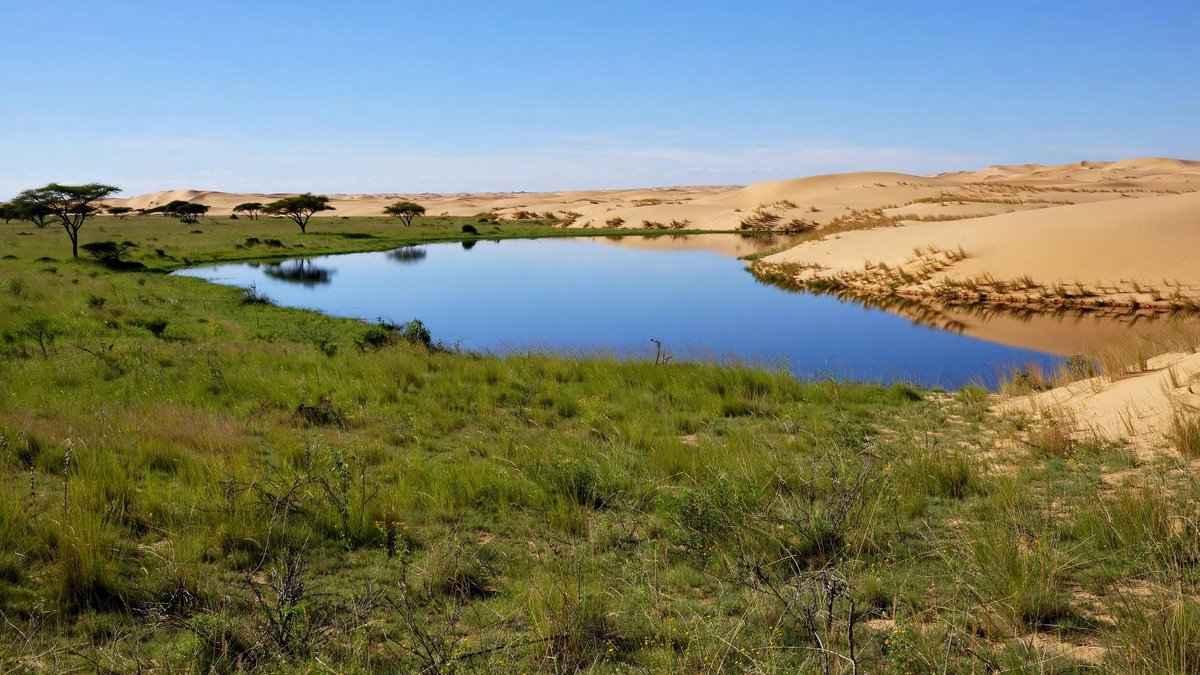
The Sahara is the world's largest hot desert. It has not always been dry. At times in the past it turned green. Wooded savanna and grassland spread across the region. Rivers ran and lakes filled in places that now sit in Libya, Niger, Chad and Mali.
A green desert in recent time
The most recent green phase is often called the Green Sahara. It is also called the African Humid Period. One account places the most recent phase at roughly 6,000 to 11,000 years ago. Climate literature describes the wider humid period more broadly, from about 14,800 to 5,500 years ago. Both ranges point to the same basic fact. Within the span of human history, the desert held water, plants and large animals.
Hippos needed deep, lasting water to survive. Rhinos and giraffes needed plants to eat. Their presence shows the change was not a brief wet season. It was a full shift in the land itself, with grass for grazers and water that stayed through the year.
Proof carved in stone
Some of the clearest proof sits on rock walls in Algeria. At Tassili n'Ajjer, people left more than 15,000 etchings and paintings. Some of the art is up to about 11,000 years old. It shows elephants, giraffes, rhinos and hippos. The images match the animals that once lived there. Today the same ground is desert. The art records a wetter world that later vanished.
Rock art alone does not explain why the Sahara changed. Sediment records add dates and timing. Together they let scientists count how often the desert turned green and test what drove each shift.
Why the rains came and went
Research published in Nature Communications looked at that pattern in detail. The team came from the University of Helsinki and the University of Bristol. Edward Armstrong led the work. The group modeled the wet phases of the Sahara. The models found that changes in Earth's orbit around the Sun drove the green phases. When the orbit shifted, sunlight and rainfall patterns over North Africa shifted with it.
The same work found a second pattern. The wet phases were weaker or suppressed during ice ages. Cold conditions held back the rains even when the orbit favored them.
Counting sediment evidence, scientists have identified more than 230 greenings over the past eight million years. The green phases came back about every 21,000 years. That rhythm fits the slow change in Earth's orbit. The desert, in other words, has flipped between dry and green many times.
A road across Africa
Those green spells mattered far beyond weather. Green corridors opened land that is now hard to cross. Species could move through the Sahara instead of going around it. The corridors likely helped animals spread. They likely helped early humans move across Africa and out of Africa as well.
When the wet phase ended, the land dried again. People and animals had to move toward lasting water. Many moved toward rivers such as the Nile. The art stayed on the rocks. The lakes dried. The largest hot desert on Earth took the shape we know today, but its past shows that shape is not fixed.