
A Moray Eel Has a Second Set of Jaws in Its Throat, and It Fires Them Into Its Mouth
The first bite only holds the prey. A second jaw then launches out of the moray eel's throat, grabs the catch, and drags it down to be swallowed.
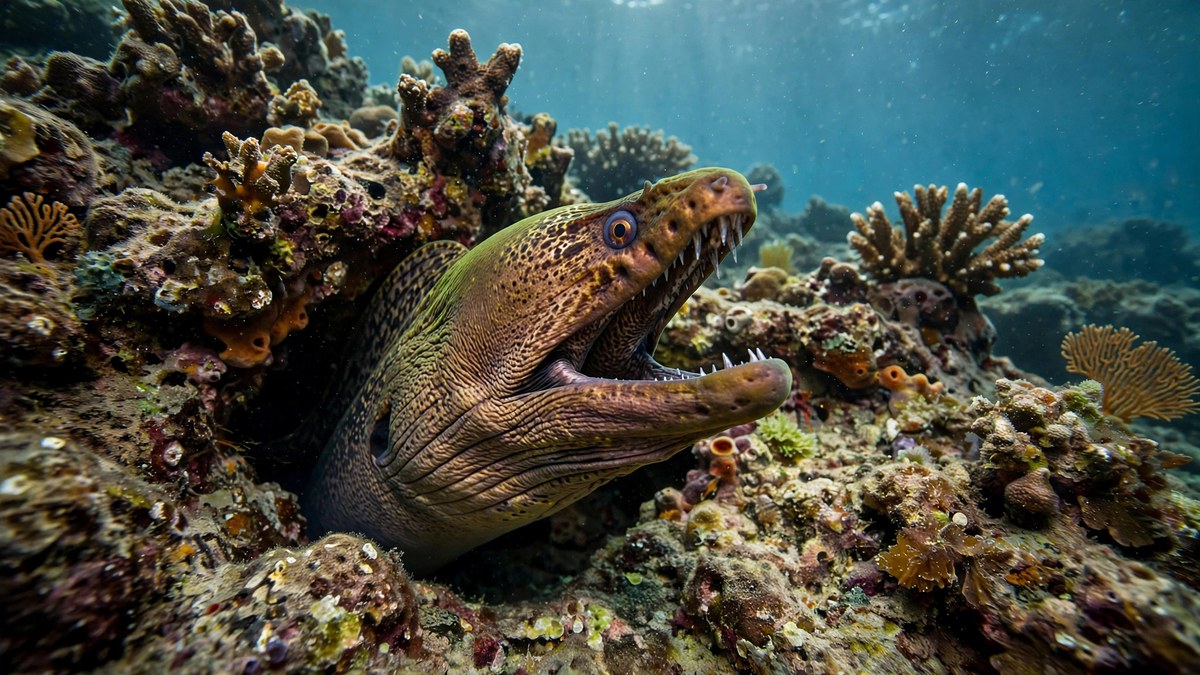
Key points
- A moray eel bites twice with two different jaws.
- Most bony fish never face this problem.
- Rita Mehta and Peter Wainwright of the University of California, Davis, filmed reticulated morays, Muraena retifera, with high-speed cameras and X-ray video as the eels fed in laboratory tanks.
A moray eel bites twice with two different jaws. The first set, in its mouth, catches the prey. Then a second set of jaws shoots forward out of its throat, into the mouth, grabs the struggling animal and hauls it back down to the gullet. It is the only known feeding system of its kind in a vertebrate.
Most bony fish never face this problem. They feed by suction. A fish opens its mouth fast, water rushes in, and the flow carries the prey back to a set of throat bones called pharyngeal jaws, which process the food and pass it down. Moray eels are poor at suction. Their heads are narrow, built for pushing into reef cracks after fish and octopus, and the suction they can produce is weak. Evolution gave them a different answer.
Filmed in the act
Rita Mehta and Peter Wainwright of the University of California, Davis, filmed reticulated morays, Muraena retifera, with high-speed cameras and X-ray video as the eels fed in laboratory tanks. The footage, published in the journal Nature on September 6, 2007, showed the throat jaws in motion. At rest, the pharyngeal jaws sit behind the skull, far back in the throat. When the eel strikes, elongated muscles launch those jaws forward into the mouth cavity. The jaws carry long, curved teeth that point backward. They close on the prey, then pull back, dragging the food into the esophagus. The front jaws can then let go, bite again further along the prey, and repeat the cycle, walking a large meal down the throat in stages.
The paper reported this as the first described case of a vertebrate using a second set of jaws both to restrain and to transport prey. Other fish have pharyngeal jaws, but theirs stay in the throat and grind or sort food that suction delivers. The moray turned its throat jaws into a second hunting weapon. The extreme reach is possible because the muscles controlling the jaws are unusually long, and the gill structures around them are reduced, clearing the path.
Why a second bite wins
The system solves two problems at once. In a tight reef crevice, a moray cannot throw its head back or open wide to swallow, and it cannot count on suction in a space full of hiding prey. A jaw that comes to the food removes both limits. It also means prey too large to swallow in one gulp can still be eaten, one ratcheted pull at a time. Film fans reached for the same comparison the scientists heard for years: the inner jaw of the creature in Alien. The moray version is real, it is older than any film, and it works on live prey several times a day.